Gastroesophageal Reflux in Infants and Children: Diagnosis and Treatment

Brian Antono, MD, MPH
Andrea Dotson, MD, MSPH

American Family Physician. 2025;111(1):62-72.

Author disclosure: As this article was going to press, Dr. Antono disclosed that he previously served as a consultant to Novo Nordisk on weight loss medications. Since obesity is mentioned in the article, this disclosure was added for full transparency. Dr. Dotson has no relevant financial relationships.

This clinical content conforms to AAFP criteria for CME.

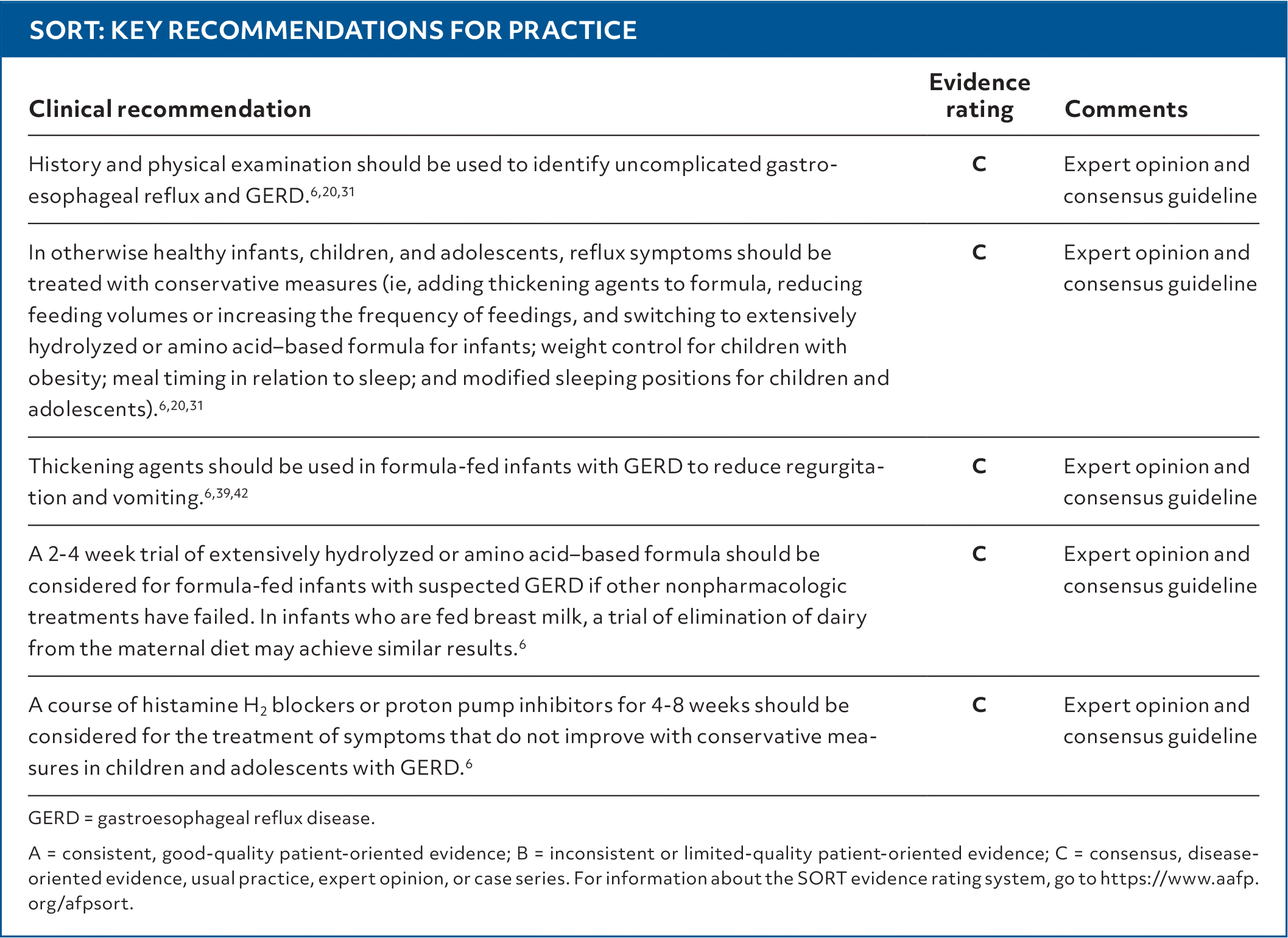
Gastroesophageal reflux is a common physiologic event in infants in which gastric contents pass from the stomach into the esophagus. Gastroesophageal reflux may be asymptomatic or cause regurgitation or “spit up.” This occurs daily in approximately 40% of infants. Symptoms often begin before 8 weeks of life, peak at approximately 4 months of age, and usually resolve by 1 year. The prevalence of gastroesophageal reflux is 2% to 8% in children and adolescents. Family physicians should reassure parents that gastroesophageal reflux is self-limited, not pathologic, and does not warrant routine testing or pharmacologic treatment. Gastroesophageal reflux may progress to gastroesophageal reflux disease when the reflux leads to troublesome symptoms (eg, recurrent postprandial expressions of distress or pain, coughing, choking) or causes complications, such as esophageal stricture or reflux esophagitis. Diagnostic tests, such as endoscopy, barium study, multichannel intraluminal impedance, and pH monitoring, may be used when there is diagnostic uncertainty or alarm symptoms are present (eg, bilious or projectile vomiting, hematemesis). Conservative treatments for gastroesophageal reflux disease in infants include the use of thickening agents or extensively hydrolyzed or amino acid–based formulas in formula-fed infants or maternal elimination of dairy for infants who are fed breast milk. Infants and children who do not improve with conservative measures may require pharmacologic treatment, including an empiric trial of acid-suppression therapy for 4 to 8 weeks.

BRIAN ANTONO, MD, MPH, is an assistant professor in the Department of Family Medicine and Community Health at Duke University School of Medicine, Durham, N.C.

ANDREA DOTSON, MD, MSPH, IBCLC, NABBLM-C, is an assistant professor in the Department of Family Medicine and Community Health at Duke University School of Medicine.

Address correspondence to Brian Antono, MD, MPH, at brian.antono@duke.edu.

Author disclosure: As this article was going to press, Dr. Antono disclosed that he previously served as a consultant to Novo Nordisk on weight loss medications. Since obesity is mentioned in the article, this disclosure was added for full transparency. Dr. Dotson has no relevant financial relationships.

  1. 1.Martin AJ, Pratt N, Kennedy JD, et al. Natural history and familial relationships of infant spilling to 9 years of age. Pediatrics. 2002;109(6):1061-1067.
  2. 2.Nelson SP, Chen EH, Syniar GM, et al.; Pediatric Practice Research Group. Prevalence of symptoms of gastroesophageal reflux during childhood: a pediatric practice-based survey. Arch Pediatr Adolesc Med. 2000;154(2):150-154.
  3. 3.Singendonk M, Goudswaard E, Langendam M, et al. Prevalence of gastroesophageal reflux disease symptoms in infants and children: a systematic review. J Pediatr Gastroenterol Nutr. 2019;68(6):811-817.
  4. 4.Chen PL, Soto-Ramírez N, Zhang H, et al. Association between infant feeding modes and gastroesophageal reflux: a repeated measurement analysis of the Infant Feeding Practices Study II. J Hum Lact. 2017;33(2):267-277.
  5. 5.Okimoto E, Ishimura N, Morito Y, et al. Prevalence of gastroesophageal reflux disease in children, adults, and elderly in the same community. J Gastroenterol Hepatol. 2015;30(7):1140-1146.
  6. 6.Rosen R, Vandenplas Y, Singendonk M, et al. Pediatric gastroesophageal reflux clinical practice guidelines: joint recommendations of the North American Society for Pediatric Gastroenterology, Hepatology, and Nutrition and the European Society for Pediatric Gastroenterology, Hepatology, and Nutrition. J Pediatr Gastroenterol Nutr. 2018;66(3):516-554.
  7. 7.Dent J. Landmarks in the understanding and treatment of reflux disease. J Gastroenterol Hepatol. 2009;24(suppl 3):S5-S14.
  8. 8.Omari TI, Barnett CP, Benninga MA, et al. Mechanisms of gastrooesophageal reflux in preterm and term infants with reflux disease. Gut. 2002;51(4):475-479.
  9. 9.Salvatore S, Hauser B, Vandemaele K, et al. Gastroesophageal reflux disease in infants: how much is predictable with questionnaires, pH-metry, endoscopy and histology? J Pediatr Gastroenterol Nutr. 2005;40(2):210-215.
  10. 10.Garza JM, Kaul A. Gastroesophageal reflux, eosinophilic esophagitis, and foreign body. Pediatr Clin North Am. 2010;57(6):1331-1345.
  11. 11.Ruigómez A, Wallander MA, Lundborg P, et al. Gastroesophageal reflux disease in children and adolescents in primary care. Scand J Gastroenterol. 2010;45(2):139-146.
  12. 12.Murray LJ, McCarron P, McCorry RB, et al. Prevalence of epigastric pain, heartburn and acid regurgitation in adolescents and their parents: evidence for intergenerational association. Eur J Gastroenterol Hepatol. 2007;19(4):297-303.
  13. 13.Pashankar DS, Corbin Z, Shah SK, et al. Increased prevalence of gastroesophageal reflux symptoms in obese children evaluated in an academic medical center. J Clin Gastroenterol. 2009;43(5):410-413.
  14. 14.Koebnick C, Getahun D, Smith N, et al. Extreme childhood obesity is associated with increased risk for gastroesophageal reflux disease in a large population-based study. Int J Pediatr Obes. 2011;6(2–2):e257-e263.
  15. 15.Djeddi D, Stephan-Blanchard E, Léké A, et al. Effects of smoking exposure in infants on gastroesophageal reflux as a function of the sleep-wakefulness state. J Pediatr. 2018;201:147-153.
  16. 16.Hegar B, Dewanti NR, Kadim M, et al. Natural evolution of regurgitation in healthy infants. Acta Paediatr. 2009;98(7):1189-1193.
  17. 17.Baird DC, Harker DJ, Karmes AS. Diagnosis and treatment of gastroesophageal reflux in infants and children. Am Fam Physician. 2015;92(8):705-714.
  18. 18.Sintusek P, Mutalib M, Thapar N. Gastroesophageal reflux disease in children: what's new right now? World J Gastrointest Endosc. 2023;15(3):84-102.
  19. 19.Jung AD. Gastroesophageal reflux in infants and children. Am Fam Physician. 2001;64(11):1853-1860.
  20. 20.National Institute for Health and Care Excellence. Gastrooesophageal reflux disease in children and young people: diagnosis and management. Updated October 9, 2019. Accessed November 16, 2023. https://www.nice.org.uk/guidance/ng1
  21. 21.Guarino A, Albano F, Ashkenazi S, et al.; ESPGHAN/ESPID Evidence-Based Guidelines for the Management of Acute Gastroenteritis in Children in Europe Expert Working Group. European Society for Paediatric Gastroenterology, Hepatology, and Nutrition/European Society for Paediatric Infectious Diseases evidence-based guidelines for the management of acute gastroenteritis in children in Europe: executive summary. J Pediatr Gastroenterol Nutr. 2008;46(5):619-621.
  22. 22.Koletzko S, Niggemann B, Arato A, et al.; European Society of Pediatric Gastroenterology, Hepatology, and Nutrition. Diagnostic approach and management of cow's-milk protein allergy in infants and children: ESPGHAN GI Committee practical guidelines. J Pediatr Gastroenterol Nutr. 2012;55(2):221-229.
  23. 23.Lucassen PL, Assendelft WJ, van Eijk JT, et al. Systematic review of the occurrence of infantile colic in the community. Arch Dis Child. 2001;84(5):398-403.
  24. 24.Wilkinson JM, Halland M. Esophageal motility disorders. Am Fam Physician. 2020;102(5):291-296.
  25. 25.Day AS, Ledder O, Leach ST, et al. Crohn's and colitis in children and adolescents. World J Gastroenterol. 2012;18(41):5862-5869.
  26. 26.Li BUK, Lefevre F, Chelimsky GG, et al.; North American Society for Pediatric Gastroenterology, Hepatology, and Nutrition. North American Society for Pediatric Gastroenterology, Hepatology, and Nutrition consensus statement on the diagnosis and management of cyclic vomiting syndrome. J Pediatr Gastroenterol Nutr. 2008;47(3):379-393.
  27. 27.Papadopoulou A, Dias JA. Eosinophilic esophagitis: an emerging disease in childhood - review of diagnostic and management strategies. Front Pediatr. 2014;2:129.
  28. 28.Juang D, Snyder CL. Neonatal bowel obstruction. Surg Clin North Am. 2012;92(3):685-711.
  29. 29.Aboagye J, Goldstein SD, Salazar JH, et al. Age at presentation of common pediatric surgical conditions: reexamining dogma. J Pediatr Surg. 2014;49(6):995-999.
  30. 30.Peters B, Oomen MWN, Bakx R, et al. Advances in infantile hypertrophic pyloric stenosis.. Expert Rev Gastroenterol Hepatol. 2014;8(5):533-541.
  31. 31.Lightdale JR, Gremse DA; Section on Gastroenterology, Hepatology, and Nutrition. Gastroesophageal reflux: management guidance for the pediatrician. Pediatrics. 2013;131(5):e1684-e1695.
  32. 32.Rosen R. Gastroesophageal reflux in infants: more than just a phenomenon. JAMA Pediatr. 2014;168(1):83-89.
  33. 33.Gupta SK, Hassall E, Chiu YL, et al. Presenting symptoms of nonerosive and erosive esophagitis in pediatric patients. Dig Dis Sci. 2006;51(5):858-863.
  34. 34.Gunasekaran TS, Dahlberg M, Ramesh P, et al. Prevalence and associated features of gastroesophageal reflux symptoms in a Caucasian-predominant adolescent school population. Dig Dis Sci. 2008;53(9):2373-2379.
  35. 35.von Baeyer CL. Children's self-report of pain intensity: what we know, where we are headed. Pain Res Manag. 2009;14(1):39-45.
  36. 36.Kleinman L, Rothman M, Strauss R, et al. The Infant Gastroesophageal Reflux Questionnaire revised: development and validation as an evaluative instrument. Clin Gastroenterol Hepatol. 2006;4(5):588-596.
  37. 37.Størdal K, Johannesdottir GB, Bentsen BS, et al. Gastroesophageal reflux disease in children: association between symptoms and pH monitoring. Scand J Gastroenterol. 2005;40(6):636-640.
  38. 38.Orenstein SR. Symptoms and reflux in infants: Infant Gastroesophageal Reflux Questionnaire Revised (I-GERQ-R)—utility for symptom tracking and diagnosis. Curr Gastroenterol Rep. 2010;12(6):431-436.
  39. 39.Jacobson JC, Pandya SR. A narrative review of gastroesophageal reflux in the pediatric patient. Transl Gastroenterol Hepatol. 2021;6:34.
  40. 40.Gonzalez Ayerbe JI, Hauser B, Salvatore S, et al. Diagnosis and management of gastroesophageal reflux disease in infants and children: from guidelines to clinical practice. Pediatr Gastroenterol Hepatol Nutr. 2019;22(2):107-121.
  41. 41.Wolf ER, Vadlamudi N, Schefft M, et al. Overuse of antireflux medications in infants. Am Fam Physician. 2023;108(6):614-616.
  42. 42.Kwok TC, Ojha S, Dorling J. Feed thickener for infants up to six months of age with gastro-oesophageal reflux. Cochrane Database Syst Rev. 2017(12):CD003211.
  43. 43.Choi YJ, Ha EK, Jeong SJ. Dietary habits and gastroesophageal reflux disease in preschool children. Korean J Pediatr. 2016;59(7):303-307.

Copyright © 2026 by the American Academy of Family Physicians.

This content is owned by the AAFP. A person viewing it online may make one printout of the material and may use that printout only for his or her personal, non-commercial reference. This material may not otherwise be downloaded, copied, printed, stored, transmitted or reproduced in any medium, whether now known or later invented, except as authorized in writing by the AAFP. See permissions for copyright questions and/or permission requests.