Sudden Vision Loss: A Diagnostic Approach

J. Alexander Fraser, MD
Maksim Son, MD
Anastasiya Vinokurtseva, MD

American Family Physician. 2025;111(1):54-61.

Author disclosure: No relevant financial relationships.

This clinical content conforms to AAFP criteria for CME.

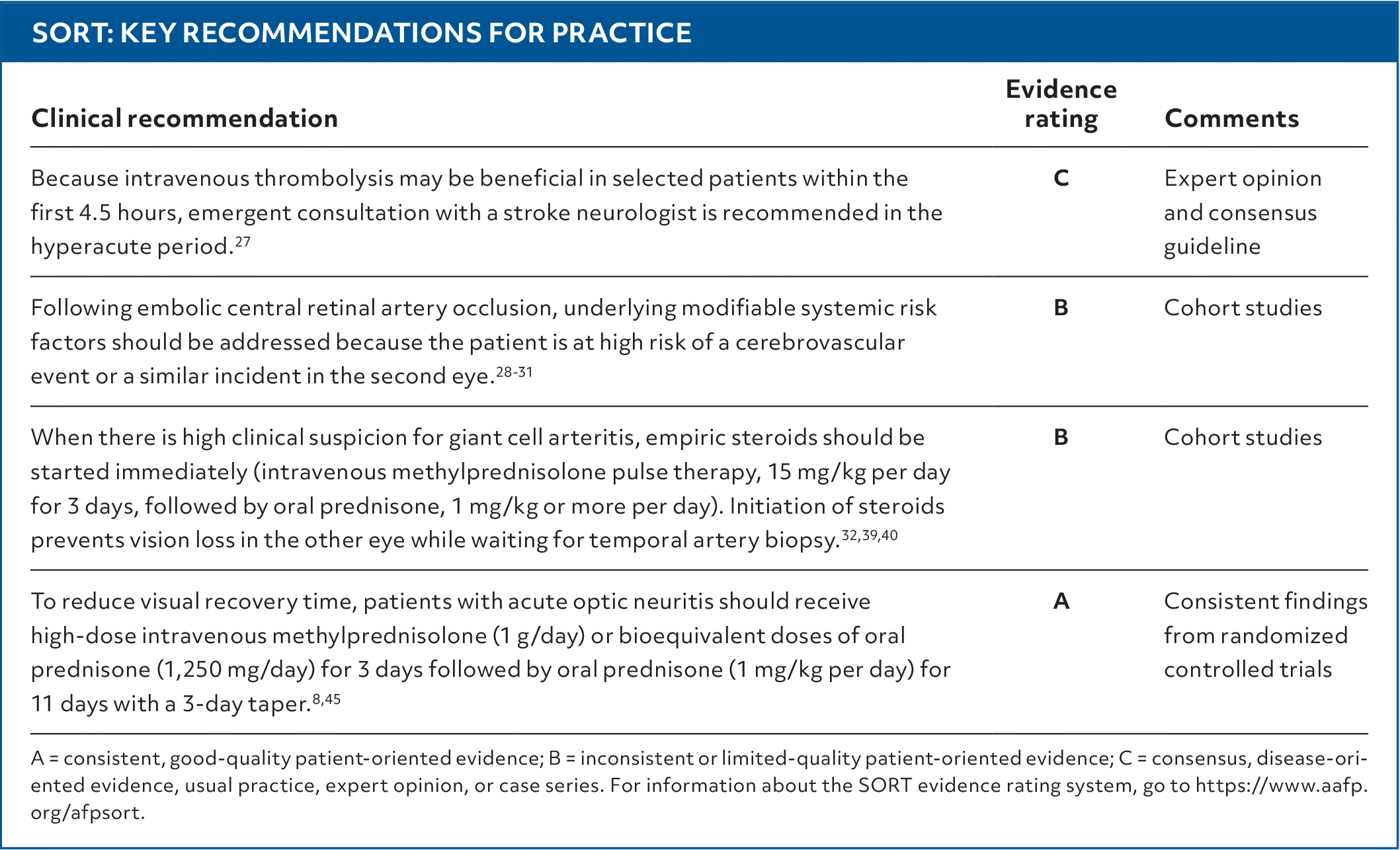
Vision loss affects more than 7 million Americans and impacts quality of life, independence, social functioning, and overall health. Common and dangerous conditions causing sudden vision loss include acute angle-closure glaucoma, retinal detachment, retinal artery occlusion, giant cell arteritis, and optic neuritis. Acute angle-closure glaucoma features ocular pain, headache, and nausea; treatment includes pilocarpine eye drops, oral or intravenous acetazolamide, and intravenous mannitol. Retinal detachment presents with a curtain-like visual field defect and usually requires surgical intervention. Retinal artery occlusion causes painless vision loss in patients with vascular risk factors, and interventions aim to prevent vision loss in the other eye. Giant cell arteritis should be suspected in patients older than 50 years with scalp tenderness, jaw claudication, proximal muscle and joint pain, constitutional symptoms, and elevated C-reactive protein level, erythrocyte sedimentation rate, and platelet count. This condition requires immediate initiation of empiric steroids to prevent vision loss in the unaffected eye, as well as referral for a temporal artery biopsy. Optic neuritis is a demyelinating condition that features color desaturation, relative afferent pupillary defect, and pain with extraocular muscle movements. Treatment requires high-dose steroids, and patients should be evaluated for multiple sclerosis.

J. ALEXANDER FRASER, MD, FRCPC, is an associate professor in the Departments of Clinical Neurological Sciences and Ophthalmology at Western University Schulich School of Medicine and Dentistry, London, Ontario, Canada.

MAKSIM SON, MD, is a stroke neurologist and neurointerventional fellow in the Division of Neurology at McMaster University, Hamilton, Ontario, Canada.

ANASTASIYA VINOKURTSEVA, MD, is an ophthalmology resident in the Department of Ophthalmology at Western University Schulich School of Medicine and Dentistry.

Address correspondence to J. Alexander Fraser, MD, FRCPC, at alex.fraser@lhsc.on.ca.

Author disclosure: No relevant financial relationships.

  1. 1.Burton MJ, Ramke J, Marques AP, et al. The Lancet Global Health Commission on Global Eye Health: vision beyond 2020. Lancet Glob Health. 2021;9(4):e489-e551.
  2. 2.West S, Sommer A. Prevention of blindness and priorities for the future. Bull World Health Organ. 2001;79(3):244-248.
  3. 3.US Centers for Disease Control and Prevention. Prevalence estimates for vision loss and blindness. May 15, 2024. Accessed November 26, 2024. https://www.cdc.gov/vision-health-data/prevalence-estimates/vision-loss-prevalence.html
  4. 4.GBD 2019 Blindness and Vision Impairment Collaborators; Vision Loss Expert Group of the Global Burden of Disease Study. Causes of blindness and vision impairment in 2020 and trends over 30 years, and prevalence of avoidable blindness in relation to VISION 2020: the right to sight: an analysis for the Global Burden of Disease Study. Lancet Glob Health. 2021;9(2):e144-e160.
  5. 5.Flaxman AD, Wittenborn JS, Robalik T, et al.; Vision and Eye Health Surveillance System study group. Prevalence of visual acuity loss or blindness in the US: a Bayesian meta-analysis. JAMA Ophthalmol. 2021;139(7):717-723.
  6. 6.Gelston CD, Deitz GA. Eye emergencies. Am Fam Physician. 2020;102(9):539-545.
  7. 7.Zarkali A, Cheng SF, Dados A, et al. Undertreatment of vascular risk factors in patients with monocular ischaemic visual loss. Cerebrovasc Dis. 2018;45(5–6):228-235.
  8. 8.Morrow SA, Fraser JA, Day C, et al. Effect of treating acute optic neuritis with bioequivalent oral vs intravenous corticosteroids: a randomized clinical trial. JAMA Neurol. 2018;75(6):690-696.
  9. 9.Sun JK, Aiello LP, Cavallerano JD, et al.; Diabetic Retinopathy Clinical Research Network. Visual acuity testing using autorefraction or pinhole occluder compared with a manual protocol refraction in individuals with diabetes. Ophthalmology. 2011;118(3):537-542.
  10. 10.He M, Jiang Y, Huang S, et al. Laser peripheral iridotomy for the prevention of angle closure: a single-centre, randomised controlled trial. Lancet. 2019;393(10181):1609-1618.
  11. 11.Zhang N, Wang J, Chen B, et al. Prevalence of primary angle closure glaucoma in the last 20 years: a meta-analysis and systematic review. Front Med (Lausanne). 2021;7:624179.
  12. 12.Tham YC, Li X, Wong TY, et al. Global prevalence of glaucoma and projections of glaucoma burden through 2040: a systematic review and meta-analysis. Ophthalmology. 2014;121(11):2081-2090.
  13. 13.Michels TC, Ivan O. Glaucoma: diagnosis and management. Am Fam Physician. 2023;107(3):253-262.
  14. 14.Wu A, Khawaja AP, Pasquale LR, et al. A review of systemic medications that may modulate the risk of glaucoma. Eye (Lond). 2020;34(1):12-28.
  15. 15.Azuara-Blanco A, Burr J, Ramsay C, et al.; EAGLE study group. Effectiveness of early lens extraction for the treatment of primary angle-closure glaucoma (EAGLE): a randomised controlled trial. Lancet. 2016;388(10052):1389-1397.
  16. 16.Guzman CP, Gong T, Nongpiur ME, et al. Anterior segment optical coherence tomography parameters in subtypes of primary angle closure. Invest Ophthalmol Vis Sci. 2013;54(8):5281-5286.
  17. 17.Shikino K, Hirose Y, Ikusaka M. Oblique flashlight test: lighting up acute angle-closure glaucoma. J Gen Intern Med. 2016;31(12):1538.
  18. 18.David R, Tessler Z, Yassur Y. Long-term outcome of primary acute angle-closure glaucoma. Br J Ophthalmol. 1985;69(4):261-262.
  19. 19.Prum BE, Herndon LW, Moroi SE, et al. Primary Angle Closure Preferred Practice Pattern(®) guidelines. Ophthalmology. 2016;123(1):P1-P40.
  20. 20.Mitry D, Charteris DG, Fleck BW, et al. The epidemiology of rhegmatogenous retinal detachment: geographical variation and clinical associations. Br J Ophthalmol. 2010;94(6):678-684.
  21. 21.Wolfensberger TJ, Tufail A. Systemic disorders associated with detachment of the neurosensory retina and retinal pigment epithelium. Curr Opin Ophthalmol. 2000;11(6):455-461.
  22. 22.Wilkinson J, Sultan L. BET2: The use of bedside ultrasound in diagnosing retinal detachment in emergency department.. Emerg Med J. 2014;31(4):337-339.
  23. 23.Kuhn F, Aylward B. Rhegmatogenous retinal detachment: a reappraisal of its pathophysiology and treatment.. Ophthalmic Res. 2014;51(1):15-31.
  24. 24.Varma DD, Cugati S, Lee AW, et al. A review of central retinal artery occlusion: clinical presentation and management. Eye (Lond). 2013;27(6):688-697.
  25. 25.Hayreh SS, Podhajsky PA, Zimmerman MB. Retinal artery occlusion: associated systemic and ophthalmic abnormalities. Ophthalmology. 2009;116(10):1928-1936.
  26. 26.Vilares-Morgado R, Nunes HMM, Dos Reis RS, et al. Management of ocular arterial ischemic diseases: a review. Graefes Arch Clin Exp Ophthalmol. 2023;261(1):1-22.
  27. 27.Mac Grory B, Schrag M, Biousse V, et al.; American Heart Association Stroke Council; Council on Arteriosclerosis, Thrombosis and Vascular Biology; Council on Hypertension; and Council on Peripheral Vascular Disease. Management of central retinal artery occlusion: a scientific statement from the American Heart Association. Stroke. 2021;52(6):e282-e294.
  28. 28.Benavente O, Eliasziw M, Streifler JY, et al.; North American Symptomatic Carotid Endarterectomy Trial Collaborators. Prognosis after transient monocular blindness associated with carotid-artery stenosis. N Engl J Med. 2001;345(15):1084-1090.
  29. 29.Chang YS, Jan RL, Weng SF, et al. Retinal artery occlusion and the 3-year risk of stroke in Taiwan: a nationwide population-based study. Am J Ophthalmol. 2012;154(4):645-652.e1.
  30. 30.Callizo J, Feltgen N, Pantenburg S, et al.; European Assessment Group for Lysis in the Eye. Cardiovascular risk factors in central retinal artery occlusion: results of a prospective and standardized medical examination. Ophthalmology. 2015;122(9):1881-1888.
  31. 31.Lauda F, Neugebauer H, Reiber L, et al. Acute silent brain infarction in monocular visual loss of ischemic origin. Cerebrovasc Dis. 2015;40(3–4):151-156.
  32. 32.Ninan J, Lester S, Hill C. Giant cell arteritis. Best Pract Res Clin Rheumatol. 2016;30(1):169-188.
  33. 33.Barra L, Pope JE, Pequeno P, et al. Incidence and prevalence of giant cell arteritis in Ontario, Canada. Rheumatology (Oxford). 2020;59(11):3250-3258.
  34. 34.Smetana GW, Shmerling RH. Does this patient have temporal arteritis? JAMA. 2002;287(1):92-101.
  35. 35.Lyons HS, Quick V, Sinclair AJ, et al. A new era for giant cell arteritis. Eye (Lond). 2020;34(6):1013-1026.
  36. 36.Raleigh MF, Stoddard J, Darrow HJ. Polymyalgia rheumatica and giant cell arteritis: rapid evidence review. Am Fam Physician. 2022;106(4):420-426.
  37. 37.Gonzalez-Gay MA, Garcia-Porrua C, Amor-Dorado JC, et al. Fever in biopsy-proven giant cell arteritis: clinical implications in a defined population. Arthritis Rheum. 2004;51(4):652-655.
  38. 38.Wojczal J, Kozera G, Luchowski P, et al. Advantages in diagnosis of giant cell arteritis by ultrasound. Postepy Dermatol Alergol. 2019;36(1):25-28.
  39. 39.Foré R, Liozon E, Dumonteil S, et al.; French study group for large-vessel arteritis (GEFA). BOB-ACG study: pulse methylprednisolone to prevent bilateral ophthalmologic damage in giant cell arteritis. A multicentre retrospective study with propensity score analysis.. Joint Bone Spine. 2024;91(1):105641.
  40. 40.Fraser JA, Weyand CM, Newman NJ, et al. The treatment of giant cell arteritis. Rev Neurol Dis. 2008;5(3):140-152.
  41. 41.Rodriguez M, Siva A, Cross SA, et al. Optic neuritis: a population-based study in Olmsted County, Minnesota. Neurology. 1995;45(2):244-250.
  42. 42.Pau D, Al Zubidi N, Yalamanchili S, et al. Optic neuritis. Eye (Lond). 2011;25(7):833-842.
  43. 43.Toosy AT, Mason DF, Miller DH. Optic neuritis. Lancet Neurol. 2014;13(1):83-99.
  44. 44.Mikolajczyk B, Ritter A, Larson C, et al. Red desaturation prevalence and severity in healthy patients. Neurol Clin Pract. 2022;12(1):1-5.
  45. 45.Beck RW, Gal RL. Treatment of acute optic neuritis: a summary of findings from the optic neuritis treatment trial. Arch Ophthalmol. 2008;126(7):994-995.

Copyright © 2026 by the American Academy of Family Physicians.

This content is owned by the AAFP. A person viewing it online may make one printout of the material and may use that printout only for his or her personal, non-commercial reference. This material may not otherwise be downloaded, copied, printed, stored, transmitted or reproduced in any medium, whether now known or later invented, except as authorized in writing by the AAFP. See permissions for copyright questions and/or permission requests.