Evaluation of Jaundice in Adults

Michelle Nelson, MD
Shaunak R. Mulani, MD
Aaron Saguil, MD, MPH

American Family Physician. 2025;111(1):25-30.

Author disclosure: No relevant financial relationships.

This clinical content conforms to AAFP criteria for CME.

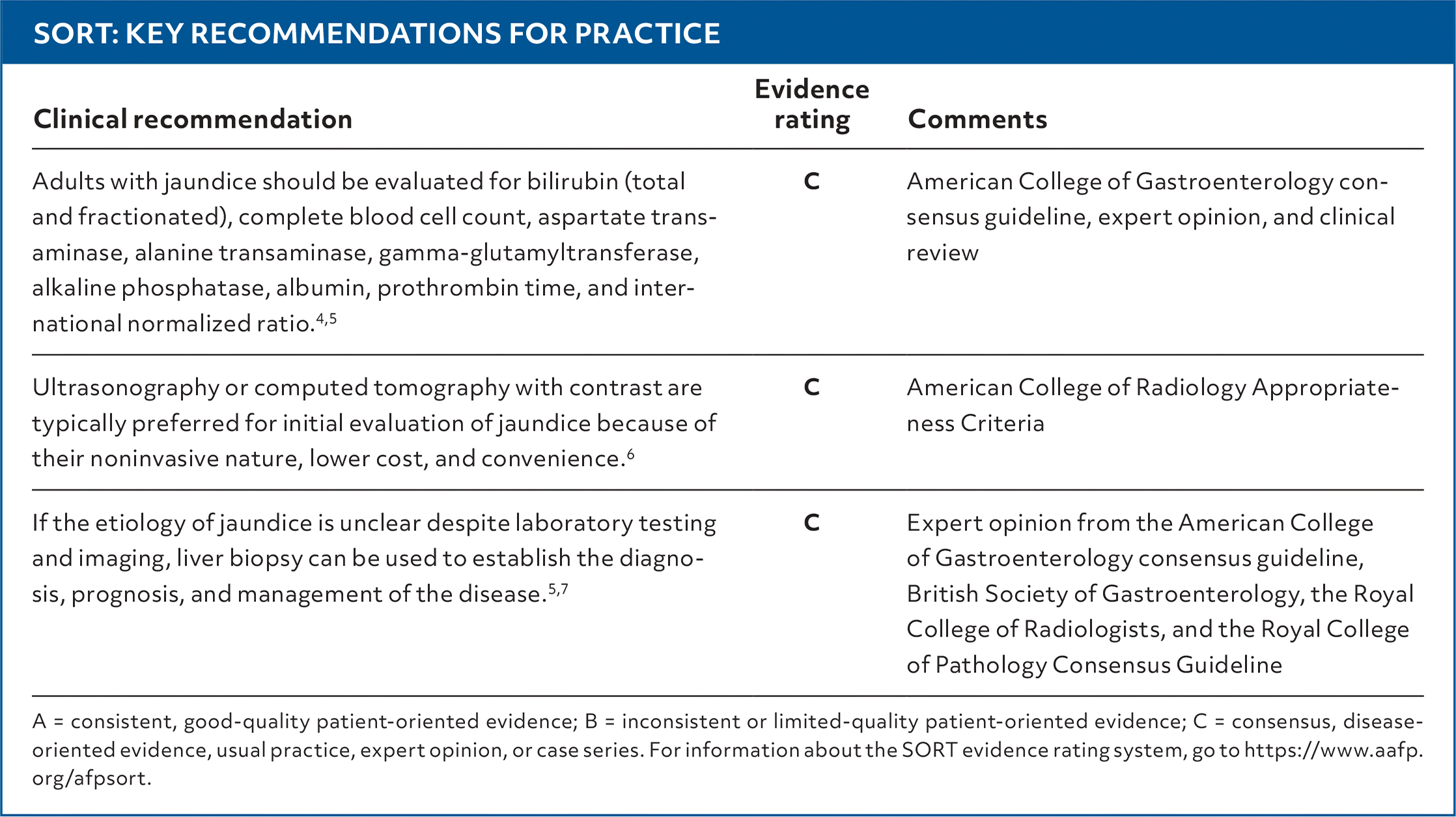
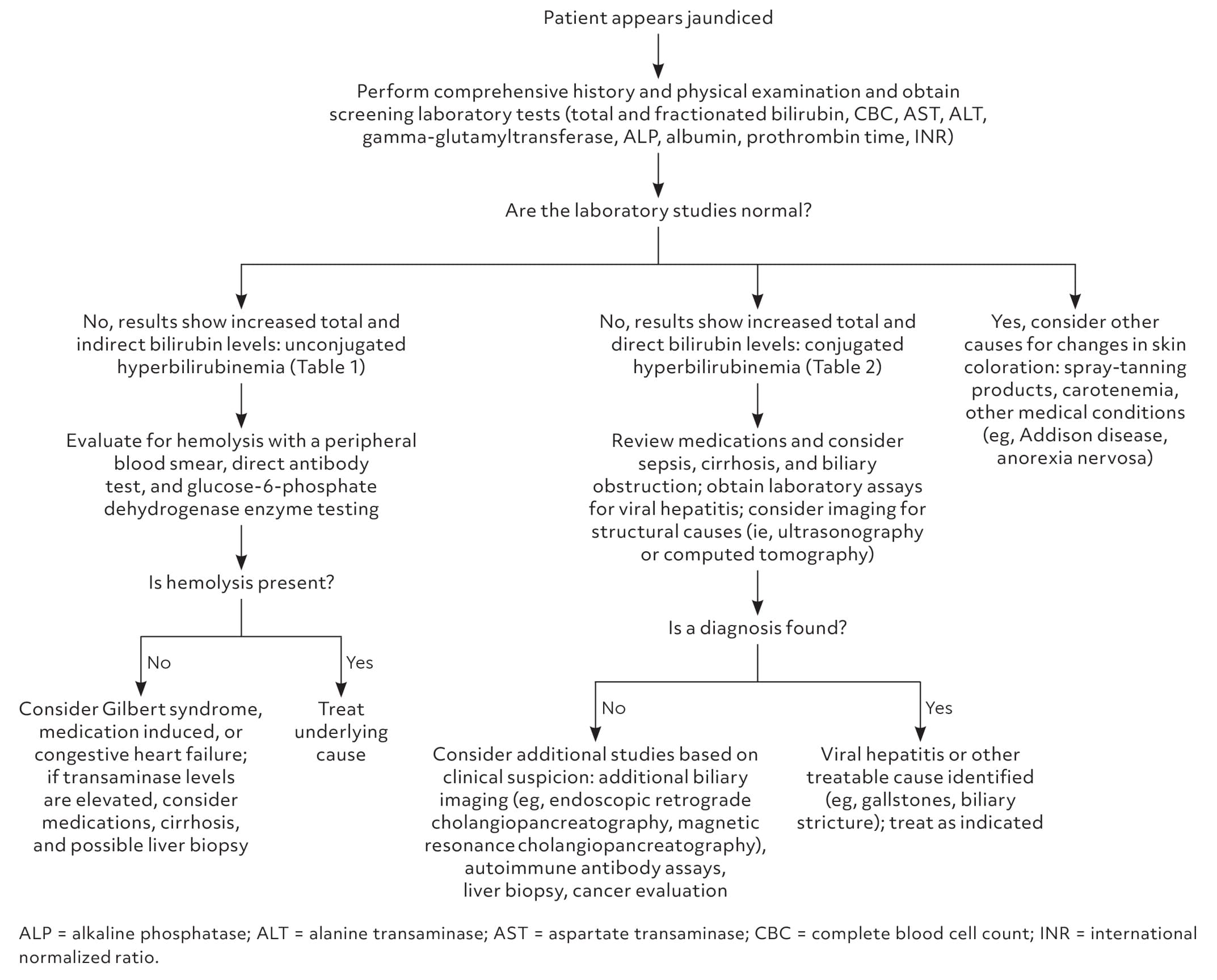
Jaundice is an indication of hyperbilirubinemia and is caused by derangements in bilirubin metabolism. It is typically apparent when serum bilirubin levels exceed 3 mg/dL and can indicate serious underlying disease of the liver or biliary tract. A comprehensive medical history, review of systems, and physical examination are essential for differentiating potential causes such as alcoholic liver disease, biliary strictures, choledocholithiasis, drug-induced liver injury, hemolysis, or hepatitis. Initial laboratory evaluation should include assays for bilirubin (total and fractionated), a complete blood cell count, aspartate transaminase, alanine transaminase, gamma-glutamyltransferase, alkaline phosphatase, albumin, prothrombin time, and international normalized ratio. Measuring fractionated bilirubin allows for determination of whether the hyperbilirubinemia is conjugated or unconjugated. Ultrasonography of the abdomen, computed tomography with intravenous contrast media, and magnetic resonance cholangiopancreatography are first-line options for patients presenting with jaundice, depending on the suspected underlying etiology. If the etiology of jaundice is unclear despite laboratory testing and imaging, liver biopsy may be required to establish the diagnosis, prognosis, and management of the disease.

MICHELLE NELSON, MD, FAAFP, is a clinical assistant professor in the Department of Family Medicine and MSU/MyMichigan Medical Center Alma Family Medicine Residency at Michigan State University College of Human Medicine, Grand Rapids.

SHAUNAK R. MULANI, MD, is an assistant professor in the Department of Community Health and Family Medicine at the University of Florida College of Medicine, Gainesville.

AARON SAGUIL, MD, MPH, is a professor and chair in the Department of Community Health and Family Medicine at the University of Florida College of Medicine, Gainesville.

Address correspondence to Aaron Saguil, MD, MPH, at a.saguil@ufl.edu.

Author disclosure: No relevant financial relationships.

  1. 1.Markovic AP, Lalosevic MS, Mijac DD, et al. Jaundice as a diagnostic and therapeutic problem. Dig Dis. 2022;40(3):362-369.
  2. 2.Kihara T, Sugihara T, Ikeda S, et al. Identification and quantification of jaundice by trans-conjunctiva optical imaging using a human brain-like algorithm. Diagnostics (Basel). 2023;13(10):1767.
  3. 3.Fargo MV, Grogan SP, Saguil A. Evaluation of jaundice in adults. Am Fam Physician. 2017;95(3):164-168.
  4. 4.Winger J, Michelfelder A. Diagnostic approach to the patient with jaundice. Prim Care. 2011;38(3):469-482.
  5. 5.Kwo PY, Cohen SM, Lim JK. ACG clinical guideline: evaluation of abnormal liver chemistries. Am J Gastroenterol. 2017;112(1):18-35.
  6. 6.Hindman NM, Arif-Tiwari H, Kamel IR, et al.; Expert Panel on Gastrointestinal Imaging. ACR Appropriateness Criteria jaundice. J Am Coll Radiol. 2019;16(5S):S126-S140.
  7. 7.Neuberger J, Patel J, Caldwell H, et al. Guidelines on the use of liver biopsy in clinical practice from the British Society of Gastroenterology, the Royal College of Radiologists and the Royal College of Pathology. Gut. 2020;69(8):1382-1403.
  8. 8.Korolnek T, Hamza I. Macrophages and iron trafficking at the birth and death of red cells. Blood. 2015;125(19):2893-2897.
  9. 9.Li MK, Crawford JM. The pathology of cholestasis. Semin Liver Dis. 2004;24(1):21-42.
  10. 10.Agarwal AM, Rets AV. Molecular diagnosis of hereditary hemolytic anemias: recent updates. Int J Lab Hematol. 2023;45(suppl2):79-86.
  11. 11.Singh S, Manrai M, P VS, et al. Association of liver cirrhosis severity with anemia: does it matter? Ann Gastroenterol. 2020;33(3):272-276.
  12. 12.Contreras-Omaña R, Velasco JAVR, Castro-Narro GE, et al. Approach to the patient with cholestasis and jaundice syndrome. Rev Gastroenterol Mex (Engl Ed). 2022;87(1):80-88.
  13. 13.Beretta-Piccoli BT, Mieli-Vergani G, Vergani D. Autoimmune hepatitis. Clin Rev Allergy Immunol. 2022;63(2):124-137.
  14. 14.Gallagher PG. Abnormalities of the erythrocyte membrane. Pediatr Clin North Am. 2013;60(6):1349-1362.
  15. 15.Koralkova P, van Solinge WW, van Wijk R. Rare hereditary red blood cell enzymopathies associated with hemolytic anemia. Int J Lab Hematol. 2014;36(3):388-397.
  16. 16.Martin A, Thompson AA. Thalassemias. Pediatr Clin North Am. 2013;60(6):1383-1391.
  17. 17.Dhaliwal G, Cornett PA, Tierney LM. Hemolytic anemia. Am Fam Physician. 2004;69(11):2599-2606.
  18. 18.Berendsohn S, Lowman J, Sundberg D, et al. Idiopathic dyserythropoietic jaundice. Blood. 1964;24(1):1-18.
  19. 19.Strassburg CP. Hyperbilirubinemia syndromes (Gilbert-Meulengracht, Crigler-Najjar, Dubin-Johnson, and Rotor syndrome). Best Pract Res Clin Gastroenterol. 2010;24(5):555-571.
  20. 20.Zucker SD, Qin X, Rouster SD, et al. Mechanism of indinavir-induced hyperbilirubinemia. Proc Natl Acad Sci U S A. 2001;98(22):12671-12676.
  21. 21.Miners JO, Chau N, Rowland A, et al. Inhibition of human UDP-glucuronosyltransferase enzymes by lapatinib, pazopanib, regorafenib and sorafenib. Biochem Pharmacol. 2017;129:85-95.
  22. 22.Giallourakis CC, Rosenberg PM, Friedman LS. The liver in heart failure. Clin Liver Dis. 2002;6(4):947-967.
  23. 23.Ohkubo A. Bilirubin metabolism in liver cirrhosis [in Japanese]. Nihon Rinsho. 1994;52(1):138-144.
  24. 24.Kenwright S, Levi AJ. Sites of competition in the selective hepatic uptake of rifamycin-SV, flavaspidic acid, bilirubin, and bromsulphthalein. Gut. 1974;15(3):220-226.
  25. 25.Singh A, Koritala T, Jialal I. Unconjugated hyperbilirubinemia. StatPearls. Updated February 20, 2023. https://www.ncbi.nlm.nih.gov/books/NBK549796/
  26. 26.Tátrai P, Krajcsi P. Prediction of drug-induced hyperbilirubinemia by in vitro testing. Pharmaceutics. 2020;12(8):755.
  27. 27.Ma MX, Jayasekeran V, Chong AK. Benign biliary strictures. Clin Exp Gastroenterol. 2019;12:83-92.
  28. 28.Chalasani NP, Maddur H, Russo MW, et al. ACG clinical guideline: diagnosis and management of idiosyncratic drug-induced liver injury. Am J Gastroenterol. 2021;116(5):878-898.
  29. 29.Tripathi N, Jialal I. Conjugated hyperbilirubinemia. StatPearls. Updated July 24, 2023. https://www.ncbi.nlm.nih.gov/books/NBK562172/
  30. 30.Jophlin LL, Singal AK, Bataller R, et al. ACG clinical guideline: alcohol-associated liver disease. Am J Gastroenterol. 2024;119(1):30-54.
  31. 31.Malhi H, Guicciardi ME, Gores GJ. Hepatocyte death: a clear and present danger. Physiol Rev. 2010;90(3):1165-1194.
  32. 32.Xanthopoulos A, Starling RC, Kitai T, et al. Heart failure and liver disease: cardiohepatic interactions. JACC Heart Fail. 2019;7(2):87-97.
  33. 33.Balistreri WF, Bezerra JA, Jansen P, et al. Intrahepatic cholestasis. Hepatology. 2005;42(1):222-235.
  34. 34.Sarcognato S, Sacchi D, Grillo F, et al. Autoimmune biliary diseases. Pathologica. 2021;113(3):170-184.
  35. 35.Delemos AS, Friedman LS. Systemic causes of cholestasis. Clin Liver Dis. 2013;17(2):301-317.
  36. 36.Terrault NA, Williamson C. Pregnancy-associated liver diseases. Gastroenterology. 2022;163(1):97.e1-117.e1.
  37. 37.Björnsson HK, Björnsson ES. Drug-induced liver injury. Eur J Intern Med. 2022;97:26-31.
  38. 38.Buxbaum JL, Fehmi SMA, Sultan S, et al. ASGE guideline on the role of endoscopy in the evaluation and management of choledocholithiasis. Gastrointest Endosc. 2019;89(6):1075.e15-1105.e15.
  39. 39.Klekowski J, Piekarska A, Góral M, et al. The current approach to the diagnosis and classification of Mirizzi syndrome. Diagnostics (Basel). 2021;11(9):1660.
  40. 40.Cantù P, Mauro A, Cassinotti E, et al. Post-operative biliary strictures. Dig Liver Dis. 2020;52(12):1421-1427.
  41. 41.Elmunzer BJ, Maranki JL, Gómez V, et al. ACG clinical guideline: diagnosis and management of biliary strictures. Am J Gastroenterol. 2023;118(3):405-426.
  42. 42.Roche SP, Kobos R. Jaundice in the adult patient. Am Fam Physician. 2004;69(2):299-304.

Copyright © 2026 by the American Academy of Family Physicians.

This content is owned by the AAFP. A person viewing it online may make one printout of the material and may use that printout only for his or her personal, non-commercial reference. This material may not otherwise be downloaded, copied, printed, stored, transmitted or reproduced in any medium, whether now known or later invented, except as authorized in writing by the AAFP. See permissions for copyright questions and/or permission requests.