Early Childhood Concerns: Counseling on Sleep Issues, Thumb-Sucking, Picky Eating, School Readiness, and Oral Health

Carl Bryce, MD
Theron Liddell, PhD
Geoffrey Gideon, DO

American Family Physician. 2025;111(1):31-36.

Author disclosure: No relevant financial relationships.

This clinical content conforms to AAFP criteria for CME.

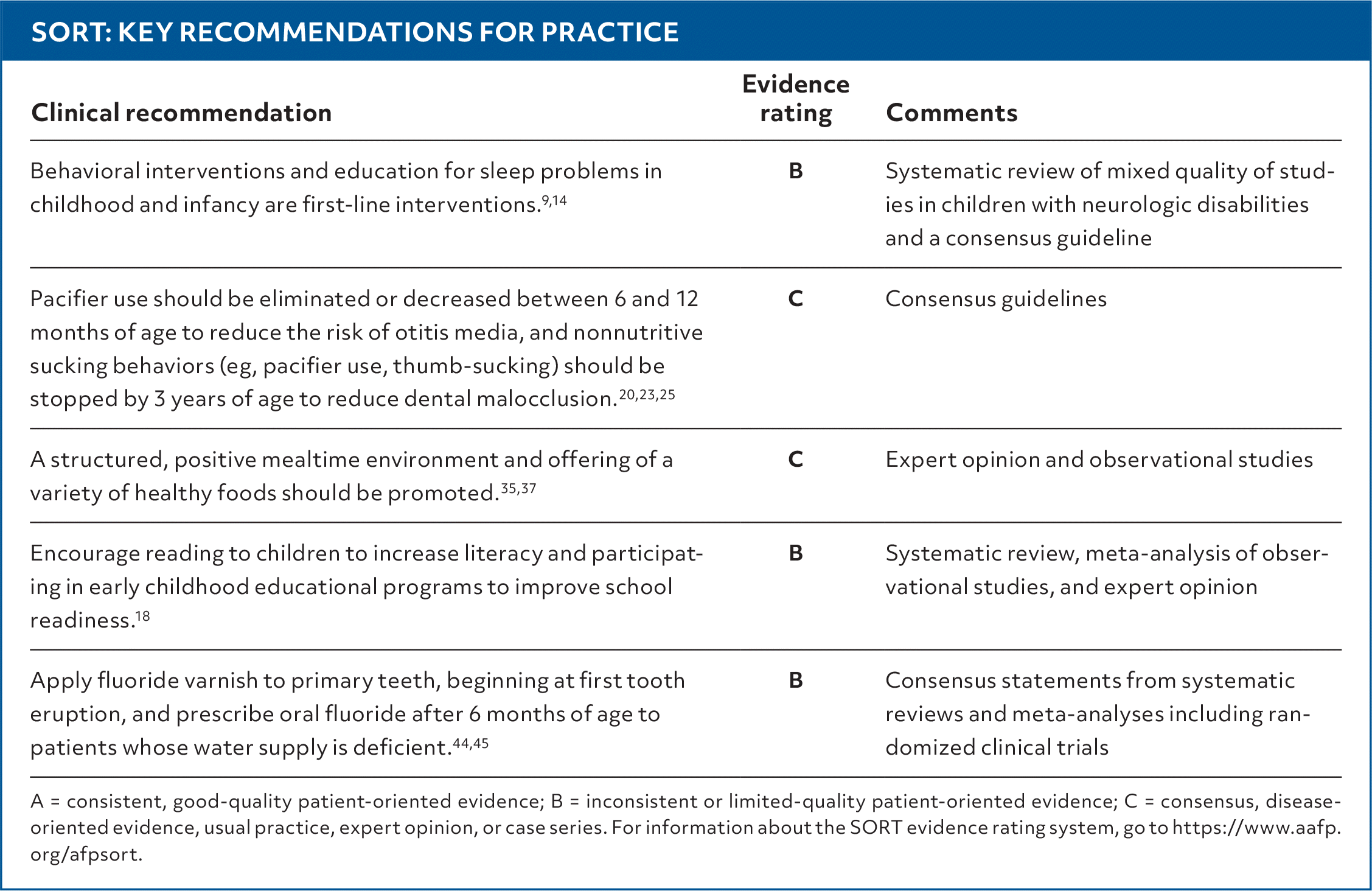
Common early childhood concerns and behaviors include sleep issues, thumb-sucking, pacifier use, picky eating, school readiness, and oral health. Family physicians must recognize when these indicate an underlying disorder and offer constructive and evidence-based strategies to support healthy child development and family well-being. Behavioral interventions and education to address sleep issues can alleviate stress and decrease fatigue for the whole family. Thumb-sucking and pacifier use have dental and social consequences if they persist beyond 3 years of age. Eating problems in childhood are common; in most cases, reassurance and trying new foods can improve picky eating. Readiness to begin school depends on child, family, and societal factors, and needs an individualized approach that emphasizes inclusion while ensuring person-centered success. Reading and participation in early childhood educational programs improve literacy and classroom preparation. Oral health is an important part of childhood well-being; preventive care, including fluoridation, should begin when the first tooth has erupted.

CARL BRYCE, MD, FAAFP, is program director at the Abrazo Family Medicine Residency, Phoenix, Arizona, and a clinical assistant professor in the Department of Family Medicine at Midwestern University Arizona College of Osteopathic Medicine in Glendale.

THERON LIDDELL, PhD, is director of behavioral sciences and a core faculty member at the Abrazo Family Medicine Residency, and a clinical assistant professor in the Department of Family Medicine at Midwestern University Arizona College of Osteopathic Medicine.

GEOFFREY GIDEON, DO, is a resident physician at the Abrazo Family Medicine Residency.

Address correspondence to Carl Bryce, MD, FAAFP, at carl.bryce@abrazohealth.com.

Author disclosure: No relevant financial relationships.

  1. 1.Byars KC, Yolton K, Rausch J, et al. Prevalence, patterns, and persistence of sleep problems in the first 3 years of life. Pediatrics. 2012;129(2):e276-e284.
  2. 2.Calhoun SL, Fernandez-Mendoza J, Vgontzas AN, et al. Prevalence of insomnia symptoms in a general population sample of young children and preadolescents: gender effects. Sleep Med. 2014;15(1):91-95.
  3. 3.Deshpande P, Salcedo B, Haq C. Common sleep disorders in children. Am Fam Physician. 2022;105(2):168-176.
  4. 4.Banks S, Dinges DF. Behavioral and physiological consequences of sleep restriction. J Clin Sleep Med. 2007;3(5):519-528.
  5. 5.Mindell JA, Leichman ES, DuMond C, et al. Sleep and social-emotional development in infants and toddlers. J Clin Child Adolesc Psychol. 2017;46(2):236-246.
  6. 6.Keating J, Bramham J, McNicholas F, et al. An exploration of sleep and family factors in young children at familial risk for ADHD. Behav Sleep Med. 2021;19(6):754-768.
  7. 7.Whalen DJ, Gilbert KE, Barch DM, et al. Variation in common preschool sleep problems as an early predictor for depression and anxiety symptom severity across time. J Child Psychol Psychiatry. 2017;58(2):151-159.
  8. 8.Paruthi S, Brooks LJ, D'Ambrosio C, et al. Recommended amount of sleep for pediatric populations: a consensus statement of the American Academy of Sleep Medicine. J Clin Sleep Med. 2016;12(6):785-786.
  9. 9.Morgenthaler TI, Owens J, Alessi C, et al.; American Academy of Sleep Medicine. Practice parameters for behavioral treatment of bedtime problems and night wakings in infants and young children. Sleep. 2006;29(10):1277-1281.
  10. 10.Gradisar M, Jackson K, Spurrier NJ, et al. Behavioral interventions for infant sleep problems: a randomized controlled trial. Pediatrics. 2016;137(6):e20151486.
  11. 11.Foley LS, Maddison R, Jiang Y, et al. Presleep activities and time of sleep onset in children. Pediatrics. 2013;131(2):276-282.
  12. 12.Brockmann PE, Diaz B, Damiani F, et al. Impact of television on the quality of sleep in preschool children. Sleep Med. 2016;20:140-144.
  13. 13.Carter B, Rees P, Hale L, et al. Association between portable screen-based media device access or use and sleep outcomes: a systematic review and meta-analysis. JAMA Pediatr. 2016;170(12):1202-1208.
  14. 14.Scantlebury A, Mcdaid C, Dawson V, et al. Non-pharmacological interventions for non-respiratory sleep disturbance in children with neurodisabilities: a systematic review. Dev Med Child Neurol. 2018;60(11):1076-1092.
  15. 15.Felt BT, Chervin RD. Medications for sleep disturbances in children. Neurol Clin Pract. 2014;4(1):82-87.
  16. 16.Milanaik R, Fruitman K, Teperman C, et al. Parent reported frequency, efficacy, and side effects of over the counter medication use for improved sleep in 5 to 11 year olds. Pediatrics. 2019;144(2_MeetingAbstract):96.
  17. 17.Williams Buckly A, Hirtz D, Oskoui M, et al. Practice guideline: treatment for insomnia and disrupted sleep behavior in children and adolescents with autism spectrum disorder: report of the Guideline Development, Dissemination, and Implementation Subcommittee of the American Academy of Neurology. Neurology. 2020;94(9):392-404.
  18. 18.High PC, Klass P; Council on Early Childhood. Literacy promotion: an essential component of primary care pediatric practice. Pediatrics. 2014;134(2):404-409.
  19. 19.Moon RY, Carlin RF, Hand I; Task Force on Sudden Infant Death Syndrome and the Committee on Fetus and Newborn. Sleep-related infant deaths: updated 2022 recommendations for reducing infant deaths in the sleep environment. Pediatrics. 2022;150(1):e2022057990.
  20. 20.Policy on pacifiers. The Reference Manual of Pediatric Dentistry. American Academy of Pediatric Dentistry; 2023: 77–80.
  21. 21.Breastfeeding FPS (position paper). American Academy of Family Physicians. Accessed July 1, 2024. https://www.aafp.org/about/policies/all/breastfeeding-position-paper.html
  22. 22.Garcia DS, Garcia KW. Pacifiers: common questions and answers. Am Fam Physician. 2025;​111(3):230-235.
  23. 23.Lieberthal AS, Carroll AE, Chonmaitree T, et al. The diagnosis and management of acute otitis media. Pediatrics. 2013;131(3):e964-e999.
  24. 24.Ros De-Marise R, Pereira-Smith S, Macias MM. Toddlerhood and the preschool years. In: Feldman HM, Elias ER, Blum NJ, et al. Developmental-Behavioral Pediatrics. 5th ed. Elsevier; 2023: 59–71.
  25. 25.Management of the developing dentition and occlusion in pediatric dentistry. The Reference Manual of Pediatric Dentistry. American Academy of Pediatric Dentistry; 2023: 466–83.
  26. 26.Bate KS, Malouff JM, Thorsteinsson ET, et al. The efficacy of habit reversal therapy for tics, habit disorders, and stuttering: a meta-analytic review. Clin Psychol Rev. 2011;31(5):865-871.
  27. 27.Khayami S, Bennani F, Farella M. Fingers in mouths: from cause to management. N Z Dent J. 2013;109(2):49-50.
  28. 28.Dovey TM, Staples PA, Gibson EL, et al. Food neophobia and ‘picky/fussy’ eating in children: a review. Appetite. 2008;50(2–3):181-193.
  29. 29.Jacobi C, Schmitz G, Agras WS. Is picky eating an eating disorder? Int J Eat Disord. 2008;41(7):626-634.
  30. 30.Brown CL, Vander Schaaf EB, Cohen GM, et al. Association of picky eating and food neophobia with weight: a systematic review. Child Obes. 2016;12(4):247-262.
  31. 31.Riley LK, Rupert J, Boucher O. Nutrition in toddlers. Am Fam Physician. 2018;98(4):227-233.
  32. 32.Dovey TM, Kumari V, Blissett J; Mealtime Hostage Parent Science Gang. Eating behaviour, behavioural problems and sensory profiles of children with avoidant/restrictive food intake disorder (ARFID), autistic spectrum disorders or picky eating: same or different? Eur Psychiatry. 2019;61:56-62.
  33. 33.Steinsbekk S, Bonneville-Roussy A, Fildes A, et al. Child and parent predictors of picky eating from preschool to school age. Int J Behav Nutr Phys Act. 2017;14(1):87.
  34. 34.Birch LL, McPhee L, Shoba BC, et al. What kind of exposure reduces children's food neophobia? Looking vs. tasting. Appetite. 1987;9(3):171-178.
  35. 35.Scaglioni S, Arrizza C, Vecchi F, et al. Determinants of children's eating behavior. Am J Clin Nutr. 2011;94(6 suppl):2006S-2011S.
  36. 36.Cathey M, Gaylord N. Picky eating: a toddler's continuing approach to mealtime. Pediatr Nurs. 2004;30(2):101-107.
  37. 37.Zohar AH, Pick S, Lev-Ari L, et al. A longitudinal study of maternal feeding and children's picky eating. Appetite. 2020;154:104804.
  38. 38.Williams PG, Lerner MA; Council on Early Childhood; Council on School Health. School readiness. Pediatrics. 2019;144(2):e20191766.
  39. 39.Fontil L, Gittens J, Beaudoin E, et al. Barriers to and facilitators of successful early school transitions for children with autism spectrum disorders and other developmental disabilities: a systematic review. J Autism Dev Disord. 2020;50(6):1866-1881.
  40. 40.DeVetter N, Westfall JM, Carrozza M, et al. Family physicians are using neighborhood navigator to address social determinants of health. Am Fam Physician. 2023;107(1):19.
  41. 41.Oral health surveillance report trends in dental caries and sealants, tooth retention, and edentulism, United States, 1999–2004 to 2011–2016. Centers for Disease Control and Prevention, US Dept of Health and Human Services; 2019.
  42. 42.Oral health tips for children. National Center for Chronic Disease Prevention and Health Promotion: CDC Division of Oral Health. Accessed July 28, 2024. https://www.cdc.gov/oral-health/prevention/oral-health-tips-for-children.html
  43. 43.O'Hagan-Wong K, Enax J, Meyer F, et al. The use of hydroxyapatite toothpaste to prevent dental caries. Odontology. 2022;110(2):223-230.
  44. 44.Fluoride therapy. The Reference Manual of Pediatric Dentistry. American Academy of Pediatric Dentistry; 2023: 352–8.
  45. 45.Davidson KW, Barry MJ, Mangione CM, et al. Screening and interventions to prevent dental caries in children younger than 5 years: US Preventive Services Task Force recommendation statement. JAMA. 2021;326(21):2172-2178.
  46. 46.Avila WM, Pordeus IA, Paiva SM, et al. Breast and bottle feeding as risk factors for dental caries: a systematic review and meta-analysis. PLoS ONE. 2015;10(11):e0142922.
  47. 47.Nasir A, Nasir L. Counseling on early childhood concerns: sleep issues, thumb-sucking, picking eating, school readiness, and oral health. Am Fam Physician. 2015;92(4):274-278.
  48. 48.Tseng AG, Biagioli FE. Counseling on early childhood concerns: sleep issues, thumb sucking, picky eating, and school readiness. Am Fam Physician. 2009;80(2):139-142.

Copyright © 2026 by the American Academy of Family Physicians.

This content is owned by the AAFP. A person viewing it online may make one printout of the material and may use that printout only for his or her personal, non-commercial reference. This material may not otherwise be downloaded, copied, printed, stored, transmitted or reproduced in any medium, whether now known or later invented, except as authorized in writing by the AAFP. See permissions for copyright questions and/or permission requests.