

CLINICAL QUESTION
How can patients at high risk for developing atrial fibrillation (AF) be identified?
EVIDENCE SUMMARY
AF is the most common arrhythmia worldwide and is associated with an increased risk of stroke, heart failure, and death.1 Risk factors for AF include older age, hypertension, alcohol consumption, tobacco use, and a history of vascular disease. Many prediction models for identifying people at high risk for incident (new onset) AF have been developed, including the Cohorts for Heart and Aging Research in Genomic Epidemiology (CHARGE)-AF and Framingham Heart Study (FHS)-AF risk scores.
The CHARGE-AF risk score was developed using data from three large US cohorts with a total of 18,556 participants (mean age 60–73 years), and it was validated in 7,672 participants from two European cohorts (mean age 72–76 years).2 The calculator is a multivariate model with 13 predictors, including electrocardiography (ECG). This creates a high data burden, although a spreadsheet is provided by the authors. The area under the receiver operating characteristic curve (AUROC), a measure of overall accuracy, was 0.76 in the derivation cohorts but 0.66 and 0.70 in the two validation cohorts, indicating only fair accuracy.
The FHS-AF risk score was developed using data from 4,764 participants with a mean age of 61 years in the FHS.3 The FHS-AF risk score is easier to use in practice than the CHARGE-AF risk score because it has only seven predictors and is a simple point score; however, it does require an ECG. The AUROC in the derivation population was 0.78 but only between 0.65 and 0.71 in prospective validation studies, indicating a loss of accuracy.4 A risk of developing AF greater than 15% was observed in 1% of patients younger than 65 years and in 27% of those older than 65 years. The risk score is available.
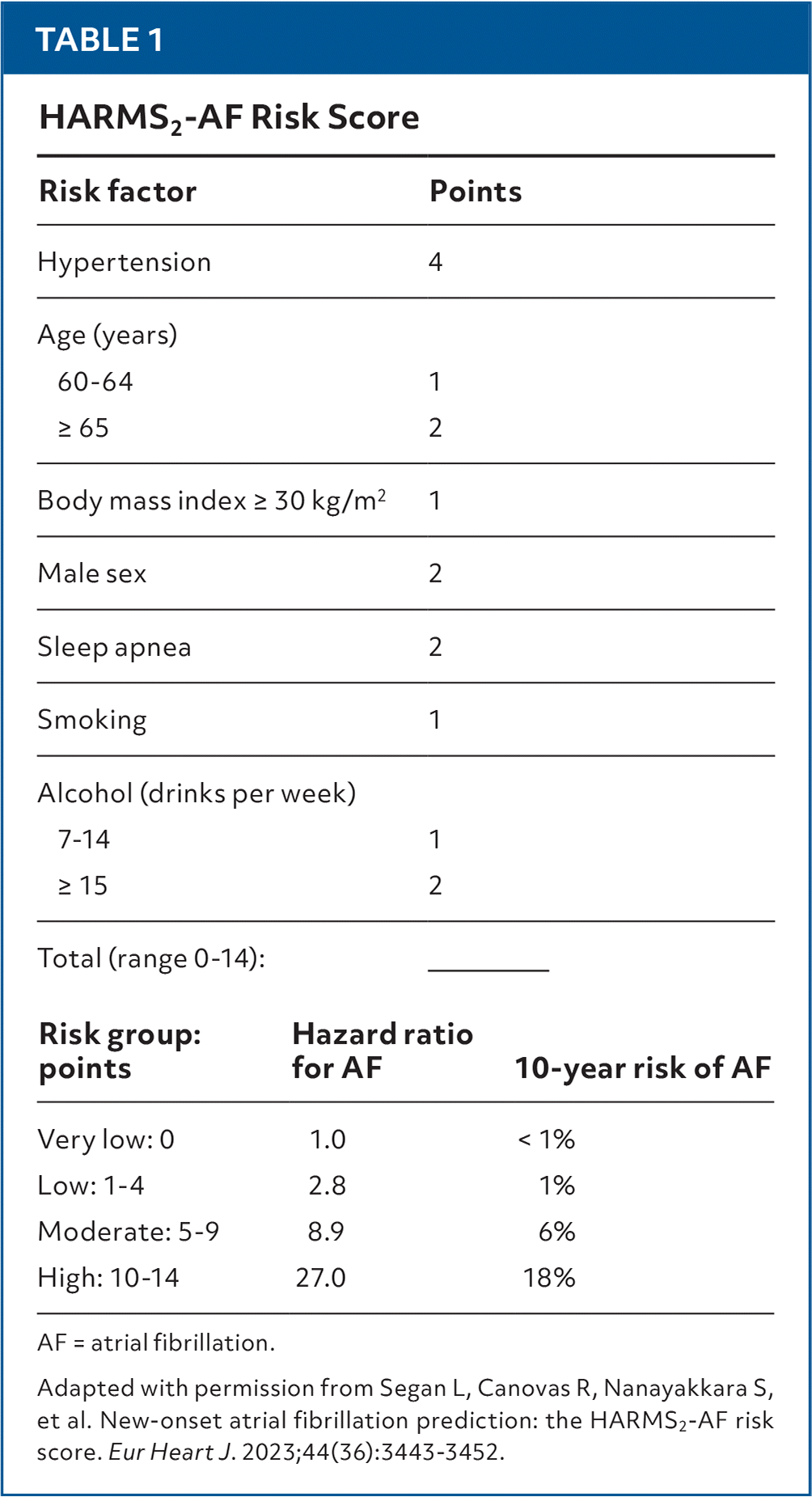
These models incorporated predictors that are nonmodifiable, such as comorbidities, ECG findings, and presence of a murmur. The most recently developed risk score was created with the intention of including primarily modifiable risk factors. The HARMS2-AF risk score was developed using data from 314,280 participants with a mean age of 57 years in the UK Biobank and validated in 7,171 participants from the FHS.5 It has only seven predictors (hypertension, age, raised body mass index, male sex, sleep apnea, smoking, alcohol use), does not require an ECG, and is easily applied in primary care practice. The AUROC was 0.78 in the derivation population and 0.75 in the validation group, indicating good generalizability and very good accuracy. The risk score is shown in Table 1.5
TABLE 1. HARMS2-AF Risk Score
| Risk factor | Points | |
|---|---|---|
| Hypertension | 4 | |
| Age (years) | ||
| 60–64 | 1 | |
| ≥ 65 | 2 | |
| Body mass index ≥ 30 kg/m2 | 1 | |
| Male sex | 2 | |
| Sleep apnea | 2 | |
| Smoking | 1 | |
| Alcohol (drinks per week) | ||
| 7–14 | 1 | |
| ≥ 15 | 2 | |
| Total (range 0–14): | _______ | |
| Risk group: points | Hazard ratio for AF | 10-year risk of AF |
| Very low: 0 | 1.0 | < 1% |
| Low: 1–4 | 2.8 | 1% |
| Moderate: 5–9 | 8.9 | 6% |
| High: 10–14 | 27.0 | 18% |
AF = atrial fibrillation.
Adapted with permission from Segan L, Canovas R, Nanayakkara S, et al. New-onset atrial fibrillation prediction: the HARMS2-AF risk score. Eur Heart J. 2023;44(36):3443–3452.
Read the full article
Get immediate access, anytime, anywhere.
Choose a single article, issue, or full-access subscription.
Earn up to 14 CME credits per issue.
