

The management of heart failure with reduced ejection fraction (HFrEF) has advanced in recent decades, and patients are surviving longer. The goals of HFrEF treatment are to reduce mortality, hospitalizations, and the severity of symptoms while improving functional status and quality of life. Treatments shown to reduce morbidity and mortality in patients with HFrEF, known as guideline-directed medical therapy, include renin-angiotensin system/neprilysin inhibitors, beta blockers, mineralocorticoid receptor antagonists, and sodium-glucose cotransporter-2 inhibitors. Guidelines recommend initiation with target dose titration within 6 to 12 weeks of diagnosis. Secondary therapies such as digoxin, hydralazine and isosorbide dinitrate, ivabradine, and vericiguat are indicated in certain patients with persistent or worsening symptoms. Guideline-directed medical therapy may require dosage adjustment due to adverse effects such as hypotension, hyperkalemia, and worsening kidney function. Intravenous iron replacement is recommended in patients with iron deficiency to improve functional status and quality of life. Device and interventional therapies may be indicated in those with prolonged QRS duration to decrease the risk of sudden cardiac death. Point-of-care ultrasonography can help diagnose heart failure and assess effectiveness of diuretic therapy.
The prevalence of heart failure is 2.4% in adults and increases to more than 10% in those older than 70 years.1,2 These figures are likely underestimated due to cases that are undiagnosed, subclinical, or in asymptomatic patients who are at risk. Hospitalization has estimated 30-day and 1-year all-cause mortality rates of 14% and 29%, respectively, and readmission rates of 19% and 53%, respectively.3 The stages and classification of heart failure are listed in Table 1.4
WHAT’S NEW ON THIS TOPIC
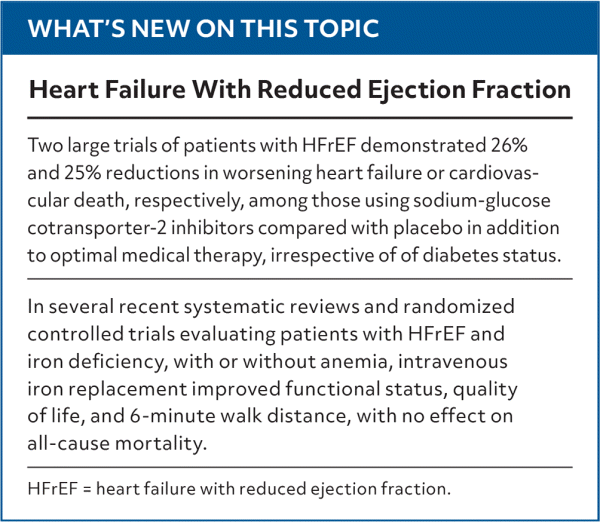
| Two large trials of patients with HFrEF demonstrated 26% and 25% reductions in worsening heart failure or cardiovascular death, respectively, among those using sodium-glucose cotransporter-2 inhibitors compared with placebo in addition to optimal medical therapy, irrespective of of diabetes status. |
| In several recent systematic reviews and randomized controlled trials evaluating patients with HFrEF and iron deficiency, with or without anemia, intravenous iron replacement improved functional status, quality of life, and 6-minute walk distance, with no effect on all-cause mortality. |
HFrEF = heart failure with reduced ejection fraction.
SORT: KEY RECOMMENDATIONS FOR PRACTICE
| Clinical recommendation | Evidence rating | Comments |
|---|---|---|
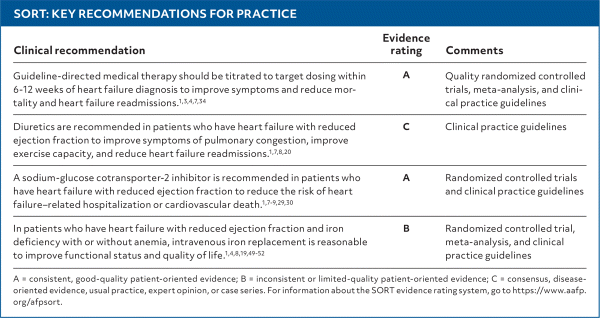
| Guideline-directed medical therapy should be titrated to target dosing within 6–12 weeks of heart failure diagnosis to improve symptoms and reduce mortality and heart failure readmissions.1,3,4,7,34 | A | Quality randomized controlled trials, meta-analysis, and clinical practice guidelines |
| Diuretics are recommended in patients who have heart failure with reduced ejection fraction to improve symptoms of pulmonary congestion, improve exercise capacity, and reduce heart failure readmissions.1,7,8,20 | C | Clinical practice guidelines |
| A sodium-glucose cotransporter-2 inhibitor is recommended in patients who have heart failure with reduced ejection fraction to reduce the risk of heart failure–related hospitalization or cardiovascular death.1,7–9,29,30 | A | Randomized controlled trials and clinical practice guidelines |
| In patients who have heart failure with reduced ejection fraction and iron deficiency with or without anemia, intravenous iron replacement is reasonable to improve functional status and quality of life.1,4,8,19,49–52 | B | Randomized controlled trial, meta-analysis, and clinical practice guidelines |
A = consistent, good-quality patient-oriented evidence; B = inconsistent or limited-quality patient-oriented evidence; C = consensus, disease-oriented evidence, usual practice, expert opinion, or case series. For information about the SORT evidence rating system, go to https://www.aafp.org/afpsort.
Read the full article
Get immediate access, anytime, anywhere.
Choose a single article, issue, or full-access subscription.
Earn up to 14 CME credits per issue.
