Hyperthyroidism: Diagnosis and Treatment

Anne Mounsey, MD
Ryan Paulus, DO
Wesley Roten, MD

American Family Physician. 2025;112(2):146-152.

Author disclosure: No relevant financial relationships.

This clinical content conforms to AAFP criteria for CME.

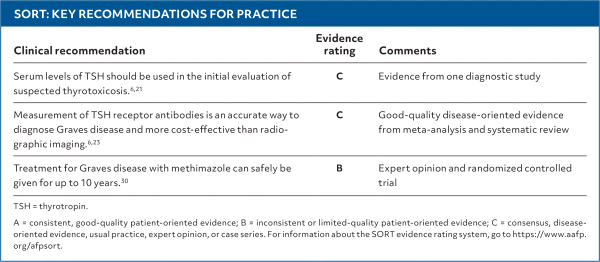
Hyperthyroidism is characterized by overproduction of thyroid hormone in the thyroid gland and affects 1.3% of adults in the United States. Thyrotoxicosis is a state of thyroid hormone excess and may be caused by hyperthyroidism, thyroiditis, or exogenous administration. The most common symptoms of hyperthyroidism are weakness, palpitations, weight loss, and heat intolerance, and the most common signs are a palpable goiter, tachycardia, muscle weakness, and tremor. A low thyroid-stimulating hormone (thyrotropin) level has a high sensitivity and specificity for diagnosing thyrotoxicosis. The most common cause of hyperthyroidism is the autoimmune condition Graves disease, typically diagnosed by the presence of thyroid eye disease, which is pathognomonic, or thyrotropin receptor antibodies. Other causes of hyperthyroidism are toxic multinodular goiter, toxic adenoma, and thyroiditis, which can be differentiated by the pattern of uptake on a radioactive iodine scan. Thionamides (most commonly methimazole) typically induce remission of Graves disease and can control hyperthyroidism caused by multinodular goiter and toxic adenoma. Radioactive iodine resolves hyperthyroidism in more than 90% of patients with Graves disease and toxic multinodular goiter, with hypothyroidism developing in most patients 1 year after treatment. Thyroidectomy is the treatment of choice for patients with compressive symptoms from an obstructive goiter.

ANNE MOUNSEY, MD, is a professor in the Department of Family Medicine, University of North Carolina, Chapel Hill.

RYAN PAULUS, DO, is an assistant professor in the Department of Family Medicine, University of North Carolina.

WESLEY ROTEN, MD, is an assistant professor in the Department of Family Medicine, University of North Carolina.

Address correspondence to Anne Mounsey, MD, at anne_mounsey@med.unc.edu.

Author disclosure: No relevant financial relationships.

  1. 1.Hollowell JG, Staehling NW, Flanders WD, et al. Serum TSH, T(4), and thyroid antibodies in the United States population (1988 to 1994): National Health and Nutrition Examination Survey (NHANES III). J Clin Endocrinol Metab. 2002;87(2):489-499.
  2. 2.Schouten BJ, Brownlie BE, Frampton CM, et al. Subclinical thyrotoxicosis in an outpatient population—predictors of outcome. Clin Endocrinol (Oxf). 2011;74(2):257-261.
  3. 3.Nayak B, Burman K. Thyrotoxicosis and thyroid storm. Endocrinol Metab Clin North Am. 2006;35(4):663-686.
  4. 4.Taylor PN, Albrecht D, Scholz A, et al. Global epidemiology of hyperthyroidism and hypothyroidism. Nat Rev Endocrinol. 2018;14(5):301-316.
  5. 5.Martinez Quintero B, Yazbeck C, Sweeney LB. Thyroiditis: evaluation and treatment. Am Fam Physician. 2021;104(6):609-617.
  6. 6.Ross DS, Burch HB, Cooper DS, et al. 2016 American Thyroid Association guidelines for diagnosis and management of hyperthyroidism and other causes of thyrotoxicosis. Thyroid. 2016;26(10):1343-1421.
  7. 7.Goichot B, Caron P, Landron F, et al. Clinical presentation of hyperthyroidism in a large representative sample of outpatients in France: relationships with age, aetiology and hormonal parameters. Clin Endocrinol (Oxf). 2016;84(3):445-451.
  8. 8.Manji N, Carr-Smith JD, Boelaert K, et al. Influences of age, gender, smoking, and family history on autoimmune thyroid disease phenotype. J Clin Endocrinol Metab. 2006;91(12):4873-4880.
  9. 9.Bogazzi F, Tomisti L, Di Bello V, et al. Tireotossicosi indotta da amiodarone. [Amiodarone-induced thyrotoxicosis]. G Ital Cardiol (Rome). 2017;18(3):219-229.
  10. 10.Basolo A, Matrone A, Elisei R, et al. Effects of tyrosine kinase inhibitors on thyroid function and thyroid hormone metabolism. Semin Cancer Biol. 2022;79:197-202.
  11. 11.Donangelo I, Suh SY. Subclinical hyperthyroidism: when to consider treatment. Am Fam Physician. 2017;95(11):710-716.
  12. 12.Boelaert K, Torlinska B, Holder RL, et al. Older subjects with hyperthyroidism present with a paucity of symptoms and signs: a large cross-sectional study. J Clin Endocrinol Metab. 2010;95(6):2715-2726.
  13. 13.Duyff RF, Van den Bosch J, Laman DM, et al. Neuromuscular findings in thyroid dysfunction: a prospective clinical and electrodiagnostic study. J Neurol Neurosurg Psychiatry. 2000;68(6):750-755.
  14. 14.Gulseren S, Gulseren L, Hekimsoy Z, et al. Depression, anxiety, health-related quality of life, and disability in patients with overt and subclinical thyroid dysfunction. Arch Med Res. 2006;37(1):133-139.
  15. 15.Bode H, Ivens B, Bschor T, et al. Hyperthyroidism and clinical depression: a systematic review and meta-analysis. Transl Psychiatry. 2022;12(1):362.
  16. 16.Bartalena L, Fatourechi V. Extrathyroidal manifestations of Graves’ disease: a 2014 update. J Endocrinol Invest. 2014;37(8):691-700.
  17. 17.Selmer C, Olesen JB, Hansen ML, et al. The spectrum of thyroid disease and risk of new onset atrial fibrillation: a large population cohort study. BMJ. 2012;345:e7895.
  18. 18.Joglar JA, Chung MK, Armbruster AL, et al. ACC/AHA/ACCP/HRS guideline for the diagnosis and management of atrial fibrillation. J Am Coll Cardiol. 2024;83(1):109-279.
  19. 19.Satoh T, Isozaki O, Suzuki A, et al. 2016 guidelines for the management of thyroid storm from The Japan Thyroid Association and Japan Endocrine Society (First edition). Endocr J. 2016;63(12):1025-1064.
  20. 20.Burch HB, Wartofsky L. Life-threatening thyrotoxicosis. Thyroid storm. Endocrinol Metab Clin North Am. 1993;22(2):263-277.
  21. 21.de los Santos ET, Starich GH, Mazzaferri EL. Sensitivity, specificity, and cost-effectiveness of the sensitive thyrotropin assay in the diagnosis of thyroid disease in ambulatory patients. Arch Intern Med. 1989;149(3):526-532.
  22. 22.Thyroid disease in pregnancy: ACOG Practice Bulletin Summary, Number 223. Obstet Gynecol. 2020;135(6):1496-1499.
  23. 23.Tozzoli R, Bagnasco M, Giavarina D, et al. TSH receptor autoantibody immunoassay in patients with Graves’ disease: improvement of diagnostic accuracy over different generations of methods. Systematic review and meta-analysis. Autoimmun Rev. 2012;12(2):107-113.
  24. 24.Cheng X, Chai X, Ma C, et al. Clinical diagnostic performance of a fully automated TSI immunoassay vs. that of an automated antiTSHR immunoassay for Graves’ disease: a Chinese multicenter study. Endocrine. 2021;71(1):139-148.
  25. 25.Tanaka T, Tanaka T, Ogo A, et al. Short-term effects of β-adrenergic antagonists and methimazole in new-onset thyrotoxicosis caused by Graves’ disease. Intern Med. 2012;51(17):2285-2290.
  26. 26.Kahaly GJ, Bartalena L, Hegedüs L, et al. 2018 European Thyroid Association guideline for the management of Graves’ hyperthyroidism. Eur Thyroid J. 2018;7(4):167-186.
  27. 27.Ma C, Xie J, Wang H, et al. Radioiodine therapy versus antithyroid medications for Graves’ disease. Cochrane Database Syst Rev. 2016(2):CD010094.
  28. 28.Abraham P, Avenell A, McGeoch SC, et al. Antithyroid drug regimen for treating Graves’ hyperthyroidism. Cochrane Database Syst Rev. 2010(1):CD003420.
  29. 29.Patel KN, Yip L, Lubitz CC, et al. The American Association of Endocrine Surgeons guidelines for the definitive surgical management of thyroid disease in adults. Ann Surg. 2020;271(3):e21-e93.
  30. 30.Azizi F, Amouzegar A, Tohidi M, et al. Increased remission rates after long-term methimazole therapy in patients with graves’ disease: results of a randomized clinical trial. Thyroid. 2019;29(9):1192-1200.
  31. 31.Kang AS, Grant CS, Thompson GB, et al. Current treatment of nodular goiter with hyperthyroidism (Plummer’s disease): surgery versus radioiodine. Surgery. 2002;132(6):916-923 , discussion 923.
  32. 32.Brito JP, Payne S, Singh Ospina N, et al. Patterns of use, efficacy, and safety of treatment options for patients with Graves’ disease: a nationwide population-based study. Thyroid. 2020;30(3):357-364.
  33. 33.Azizi F, Saadat N, Takyar MA, et al. Efficacy and safety of long-term methimazole versus radioactive iodine in the treatment of toxic multinodular goiter. Endocrinol Metab (Seoul). 2022;37(6):861-869.
  34. 34.Sjölin G, Holmberg M, Törring O, et al. The long-term outcome of treatment for Graves’ hyperthyroidism. Thyroid. 2019;29(11):1545-1557.
  35. 35.Saadat N, Azizi F, Abdi H, et al. Treatment of post-radioactive iodine relapse of hyperthyroidism: comparison of long-term methimazole and radioactive iodine treatment. J Endocrinol Invest. 2022;45(10):1919-1924.
  36. 36.Vija Racaru L, Fontan C, Bauriaud-Mallet M, et al. Clinical outcomes 1 year after empiric 131I therapy for hyperthyroid disorders: real life experience and predictive factors of functional response. Nucl Med Commun. 2017;38(9):756-763.
  37. 37.Azizi F, Smyth P. Breastfeeding and maternal and infant iodine nutrition. Clin Endocrinol (Oxf). 2009;70(5):803-809.
  38. 38.Träisk F, Tallstedt L, Abraham-Nordling M, et al. Thyroid-associated ophthalmopathy after treatment for Graves’ hyperthyroidism with antithyroid drugs or iodine-131. J Clin Endocrinol Metab. 2009;94(10):3700-3707.
  39. 39.Kravets I. Hyperthyroidism: diagnosis and treatment. Am Fam Physician. 2016;93(5):363-370.
  40. 40.Reid JR, Wheeler SF. Hyperthyroidism: diagnosis and treatment. Am Fam Physician. 2005;72(4):623-630.

Copyright © 2026 by the American Academy of Family Physicians.

This content is owned by the AAFP. A person viewing it online may make one printout of the material and may use that printout only for his or her personal, non-commercial reference. This material may not otherwise be downloaded, copied, printed, stored, transmitted or reproduced in any medium, whether now known or later invented, except as authorized in writing by the AAFP. See permissions for copyright questions and/or permission requests.