Colorectal Cancer Screening and Prevention

Denise K. C. Sur, MD
Phillip C. Brown, MD

American Family Physician. 2025;112(3):278-283.

Author disclosure: No relevant financial relationships.

This clinical content conforms to AAFP criteria for CME.

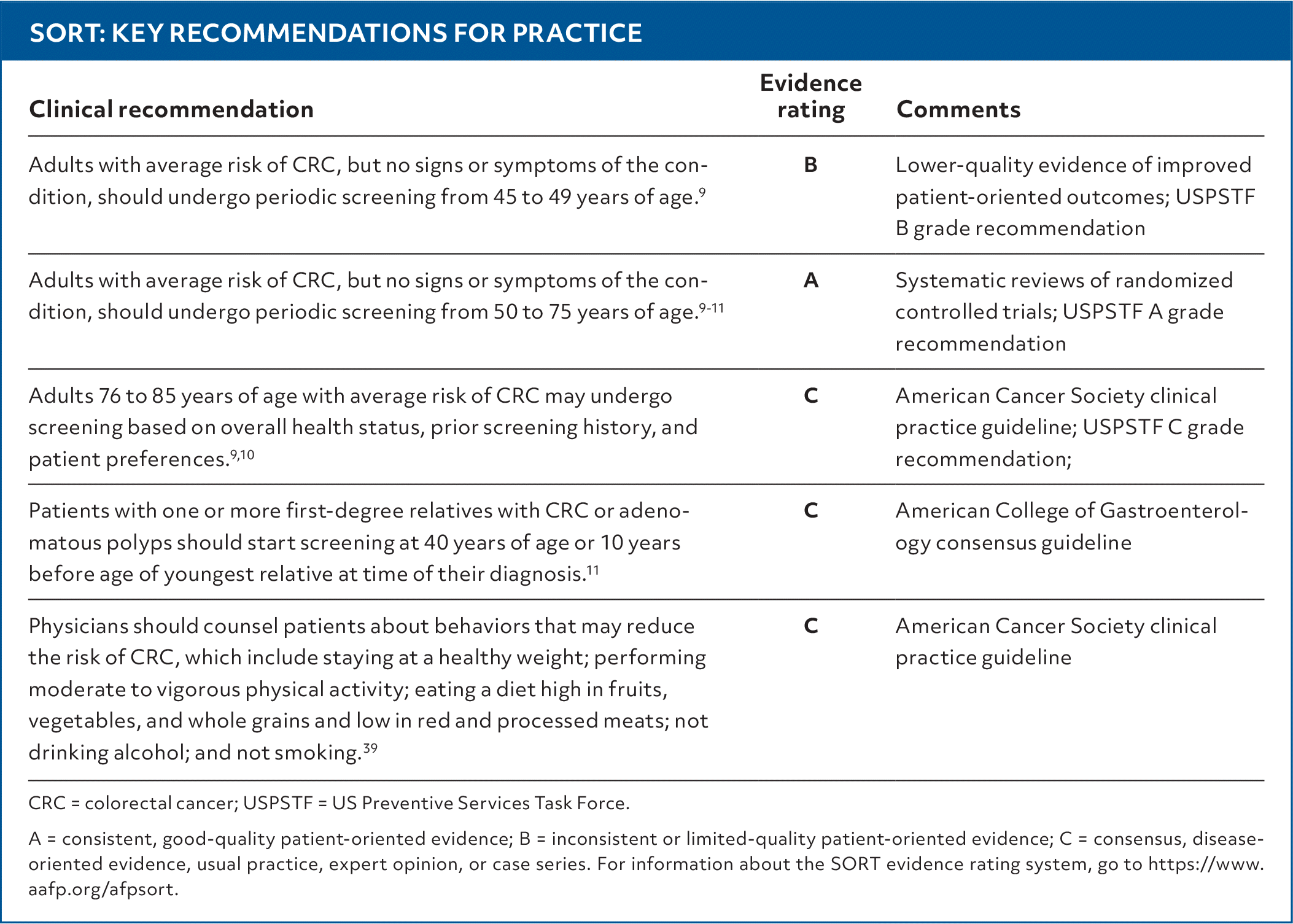
In the United States, colorectal cancer is the third most commonly diagnosed cancer and the second most common cause of cancer death. The annual incidence has decreased since the 1980s. However, in the past 25 years, the incidence in adults 40 to 49 years of age, although low, has increased by 15%. The US Preventive Services Task Force recommends that adults with average risk and no signs or symptoms of colorectal cancer undergo periodic screening from 45 to 75 years of age. Starting screening or surveillance at an earlier age should be considered in patients with a prior diagnosis of adenomatous polyps or inflammatory bowel disease, a history of radiation to the abdomen or pelvis to treat a prior cancer, any genetic disorder that predisposes the patient to a high lifetime risk of cancer, or a first-degree relative with colorectal cancer or adenomatous polyps. Recommended screening modalities include stool-based fecal immunochemical tests, which can also include DNA analysis, and direct visualization via computed tomography colonography, flexible sigmoidoscopy, or colonoscopy. Blood-based testing has low sensitivity and high cost and is therefore a second-line screening option performed only when the patient declines all first-line tests. Physicians should emphasize to patients that regular screening is a powerful tool for preventing colorectal cancer and highlight modifiable risk factors, which include staying at a healthy weight; performing moderate to vigorous physical activity; eating a diet high in fruits, vegetables, and whole grains and low in red and processed meats; not drinking alcohol; and not smoking.

DENISE K. C. SUR, MD, is a clinical professor, vice chair for education, and residency director in the Department of Family Medicine at the David Geffen School of Medicine, University of California, Los Angeles.

PHILLIP C. BROWN, MD, is an associate clinical professor and director of the Community Medicine Fellowship in the Department of Family Medicine at the David Geffen School of Medicine, University of California, Los Angeles.

Address correspondence to Denise K.C. Sur, MD, at dsur@mednet.ucla.edu.

Author disclosure: No relevant financial relationships.

  1. 1.American Cancer Society. Colorectal cancer facts & figures 2023–2025. Accessed June 19, 2024. https://www.cancer.org/content/dam/cancer-org/research/cancer-facts-and-statistics/colorectal-cancer-facts-and-figures/colorectal-cancer-facts-and-figures-2023.pdf
  2. 2.National Cancer Institute. Cancer stat facts: colorectal cancer. Accessed July 2, 2025. https://seer.cancer.gov/statfacts/html/colorect.html
  3. 3.Carethers JM. Racial and ethnic disparities in colorectal cancer incidence and mortality. Adv Cancer Res. 2021;151:197-229.
  4. 4.Doubeni CA, Gabler NB, Wheeler CM, et al. Timely follow-up of positive cancer screening results: a systematic review and recommendations from the PROSPR Consortium. CA Cancer J Clin. 2018;68(3):199-216.
  5. 5.Lopes G, Stern MC, Temin S, et al. Early detection for colorectal cancer: ASCO resource-stratified guideline. J Glob Oncol. 2019;5:1-22.
  6. 6.Montminy EM, Zhou M, Maniscalco L, et al. Contributions of adenocarcinoma and carcinoid tumors to early-onset colorectal cancer incidence rates in the United States. Ann Intern Med. 2021;174(2):157-166.
  7. 7.Welch HG, Robertson DJ. Colorectal cancer on the decline—why screening can't explain it all. N Engl J Med. 2016;374(17):1605-1607.
  8. 8.Fight Colorectal Cancer. Colorectal cancer risk factors. December 18, 2023. Accessed January 2, 2025. https://fightcolorectalcancer.org/facts/risk-factors/
  9. 9.US Preventive Services Task Force. Final recommendation statement: colorectal cancer: screening. May 18, 2021. Accessed June 12, 2024. https://www.uspreventiveservicestaskforce.org/uspstf/recommendation/colorectal-cancer-screening
  10. 10.American Cancer Society. American Cancer Society guideline for colorectal cancer screening. Updated January 29, 2024. Accessed March 2, 2025. https://www.cancer.org/cancer/types/colon-rectal-cancer/detection-diagnosis-staging/acs-recommendations.html
  11. 11.Shaukat A, Kahi CJ, Burke CA, et al. ACG clinical guidelines: colorectal cancer screening 2021. Am J Gastroenterol. 2021;116(3):458-479.
  12. 12.Lewandowska A, Rudzki G, Lewandowski T, et al. Risk factors for the diagnosis of colorectal cancer. Cancer Control. 2022;29 : 10732748211056692.
  13. 13.Colorectal cancer organizations unite in screening age recommendations. Fight Colorectal Cancer blog. August 2, 2023. Accessed June 20, 2024. https://fightcolorectalcancer.org/blog/colorectal-cancer-organizations-unite-in-screening-age-recommendations/
  14. 14.Schoenfeld P; American College of Gastroenterology. American College of Physicians guidance statement on colorectal cancer screening: pitfalls of second-guessing guidelines. September 13, 2023. Accessed June 20, 2024. https://gi.org/journals-publications/ebgi/schoenfeld_sept2023/
  15. 15.American Academy of Family Physicians. Clinical preventive service recommendation: colorectal cancer screening, adults. Accessed June 20, 2024. https://www.aafp.org/family-physician/patient-care/clinical-recommendations/all-clinical-recommendations/colorectal-cancer-adults.html
  16. 16.Wender RC. Should routine screening for colorectal cancer start at 45 years of age? Yes: lowering the starting age is a settled issue [editorial]. Am Fam Physician. 2022;105(2):120-121.
  17. 17.Robertson DJ, Lee JK, Boland CR, et al. Recommendations on fecal immunochemical testing to screen for colorectal neoplasia: a consensus statement by the US Multi-Society Task Force on Colorectal Cancer. Gastroenterology. 2017;152(5):1217.e3-1237.e3.
  18. 18.National Library of Medicine. Clinical validation of an optimized multi-target stool DNA (Mt-sDNA 2.0) test, for colorectal cancer screening “BLUE-C.” Updated September 1, 2023. Accessed June 1, 2024. https://www.clinicaltrials.gov/study/NCT04144738
  19. 19.Imperiale TF, Porter K, Zella J, et al.; BLUE-C Study Investigators. Next-generation multitarget stool DNA test for colorectal cancer screening. N Engl J Med. 2024;390(11):984-993.
  20. 20.Geneoscopy. ColoSense clinician brochure, version 4; 2024. Accessed July 2025. https://www.accessdata.fda.gov/cdrh_docs/pdf23/P230001C.pdf
  21. 21.Exact Sciences. Cologuard: frequently asked questions. Accessed July 2025. https://www.cologuardhcp.com/resources/faq
  22. 22.Geneoscopy. ColoSense. Accessed August 14, 2025. https://colosense.com
  23. 23.Barnell EK, Wurtzler EM, La Rocca J, et al. Multitarget stool RNA test for colorectal cancer screening. JAMA. 2023;330(18):1760-1768.
  24. 24.Bretthauer M, Løberg M, Wieszczy P, et al.; NordICC Study Group. Effect of colonoscopy screening on risks of colorectal cancer and related death. N Engl J Med. 2022;387(17):1547-1556.
  25. 25.Huffstetler AN, Fraiman J, Brownlee S, et al. An estimate of severe harms due to screening colonoscopy: a systematic review. J Am Board Fam Med. 2023;36(3):493-500.
  26. 26.Lin JS, Piper MA, Perdue LA, et al. Screening for colorectal cancer: updated evidence report and systematic review for the US Preventive Services Task Force. JAMA. 2016;315(23):2576-2594.
  27. 27.Kumar R, Lewis CR. Colon cancer screening. StatPearls Updated September 10, 2024. Accessed July 2025. https://www.ncbi.nlm.nih.gov/books/NBK559064/
  28. 28.Gupta S. Screening for colorectal cancer. Hematol Oncol Clin North Am. 2022;36(3):393-414.
  29. 29.De Tranaltes K, Brown SR. Guardant Health Shield screening for colon cancer [Diagnostic Tests]. Am Fam Physician. 2023;107(6):655-656.
  30. 30.Chung DC, Gray DM, Singh H, et al. A cell-free DNA blood-based test for colorectal cancer screening. N Engl J Med. 2024;390(11):973-983.
  31. 31.Ladabaum U, Mannalithara A, Weng Y, et al. Comparative effectiveness and cost-effectiveness of colorectal cancer screening with blood-based biomarkers (liquid biopsy) vs fecal tests or colonoscopy. Gastroenterology. 2024;167(2):378-391.
  32. 32.van den Puttelaar R, Nascimento de Lima P, Knudsen AB, et al. Effectiveness and cost-effectiveness of colorectal cancer screening with a blood test that meets the Centers for Medicare & Medicaid Services coverage decision. Gastroenterology. 2024;167(2):368-377.
  33. 33.Lieberman DA; AGA CRC Workshop Panel. Commentary: liquid biopsy for average-risk colorectal cancer screening. Clin Gastroenterol Hepatol. 2024;22(6):1160.e1-1164.e1.
  34. 34.US Food and Drug Administration. FDA roundup: July 30, 2024. Accessed July 2025. https://www.fda.gov/news-events/press-announcements/fda-roundup-july-30-2024
  35. 35.Rostom A, Dubé C, Lewin G, et al. Nonsteroidal anti-inflammatory drugs and cyclooxygenase-2 inhibitors for primary prevention of colorectal cancer: a systematic review prepared for the U.S. Preventive Services Task Force. Ann Intern Med. 2007;146(5):376-389.
  36. 36.Cole BF, Logan RF, Halabi S, et al. Aspirin for the chemoprevention of colorectal adenomas: meta-analysis of the randomized trials. J Natl Cancer Inst. 2009;101(4):256-266.
  37. 37.Flossmann E, Rothwell PM; British Doctors Aspirin Trial and the UK-TAI Aspirin Trial. Effect of aspirin on long-term risk of colorectal cancer: consistent evidence from randomized trials. Lancet. 2007;369(9573):1603-1613.
  38. 38.Algra AM, Rothwell PM. Effects of regular aspirin on long-term cancer incidence and metastasis: a systematic comparison of evidence from observational studies versus randomised trials. Lancet Oncol. 2012;13(5):518-527.
  39. 39.Rock CL, Thomson C, Gansler T. American Cancer Society guideline for diet and physical activity for cancer prevention. CA Cancer J Clin. 2020;70(4):245-271.
  40. 40.Xiao Y, Xiang L, Jiang Y, et al. Carbohydrate quality, not quantity, linked to reduced colorectal cancer incidence and mortality in US populations: evidence from a prospective study. BMC Med. 2024;22(1):97.
  41. 41.Wilkins T, McMechan D, Talukder A. Colorectal cancer screening and prevention. Am Fam Physician. 2018;97(10):658-665.
  42. 42.Wilkins T, Reynolds PL. Colorectal cancer: a summary of the evidence for screening and prevention. Am Fam Physician. 2008;78(12):1385-1392.
  43. 43.Pignone M, Levin B. Recent developments in colorectal cancer screening and prevention. Am Fam Physician. 2002;66(2):297-303.

Copyright © 2026 by the American Academy of Family Physicians.

This content is owned by the AAFP. A person viewing it online may make one printout of the material and may use that printout only for his or her personal, non-commercial reference. This material may not otherwise be downloaded, copied, printed, stored, transmitted or reproduced in any medium, whether now known or later invented, except as authorized in writing by the AAFP. See permissions for copyright questions and/or permission requests.