

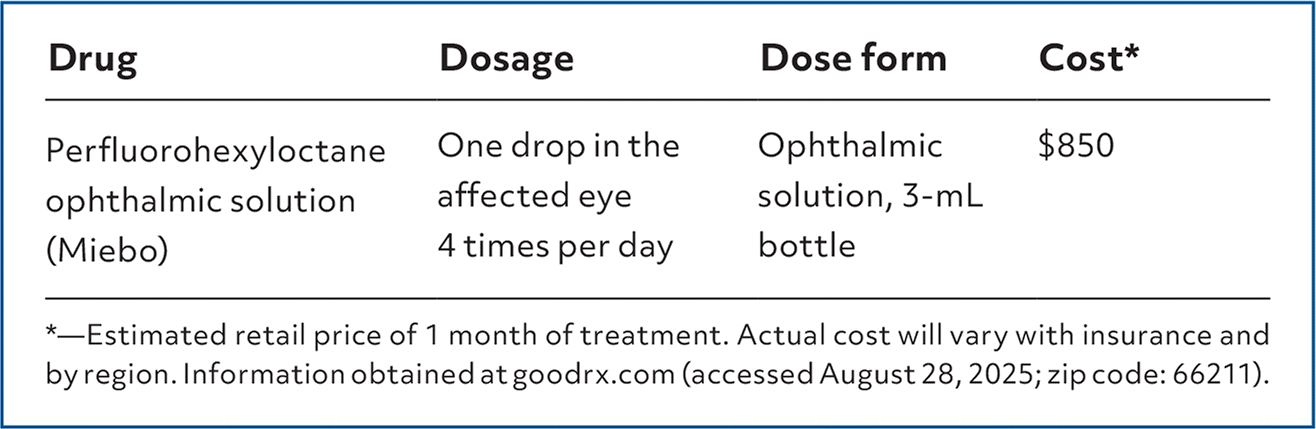
| Drug | Dosage | Dose form | Cost* |
|---|---|---|---|
| Perfluorohexyloctane ophthalmic solution (Miebo) | One drop in the affected eye 4 times per day | Ophthalmic solution, 3-mL bottle | $850 |
*—Estimated retail price of 1 month of treatment. Actual cost will vary with insurance and by region. Information obtained at goodrx.com (accessed August 28, 2025; zip code: 66211).
Perfluorohexyloctane ophthalmic solution (Miebo) is labeled for the treatment of dry eye (keratoconjunctivitis sicca) in adults. It is a water- and preservative-free drop that forms a stable, moisture-retaining layer on the surface of the eye to prevent tear evaporation.1
SAFETY
Perfluorohexyloctane ophthalmic solution is safe for short- and long-term use in adults, with a safety profile comparable to that of hypotonic saline. In two studies, each lasting 8 weeks, 614 participants using the solution four times daily in both eyes reported no serious ocular or nonocular adverse events.2,3 One participant experienced severe eye irritation that led to treatment discontinuation.3 A 52-week extension study found no serious ocular adverse effects among solution users.4
There is a theoretical risk, as with many ophthalmic products, of interference with contact lenses. For patients who wear contact lenses, perfluorohexyloctane ophthalmic solution cannot be administered while wearing them. Lenses should be removed before using the solution and patients should wait at least 30 minutes after application before reinserting them.1 Perfluorohexyloctane ophthalmic solution has not been studied in pregnant individuals or patients younger than 18 years. No drug-drug interactions have been identified to date.1
TOLERABILITY
Perfluorohexyloctane ophthalmic solution is well tolerated, and its safety profile is consistent with long-term use up to 1 year.4 As with saline, about 1% to 3% of patients using the solution will experience blurred vision and conjunctival redness.1 Discontinuation rates were comparable with those of saline.4
EFFECTIVENESS
Perfluorohexyloctane ophthalmic solution has been evaluated in two studies of more than 1,200 patients with dry eye. The studies used a visual analog scale of 0 to 100 points to rate patient level of eye dryness and discomfort, with 100 points indicating maximal discomfort. The baseline average scores were 67 and 65 points, respectively.2,3
Participants reported significantly greater improvement in dry eye scores with perfluorohexyloctane ophthalmic solution compared with hypotonic saline at 15 days (a decrease of 18–18.5 points vs 10.5–13.4 points; P < .001) and at 57 days (27.4–29.5 points vs 10.24–19.7 points; P < .001).2,3 A reduction or difference in scores of 10 points or greater is considered clinically meaningful.
A 52-week extension study further confirmed the continued reductions in eye dryness scores observed in the short-term trials. Participants who switched from saline to perfluorohexyloctane ophthalmic solution in the extension study had improved visual analog scale scores as early as week 4, which were sustained for the remainder of the study.4 Perfluorohexyloctane ophthalmic solution has not yet been studied in head-to-head trials with other treatments.
PRICE
The retail price of one 3-mL bottle of perfluorohexyloctane ophthalmic solution is approximately $850. In comparison, prescription ophthalmic cyclosporine and lifitegrast (Xiidra) cost between $650 and $750 per month. Artificial tears typically cost less than $10 per month.
Read the full article
Get immediate access, anytime, anywhere.
Choose a single article, issue, or full-access subscription.
Earn up to 14 CME credits per issue.
