

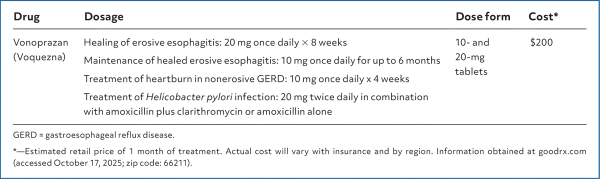
| Drug | Dosage | Dose form | Cost* |
|---|---|---|---|
| Vonoprazan (Voquezna) | Healing of erosive esophagitis: 20 mg once daily × 8 weeks | 10- and 20-mg tablets | $200 |
| Maintenance of healed erosive esophagitis: 10 mg once daily for up to 6 months | |||
| Treatment of heartburn in nonerosive GERD: 10 mg once daily x 4 weeks | |||
| Treatment of Helicobacter pylori infection: 20 mg twice daily in combination with amoxicillin plus clarithromycin or amoxicillin alone |
GERD = gastroesophageal reflux disease.
*—Estimated retail price of 1 month of treatment. Actual cost will vary with insurance and by region. Information obtained at goodrx.com (accessed October 17, 2025; zip code: 66211).
Vonoprazan (Voquezna) is labeled for use in adults for the healing and maintenance treatment of erosive esophagitis and heartburn associated with erosive esophagitis, treatment of heartburn associated with nonerosive gastroesophageal reflux disease (GERD), and eradication of Helicobacter pylori as part of double or triple therapy.1 Vonoprazan inhibits the H+, K+-ATPase enzyme, suppressing gastric acid secretion similarly to other proton pump inhibitors but with a different mechanism of action.
SAFETY
Safety concerns related to vonoprazan identified in postmarketing reports are similar to those of other long-term acid suppressive therapies, including risk of osteoporotic fractures, Clostridioides difficile–associated diarrhea, vitamin B12 deficiency, and hypomagnesemia with associated hypocalcemia and hypokalemia.1 Baseline and periodic monitoring of serum vitamin B12, magnesium, calcium, and potassium levels may be indicated in patients with symptoms or comorbidities. Postmarketing reports with unknown incidence include more serious safety concerns, such as fundic gland polyps, acute tubulointerstitial nephritis, and severe cutaneous adverse reactions (eg, Stevens-Johnson syndrome, toxic epidermal necrolysis).1
Patients taking vonoprazan should be counseled about these concerns and warned that symptomatic response to treatment does not necessarily rule out the presence of gastric malignancy. If symptoms return quickly or do not completely resolve, further diagnostic testing such as endoscopy should be considered, especially in persons older than 50 years.
In patients taking vonoprazan for healing of erosive esophagitis, reducing the dosage to 10 mg/day is indicated for those with an estimated glomerular filtration rate less than 30 mL/min or Child-Pugh class B or C liver impairment. Vonoprazan is not recommended for H pylori eradication in either of these populations. There are no adequate, well-controlled studies to evaluate its safe use in pregnancy; however, animal studies have suggested liver injury is possible in breastfeeding infants.1,2
TOLERABILITY
Vonoprazan is generally well tolerated. Discontinuation rates are similar to those of treatments containing lansoprazole, with rates ranging from 0.9% to 2.3%, and higher rates with triple therapy.3,4 In the treatment of GERD, discontinuation rates are similar to those with placebo.5
EFFECTIVENESS
Vonoprazan has demonstrated consistent effectiveness for all labeled uses. In a study of 1,027 patients with erosive esophagitis randomized to lansoprazole 30 mg/day or vonoprazan 20 mg/day endoscopy-confirmed rates of erosive esophagitis healing were similar (84.6% with lansoprazole vs 92.9% with vonoprazan) at 8 weeks. Maintenance rates of healed erosive esophagitis (any Los Angeles Classification grade) with vonoprazan 10 mg/day were noninferior to those with lansoprazole 15 mg/day (79.2% vs 72.0%) at 24 weeks. In the same study, the percentage of heartburn-free days in patients with healed erosive esophagitis was comparable between the two treatments at week 24 (80.9% with vonoprazan 10 mg vs 78.6% with lansoprazole 15 mg).4
Read the full article
Get immediate access, anytime, anywhere.
Choose a single article, issue, or full-access subscription.
Earn up to 14 CME credits per issue.
