

Neck masses are common in the outpatient setting. Although the differential diagnosis is broad, 95% of neck masses are benign. Efficiently identifying malignant masses is a priority. An investigatory framework allows for accurate diagnosis without delays in care. Human papillomavirus–related oropharyngeal squamous cell carcinoma constitutes approximately 70% of new head and neck cancer diagnoses. The differential diagnosis of a neck mass can be divided into three categories based on acuity: acute (eg, infection), subacute (eg, malignancy), and chronic (eg, congenital, thyroid). When a diagnosis cannot be made by history, risk factors, and physical examination alone, imaging or biopsy is indicated. Contrast-enhanced computed tomography is recommended for most nonpulsatile, nonthyroid masses. For thyroid masses, ultrasonography is the imaging modality of choice. Contrast-enhanced magnetic resonance imaging, computed tomography angiography, and positron emission tomography are preferred in cases of cranial nerve involvement, pulsatile masses, and potential metastases, respectively. When biopsy is indicated, fine-needle aspiration is recommended. In the detection of malignancy, fine-needle aspiration has an accuracy of 93%, sensitivity of 90%, and specificity of 97%, regardless of anatomic site.
Malignancy is a primary concern when an adult presents with a neck mass. However, 95% of neck masses are benign and making a correct diagnosis requires a methodical approach.1 The epidemiology has not been well characterized, and data on overall incidence of neck masses (benign or malignant) are lacking.2 This article provides an algorithmic approach to diagnosing neck masses that is organized by acuity and guided by the history and physical examination.
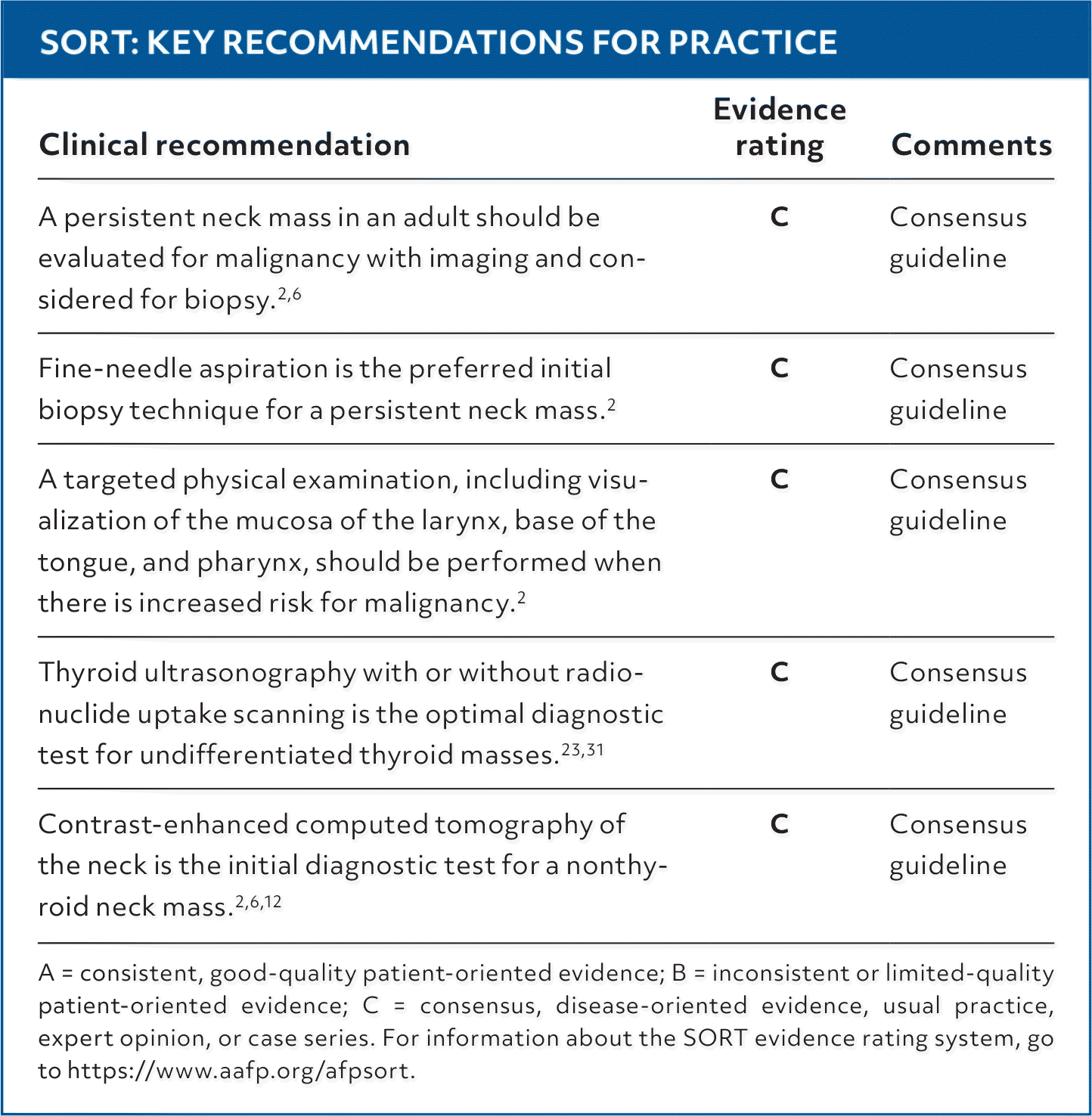
SORT: KEY RECOMMENDATIONS FOR PRACTICE
| Clinical recommendation | Evidence rating | Comments |
|---|---|---|
| A persistent neck mass in an adult should be evaluated for malignancy with imaging and considered for biopsy.2,6 | C | Consensus guideline |
| Fine-needle aspiration is the preferred initial biopsy technique for a persistent neck mass.2 | C | Consensus guideline |
| A targeted physical examination, including visualization of the mucosa of the larynx, base of the tongue, and pharynx, should be performed when there is increased risk for malignancy.2 | C | Consensus guideline |
| Thyroid ultrasonography with or without radionuclide uptake scanning is the optimal diagnostic test for undifferentiated thyroid masses.23,31 | C | Consensus guideline |
| Contrast-enhanced computed tomography of the neck is the initial diagnostic test for a nonthyroid neck mass.2,6,12 | C | Consensus guideline |
A = consistent, good-quality patient-oriented evidence; B = inconsistent or limited-quality patient-oriented evidence; C = consensus, disease-oriented evidence, usual practice, expert opinion, or case series. For information about the SORT evidence rating system, go to https://www.aafp.org/afpsort.
NECK ANATOMY
An understanding of neck anatomy facilitates accurate diagnosis of neck masses and helps differentiate normal variations from masses requiring further evaluation. The neck is divided anatomically into triangles, with the sternocleidomastoid muscle dividing the anterior and posterior cervical triangles (Figure 13). Found throughout the neck, lymph nodes are the most common source of neck masses, and understanding lymphatic drainage is essential in investigating reactive lymphadenopathy and lymphatic metastasis. Other potential sources of masses include the thyroid gland, blood vessels, and the major salivary glands (Figure 24).
Read the full article
Get immediate access, anytime, anywhere.
Choose a single article, issue, or full-access subscription.
Earn up to 14 CME credits per issue.
