Foreign Body Ingestion in Children

Christina Valerio, MD, MPH
Ryan Williamson, DO

American Family Physician. 2026;113(4):326-331.

Author disclosure: No relevant financial relationships.

This clinical content conforms to AAFP criteria for CME.

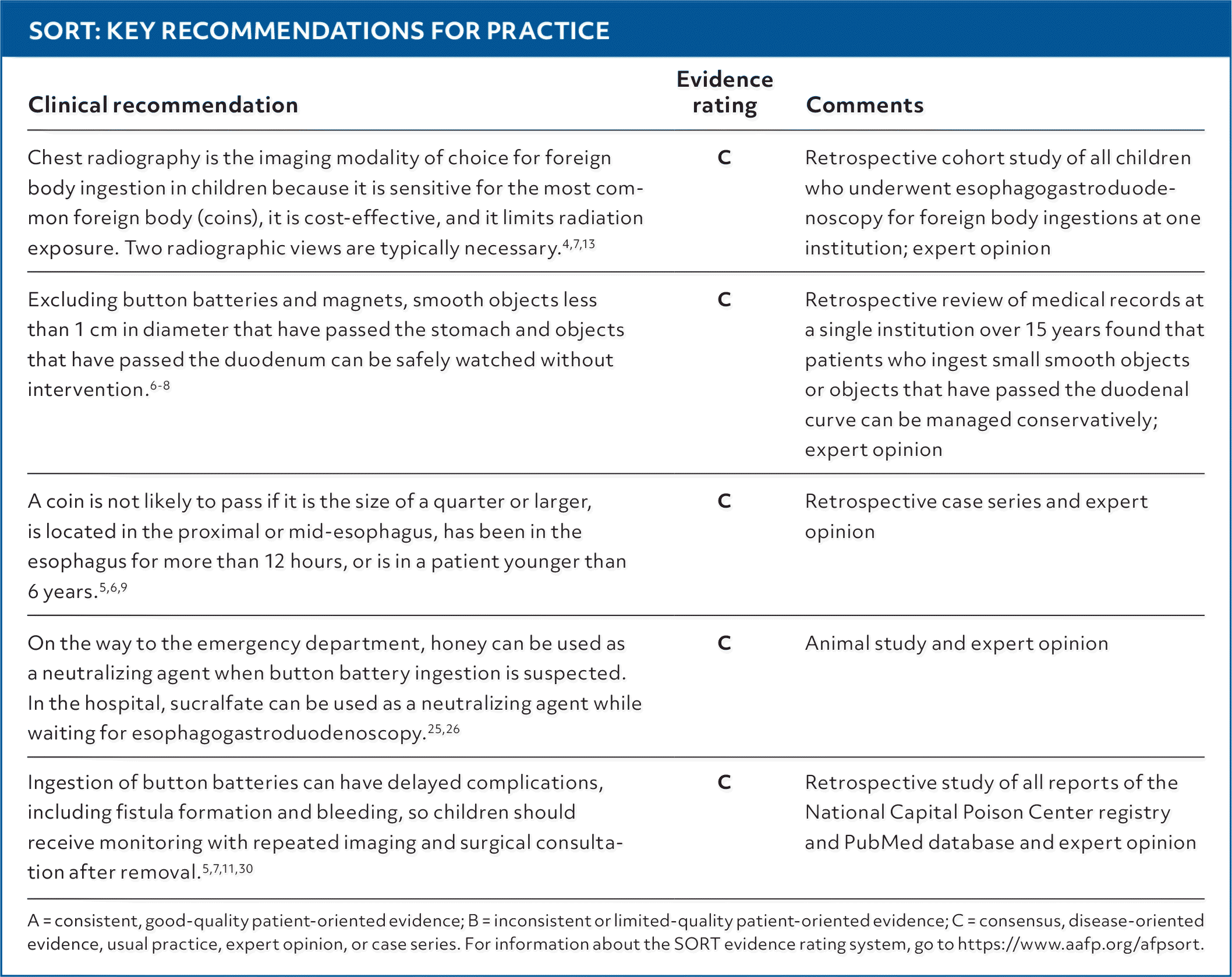
Foreign body ingestions are a common reason for visits to the emergency department in the United States. The most commonly ingested objects include coins and toys, whereas button batteries and magnets are most likely to cause serious complications. Most ingestions are unwitnessed and do not cause symptoms, but choking and vomiting may occur. Diagnosis should begin with plain radiography because it is most sensitive for metallic objects. Management can include watchful waiting, esophagogastroduodenoscopy (EGD), and general or cardiothoracic surgery, depending on the type of object ingested, its location, and symptoms. Coins often pass spontaneously, but large or proximally lodged coins in young children may require EGD. Button battery ingestion is a medical emergency due to rapid tissue damage and risk of fatal vascular injury; honey or sucralfate can be used as interim treatment before emergent EGD. Magnet ingestion, especially when it involves multiple high-powered magnets, poses a severe risk of gastrointestinal injury and often necessitates emergent EGD or surgical intervention. Sharp objects may cause perforation and require close monitoring for removal with emergent or urgent EGD. Food impactions and absorptive objects also require emergent EGD because of their propensity to obstruct the esophagus. Prompt evaluation, imaging, and object-specific management are critical to prevent complications.

CHRISTINA VALERIO, MD, MPH, is the military program director at SSM Health Saint Louis University (Southwest Illinois) Family Medicine Residency Program and an assistant professor in the Department of Family Medicine at the Uniformed Services University of the Health Sciences, Bethesda, Maryland.

RYAN WILLIAMSON, DO, is a family medicine resident at David Grant Medical Center, Travis Air Force Base, California.

Address correspondence to Christina Valerio, MD, MPH, at christina.r.valerio.mil@health.mil.

Author disclosure: No relevant financial relationships.

  1. 1.Gummin DD, Mowry JB, Beuhler MC, et al. 2023 annual report of the National Poison Data System® (NPDS) from America’s Poison Centers®: 41st annual report. Clin Toxicol (Phila). 2024;62(12):793-1027.
  2. 2.Orsagh-Yentis D, McAdams RJ, Roberts KJ, et al. Foreign-body ingestions of young children treated in US emergency departments: 1995–2015. Pediatrics. 2019;143(5):e20181988.
  3. 3.Bekkerman M, Sachdev AH, Andrade J, et al. Endoscopic management of foreign bodies in the gastrointestinal tract: a review of the literature. Gastroenterol Res Pract. 2016;2016:8520767.
  4. 4.Sink JR, Kitsko DJ, Mehta DK, et al. Diagnosis of pediatric foreign body ingestion: clinical presentation, physical examination, and radiologic findings. Ann Otol Rhinol Laryngol. 2016;125(4):342-350.
  5. 5.Kramer RE, Lerner DG, Lin T, et al.; North American Society for Pediatric Gastroenterology, Hepatology, and Nutrition Endoscopy Committee. Management of ingested foreign bodies in children: a clinical report of the NASPGHAN Endoscopy Committee. J Pediatr Gastroenterol Nutr. 2015;60(4):562-574.
  6. 6.Cagil Y, Diaz J, Iskowitz S, et al. Ingested foreign bodies and toxic materials: who needs to be scoped and when? Pediatr Rev. 2021;42(6):290-301.
  7. 7.Tseng HJ, Hanna TN, Shuaib W, et al. Imaging foreign bodies: ingested, aspirated, and inserted. Ann Emerg Med. 2015;66(6):570-582.e5.
  8. 8.Yeh HY, Chao HC, Chen SY, et al. Analysis of radiopaque gastrointestinal foreign bodies expelled by spontaneous passage in children: a 15-year single-center study. Front Pediatr. 2018;6:172.
  9. 9.Dedhia K, Chang YF, Leonardis R, et al. Is there a need for repeat radiologic examination of children with esophageal coin foreign body? Otolaryngol Head Neck Surg. 2017;156(1):173-179.
  10. 10.Litovitz T, Whitaker N, Clark L, et al. Emerging battery-ingestion hazard: clinical implications. Pediatrics. 2010;125(6):1168-1177.
  11. 11.Akinkugbe O, James AL, Ostrow O, et al. Vascular complications in children following button battery ingestions: a systematic review. Pediatrics. 2022;150(3):e2022057477.
  12. 12.Middelberg LK, Funk AR, Hays HL, et al. Magnet injuries in children: an analysis of the National Poison Data System from 2008 to 2019. J Pediatr. 2021;232:251-256.e2.
  13. 13.Whelan-Johnson S, Hall CEJ. Multiple oesophageal foreign bodies: the importance of two radiological views. J Laryngol Otol. 2009;123(1):121-122.
  14. 14.Shrime MG, Johnson PE, Stewart MG. Cost-effective diagnosis of ingested foreign bodies. Laryngoscope. 2007;117(5):785-793.
  15. 15.Loh WS, Eu DKC, Loh SRH, et al. Efficacy of computed tomographic scans in the evaluation of patients with esophageal foreign bodies. Ann Otol Rhinol Laryngol. 2012;121(10):678-681.
  16. 16.Long B, Koyfman A, Gottlieb M. Esophageal foreign bodies and obstruction in the emergency department setting: an evidence-based review. J Emerg Med. 2019;56(5):499-511.
  17. 17.Crosby JC. Emergency department management of gastrointestinal foreign body ingestion. Emerg Med Pract. 2023;25(5):1-28.
  18. 18.Oliva S, Romano C, De Angelis P, et al.; Italian Society of Pediatric Gastroenterology Hepatology and Nutrition (SIGENP), and The Italian Association of Hospital Gastroenterologists and Endoscopists (AIGO). Foreign body and caustic ingestions in children: a clinical practice guideline. Dig Liver Dis. 2020;52(11):1266-1281.
  19. 19.Waltzman ML. Management of esophageal coins. Curr Opin Pediatr. 2006;18(5):571-574.
  20. 20.Children’s Hospital of Philadelphia. Pathway for the evaluation/treatment of the child with foreign body ingestion: coins/blunt objects confirmed on x-ray. Accessed July 1, 2025. https://www.chop.edu/clinical-pathway/foreign-body-ingestion-coinsblunt-objects-confirmed-x-ray
  21. 21.Sharpe SJ, Rochette LM, Smith GA. Pediatric battery-related emergency department visits in the United States, 1990–2009. Pediatrics. 2012;129(6):1111-1117.
  22. 22.Litovitz T, Whitaker N, Clark L. Preventing battery ingestions: an analysis of 8648 cases. Pediatrics. 2010;125(6):1178-1183.
  23. 23.Children’s Hospital of Philadelphia. Pathway for the evaluation/treatment of the child with foreign body ingestion: button battery ingestion confirmed by x-ray. Accessed July 1, 2025. https://www.chop.edu/clinical-pathway/foreign-body-ingestion-button-battery-ingestion-confirmed-x-ray
  24. 24.Soto PH, Reid NE, Litovitz TL. Time to perforation for button batteries lodged in the esophagus. Am J Emerg Med. 2019;37(5):805-809.
  25. 25.Anfang RR, Jatana KR, Linn RL, et al. pH-neutralizing esophageal irrigations as a novel mitigation strategy for button battery injury. Laryngoscope. 2019;129(1):49-57.
  26. 26.National Capital Poison Center. Poison control button battery ingestion triage and treatment guideline. Updated June 2018. Accessed February 2, 2026. https://www.poison.org/battery/guideline
  27. 27.Brumbaugh DE, Colson SB, Sandoval JA, et al. Management of button battery–induced hemorrhage in children. J Pediatr Gastroenterol Nutr. 2011;52(5):585-589.
  28. 28.Philteos J, James AL, Propst EJ, et al. Airway complications resulting from pediatric esophageal button battery impaction: a systematic review. JAMA Otolaryngol Head Neck Surg. 2022;148(7):677-683.
  29. 29.Patel SA, Hillel AD, Perkins J. Battery ingestion leading to bilateral vocal cord paresis. JAMA Otolaryngol Head Neck Surg. 2013;139(3):304-306.
  30. 30.Riedesel EL, Richer EJ, Sinclair EM, et al. Serial MRI findings after endoscopic removal of button battery from the esophagus. AJR Am J Roentgenol. 2020;215(5):1238-1246.
  31. 31.Tavarez MM, Saladino RA, Gaines BA, et al. Prevalence, clinical features and management of pediatric magnetic foreign body ingestions. J Emerg Med. 2013;44(1):261-268.
  32. 32.Children’s Hospital of Philadelphia. Pathway for the evaluation/treatment of the child with foreign body ingestion: single magnet confirmed on x-ray. Accessed July 1, 2025. https://www.chop.edu/clinical-pathway/foreign-body-ingestion-single-magnet-confirmed-x-ray
  33. 33.Children’s Hospital of Philadelphia. Pathway for the evaluation/treatment of the child with foreign body ingestion: ingestion of sharp object. Accessed July 1, 2025. https://www.chop.edu/clinical-pathway/foreign-body-ingestion-ingestion-sharp-object
  34. 34.Uyemura MC. Foreign body ingestion in children. Am Fam Physician. 2005;72(2):287-291.

Copyright © 2026 by the American Academy of Family Physicians.

This content is owned by the AAFP. A person viewing it online may make one printout of the material and may use that printout only for his or her personal, non-commercial reference. This material may not otherwise be downloaded, copied, printed, stored, transmitted or reproduced in any medium, whether now known or later invented, except as authorized in writing by the AAFP. See permissions for copyright questions and/or permission requests.