

An 80-year-old man presented with acute left foot and ankle pain that started shortly after hospitalization for alcohol withdrawal. He had no related injuries or family history of skin conditions. He frequently traveled to the Dominican Republic, his home country, but was unsure of his immunization status. His vital signs were normal.
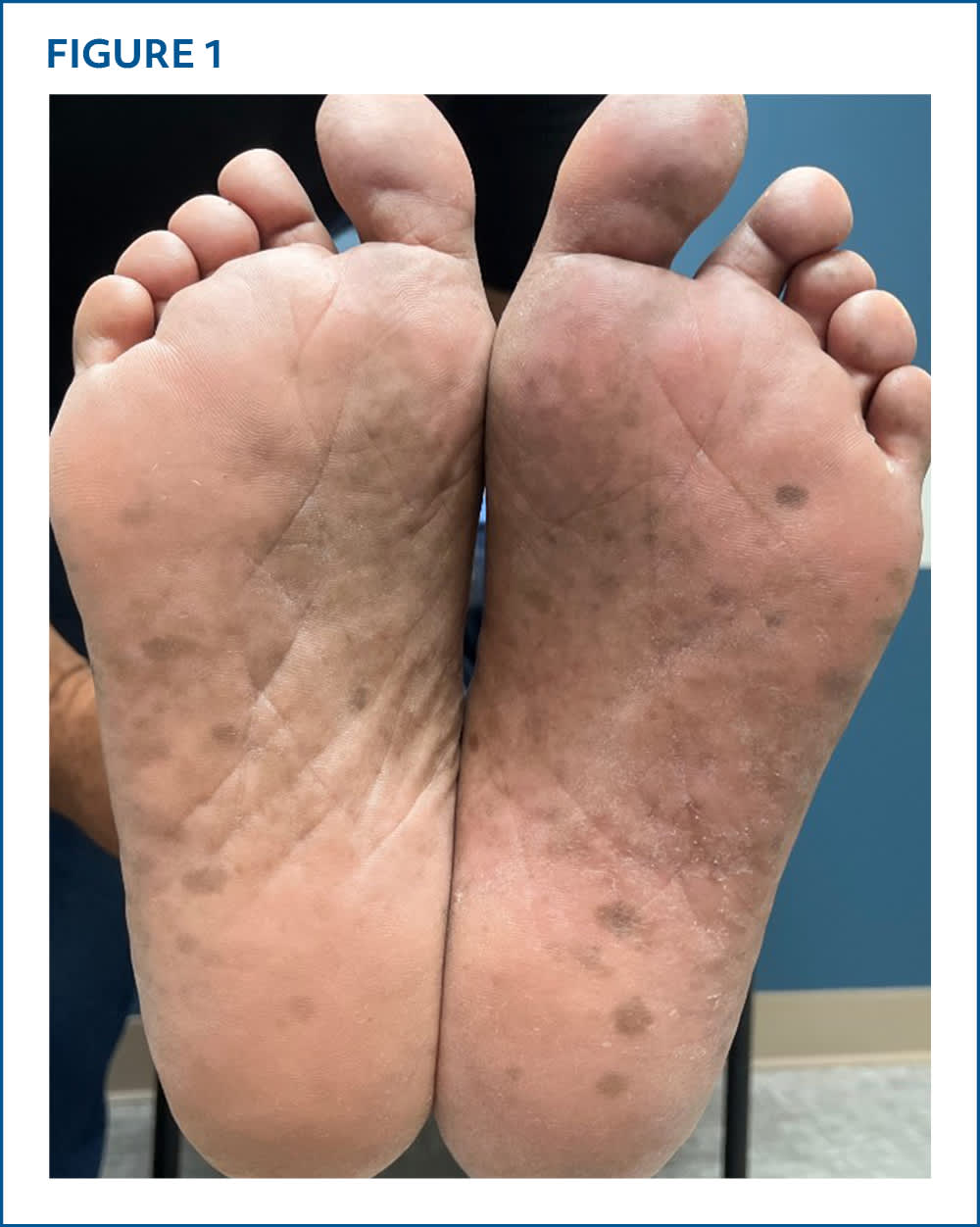
Physical examination revealed multiple hyperpigmented macules on the soles of the feet (Figure 1). The rash was not tender or pruritic, and it did not affect any other area.
FIGURE 1
QUESTION
Based on the patient's history and physical examination, which one of the following is the most likely diagnosis?
- A. Black walnut stain.
- B. Hand-foot-and-mouth disease.
- C. Rocky mountain spotted fever.
- D. Scabies.
- E. Secondary syphilis.
DISCUSSION
The answer is E: secondary syphilis. Syphilis is caused by the spirochete Treponema pallidum. Most cases are acquired via sexual contact. Syphilis has many systemic manifestations that can present decades after the initial exposure. Untreated cases may progress through distinctive primary, secondary, and tertiary stages.1
Primary syphilis typically presents as a single, nontender chancre in the genital region, often with associated local lymphadenopathy. The chancre appears 10 to 90 days after exposure. Due to the often mild manifestation and spontaneous resolution of the chancre within 3 to 6 weeks, many patients are unaware of the infection. About one-fourth of untreated cases progress to the secondary stage.1
The secondary stage presents 2 to 8 weeks after chancre resolution.1 Many generalized symptoms can occur as the spirochete rapidly reproduces, including fever, malaise, myalgia, weight loss, and reduced appetite. However, the distinctive feature of the secondary stage is the macular rash on the palms and/or soles.2 The lesions are usually copper colored, small, scaly, and nonpruritic. The rash may resolve within a few weeks. In one-fourth of untreated patients, the rash reappears within 1 year.1 One-third of patients with untreated secondary syphilis proceed to the tertiary stage, which features systemic cardiovascular and neurologic symptoms that can occur months to decades after the initial infection.1
Black walnut stains result from exposure to black walnuts (eg, from handling walnuts or walking through areas with walnut trees). Organic compounds in black walnuts oxidize and may stain the skin and clothing black.3
Hand-foot-and-mouth disease is caused by nonpolio enteroviruses, usually coxsackievirus A16. The condition typically occurs in children younger than 5 years, but adults can be infected through droplet spread and close contact.4 Patients present with fever, painful mouth sores, and a vesicular rash on the hands and feet.
Rocky Mountain spotted fever is caused by the bacterium Rickettsia rickettsii, which is transmitted by tick bites. The classic rash manifests 2 to 4 days after the onset of fever as pink macules on the extremities that spread to the trunk. It typically affects children, presenting with general malaise, abdominal pain, and myalgia that progresses to altered mental status and respiratory distress after about 5 days.5
Scabies is caused by Sarcoptes scabiei mites that spread through skin-to-skin contact. Commonly affected areas are between the fingers and in the periumbilical and genital regions. The classic symptom of intense nocturnal pruritus presents 4 to 10 weeks after infestation.6 The characteristic skin findings are excoriations and papules that may be tunnel-shaped from the mites burrowing into the skin.
Read the full article
Get immediate access, anytime, anywhere.
Choose a single article, issue, or full-access subscription.
Earn up to 14 CME credits per issue.
