A 60-year-old man presented with five days of fever, dry cough, nausea, diarrhea, weakness, and poor oral intake. He reported body temperatures up to 103°F (39.4°C) at home. At an urgent care visit three days prior, he tested negative for influenza and COVID-19. His medical history included rheumatoid arthritis, type 2 diabetes, and gout. He frequently used the whirlpool spa in his apartment complex.
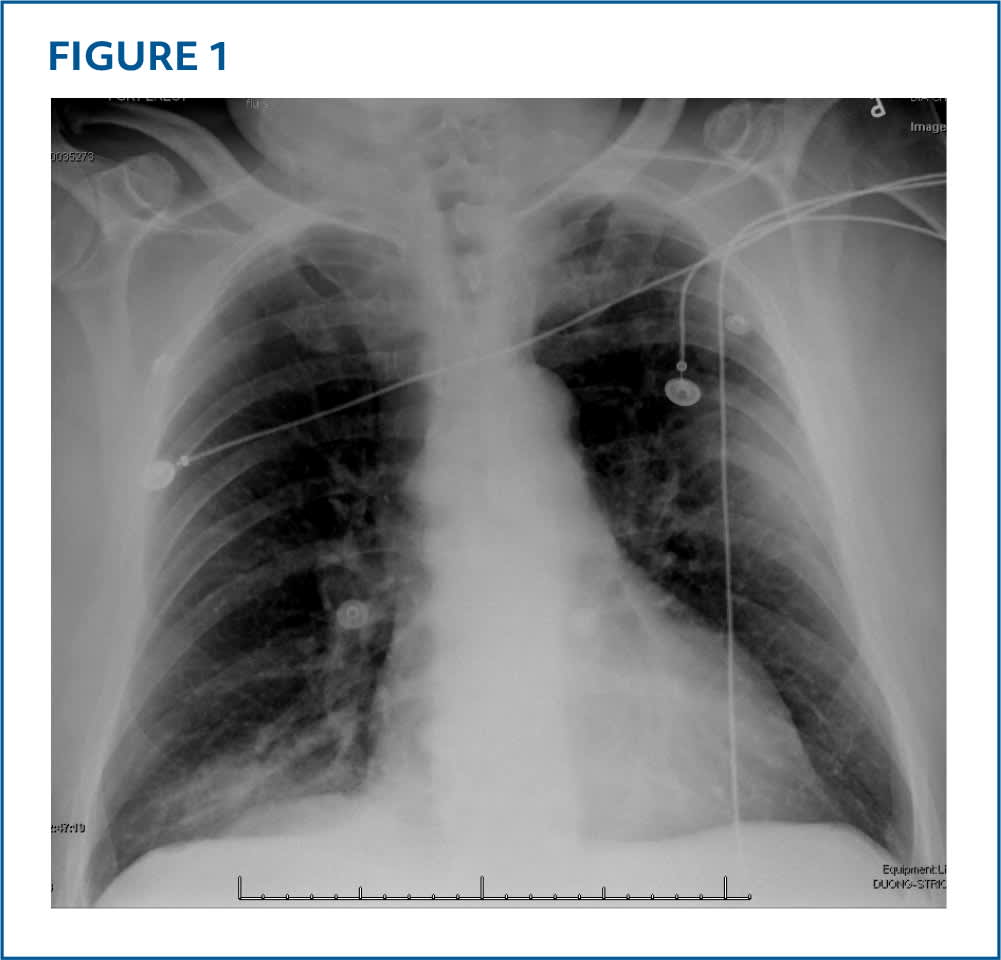
On examination, his temperature was 101.7°F (38.7°C), blood pressure was 98/62 mm Hg, respiratory rate was 20 breaths per minute, and oxygen saturation was 95% on room air. Laboratory evaluation revealed a sodium level of 125 mEq/L (125 mmol/L), aspartate transaminase level of 90 U/L (1.50 μkat/L), and magnesium level of 1.5 mg/dL (0.62 mmol/L). Chest radiography showed a focal infiltrate (Figure 1).
QUESTION
Based on the patient's history, laboratory findings, and chest radiography, which one of the following is the most likely diagnosis?
- A. Influenzal pneumonia.
- B. Legionella pneumophila infection.
- C. Mycoplasma pneumonia infection.
- D. Streptococcus pneumoniae infection.
FIGURE 1
DISCUSSION
The answer is: B. Legionella pneumophila infection. This patient's systemic symptoms (fever, weakness), gastrointestinal issues (nausea, diarrhea), significant hyponatremia, and focal infiltrate on chest radiography are most consistent with an atypical cause of community-acquired pneumonia (CAP). Although no single clinical feature confirms the diagnosis, findings such as hyponatremia and gastrointestinal symptoms are common in Legionella infection. Other risk factors include whirlpool spa use, cruises, hotel stays, hospitalization, or a congregate living situation where a shared water supply is used for showering.1Legionella infections are most commonly associated with aerosolization from contaminated water sources.
American Thoracic Society/Infectious Diseases Society of America guidelines emphasize consideration of atypical pathogens in patients with CAP and recommend targeted diagnostic testing in specific clinical scenarios.2 Routine diagnostic testing is not recommended for all patients with CAP; however, Legionella urine antigen testing is recommended for patients with severe CAP or when epidemiologic or clinical factors increase suspicion for Legionella.2,3 The urine antigen test detects L pneumophila serogroup 1, which accounts for most cases in the United States. Because Legionella does not reliably grow on routine sputum cultures, urine antigen testing provides a rapid and practical diagnostic tool when suspicion is high.
American Thoracic Society/Infectious Diseases Society of America guidelines recommend use of the Pneumonia Severity Index to determine need for hospitalization. The Pneumonia Severity Index has higher discriminative power for mortality prediction and better identifies low-risk patients appropriate for outpatient treatment over hospitalization.2 Using the index, this patient has a risk class IV (range I–V), for which inpatient management is recommended. Empiric treatment of inpatients with CAP and comorbidities should include coverage for typical and atypical pathogens. Recommended regimens include a beta-lactam plus macrolide or a respiratory fluoroquinolone alone.2 Macrolides (eg, azithromycin) and respiratory fluoroquinolones provide reliable coverage for Legionella species.
Viral pneumonias such as influenzal pneumonia often produce diffuse or bilateral interstitial patterns on radiography and are commonly accompanied by upper respiratory tract symptoms.2 Cough and wheezing are common. A rapid polymerase chain reaction test can help identify viral infection.4
Mycoplasma pneumoniae infection is a common cause of CAP, particularly in younger patients, and often presents with gradual onset of symptoms and a relatively mild clinical course (ie, walking pneumonia). Radiography commonly demonstrates patchy or interstitial infiltrates rather than dense lobar consolidation.5
Read the full article
Get immediate access, anytime, anywhere.
Choose a single article, issue, or full-access subscription.
Earn up to 14 CME credits per issue.