
5 signs of a good physician employer

You may know your goals, but it’s hard to tell if a job will truly meet them.
You have a variety of options when it comes to choosing employers and job opportunities. The AAFP’s policy on family physician employment identifies five key qualities to focus on when evaluating whether an organization would be an optimal employer.
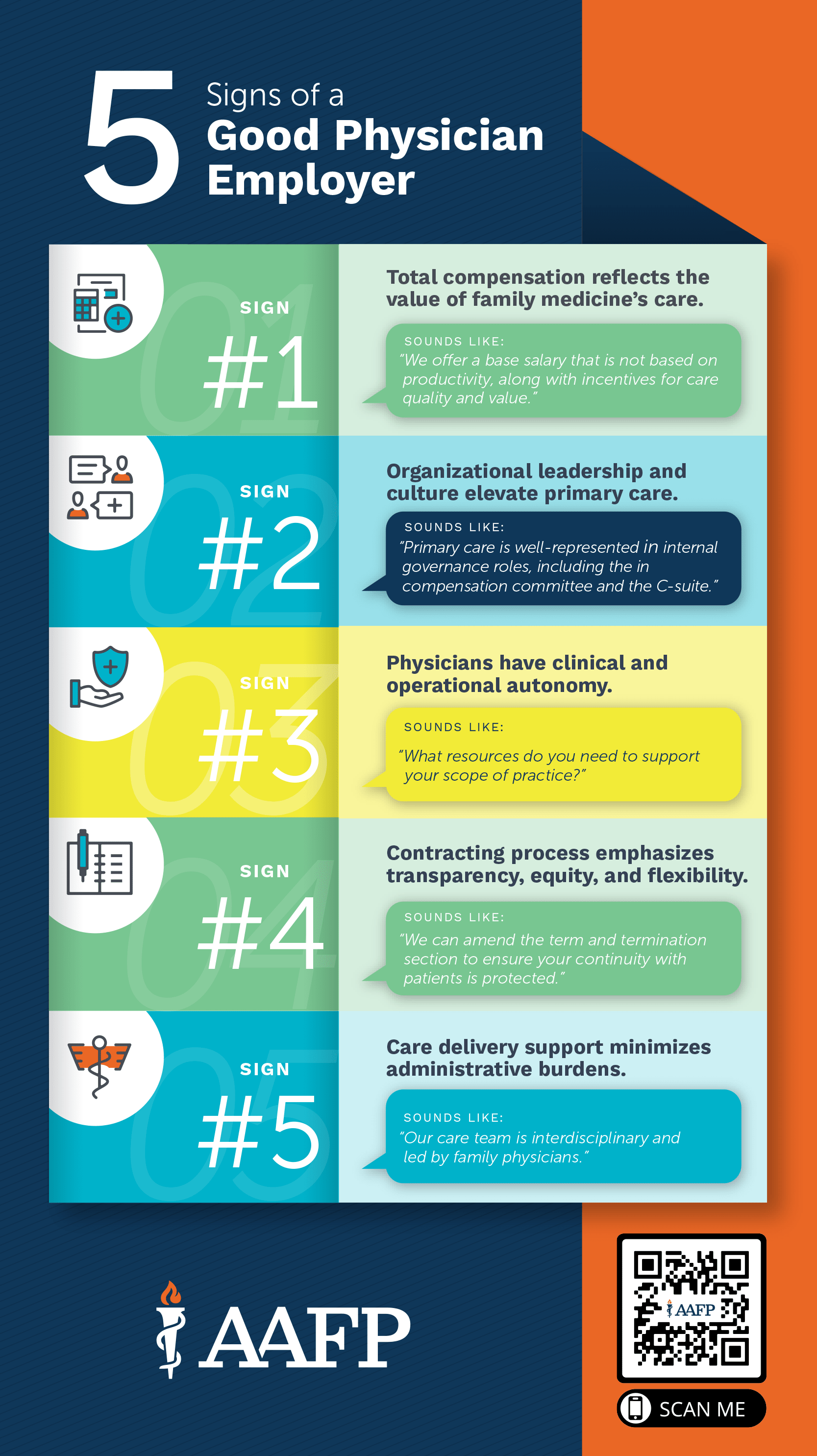
Infographic: 5 signs of a good physician employer
Download image
Do you employ physicians?
Sign #1. Total compensation reflects the value of family medicine’s care.
An organization that understands the value of primary care’s core functions should ideally:
Structure primary care physicians’ compensation using a base salary plus incentives for achieving quality, value and metrics, without basing any part of that salary on productivity. AAFP members can use the Career Benchmark Dashboard to get real-world family medicine income data.
Regularly provide information and insight on the revenue primary care generates and the value primary care creates in terms of patient loyalty and other benefits.
Provide appropriate benefits to clinical and nonclinical staff, such as paid vacation time and paid sick and family leave.
Offer flexible work arrangements (e.g., late start times, four-day workweek, part-time opportunities) that accommodate the diverse needs of its physician workforce.
Sign #2. Organizational leadership and culture elevate primary care.
Primary care is well-represented in internal governance roles, including the compensation committee and the C-suite.
The organization outlines clear pathways to leadership positions and prioritizes diversity, equity and inclusion in its considerations.
There are strong relationships between primary care physician leaders and the organization’s top decision-makers (e.g., general counsel, chief financial officer).
The organization fosters the continuous development of primary care leaders by providing opportunities to serve in formal and informal leadership roles and support and compensation to invest in team building.
The organization promotes participation in professional associations.
The organization provides access and time to participate in ongoing training and professional development opportunities its physicians find meaningful and personally fulfilling.
The organization has specific strategies for creating a diverse workforce and partnering with local communities.
The organization creates a culture that supports all staff (including family physicians and their teams) and promotes their well-being and health.
Interview tip
Find out how committed an organization is to making primary care a foundational part of health care by asking whether:
Primary care is well-represented in internal governance roles, including the compensation committee and the C-suite.
The organization outlines clear pathways to leadership positions and prioritizes diversity, equity and inclusion in its considerations.
There are strong relationships between primary care physician leaders and the organization’s top decision-makers (e.g., general counsel, chief financial officer).
The organization fosters the continuous development of primary care leaders by providing opportunities to serve in formal and informal leadership roles and support and compensation to invest in team building.
The organization promotes participation in professional associations.
The organization provides access and time to participate in ongoing training and professional development opportunities its physicians find meaningful and personally fulfilling.
The organization has specific strategies for creating a diverse workforce and partnering with local communities.
The organization creates a culture that supports all staff (including family physicians and their teams) and promotes their well-being and health.
Sign #3. Physicians have clinical and operational autonomy.
Protect your duty to your patients and your scope of practice by ensuring that an organization:
Works with physicians to mutually define their scope of practice and provides sufficient resources to support the physician’s scope of practice.
Provides protected time (away from patient care) allocated to professional development, leadership and administrative tasks.
Provides resources and support to drive quality and performance improvement activities.
Supports physicians in making decisions on the make-up and structure of their care team to best meet the needs of their patient population.
Sign #4. Contracting process emphasizes transparency, equity and flexibility.
Transparency in contracting signals commitment to nondiscrimination and the patient-physician relationship (for example, by allowing exemptions from non-compete clauses). Check that:
The organization is open to modifying employment contracts to address the unique needs or value of primary care, where possible, including the elimination of non-compete clauses that interfere with the unique, continuous nature of the patient-primary care physician relationship.
The contracting terms do not require employees to pay back unreasonable amounts they received as recruitment incentives, which effectively serve as non-compete clauses by restricting the ability of primary care physicians to practice in a new setting.
Sign #5. Care delivery support minimizes burdens.
Systems of care affect everything from your administrative workload to your access to resources in the clinic. Try to find out whether the organization:
Aligns support for primary care with the four core functions (4Cs) model (first contact, continuity, comprehensiveness and coordination of care).
Gives primary care physicians and their teams the data and information they need to be successful, including but not limited to: Information on the performance of others to whom the physician may make referrals; Information on patient engagement with other parts of the health system (e.g., hospital, emergency department)
Advocates with health plans for contracts that reward and recognize the importance of primary care and ensures that all financial and nonfinancial supports provided through these contracts are delivered directly to the primary care teams for whom they are intended.
Has methods to identify and implement systemic improvements such as streamlining workflow (e.g., electronic health record designed to prioritize continuity for patients and physicians), reducing administrative burdens for such services as prior authorizations, and using technology and automation as appropriate to mitigate the burdens and care delays these tasks create (e.g., via the use of scribes, primary care-specific templates, physician informatics champions).
Has family physician-led interdisciplinary teams, including behavioral health, clinical pharmacy and other fields critical to providing whole-person, equitable care.