
Medical coding basics: HCPCS, CPT and ICD-10 for physicians

Family physicians rely on accurate coding to get paid, track care and reduce audit risk.
Accurate coding is essential not just for getting paid, but for maintaining complete clinical documentation. Many electronic health records (EHRs) and medical billing systems generate reports from the Healthcare Common Procedure Coding System (HCPCS) data to help identify care gaps and support population health efforts.
HCPCS codes
HCPCS allows physicians to document and report the services they provide. These codes are included on insurance claims submitted for payment. They are divided into two levels. Whether you’re coding a routine procedure or billing for supplies, it’s essential to understand Level I Current Procedural Terminology (CPT®) and Level II codes.
Quick reference: CPT vs. HCPCS codes
|
Feature |
HCPCS Level I: CPT codes |
HCPCS Level II codes |
|
What they cover |
Office visits, procedures and evaluation and management (E/M) services |
Supplies, equipment and |
|
Maintained by |
American Medical Association (AMA) |
Centers for Medicare and |
|
Code format |
Five-digit numeric codes |
Five-character alphanumeric codes (starts with a letter) |
|
Modifier format |
Two-digit numeric modifiers |
Two-character alphanumeric modifiers |
|
Common uses |
Exams, surgeries, counseling and preventive care |
Vaccines, durable medical equipment, ambulance and other services |
|
Code example |
99204—New patient, Level 4 E/M visit |
G0008—Flu vaccine administration |
|
Modifier example |
25—Significant, separate E/M service |
AJ—Clinical social worker |
|
Tip: Many EHR systems allow you to filter or report based on these codes, which can help uncover care gaps. |
||
Quick reference: ICD-10 codes
|
Feature |
Description |
|
What they cover |
Diagnoses, signs, symptoms and reasons for encounters (e.g., prevention, counseling) |
|
Code format |
Alphanumeric, three to seven characters and always begins with a letter |
|
Purpose |
Communicates the reason for a visit on insurance claims; supports reporting |
|
Other uses |
Also used to report certain patient characteristics, like body mass index (BMI) |
|
Code example |
E11.42—Type 2 diabetes with diabetic polyneuropathy |
A detailed look at HCPCS Level 1 and 2 codes
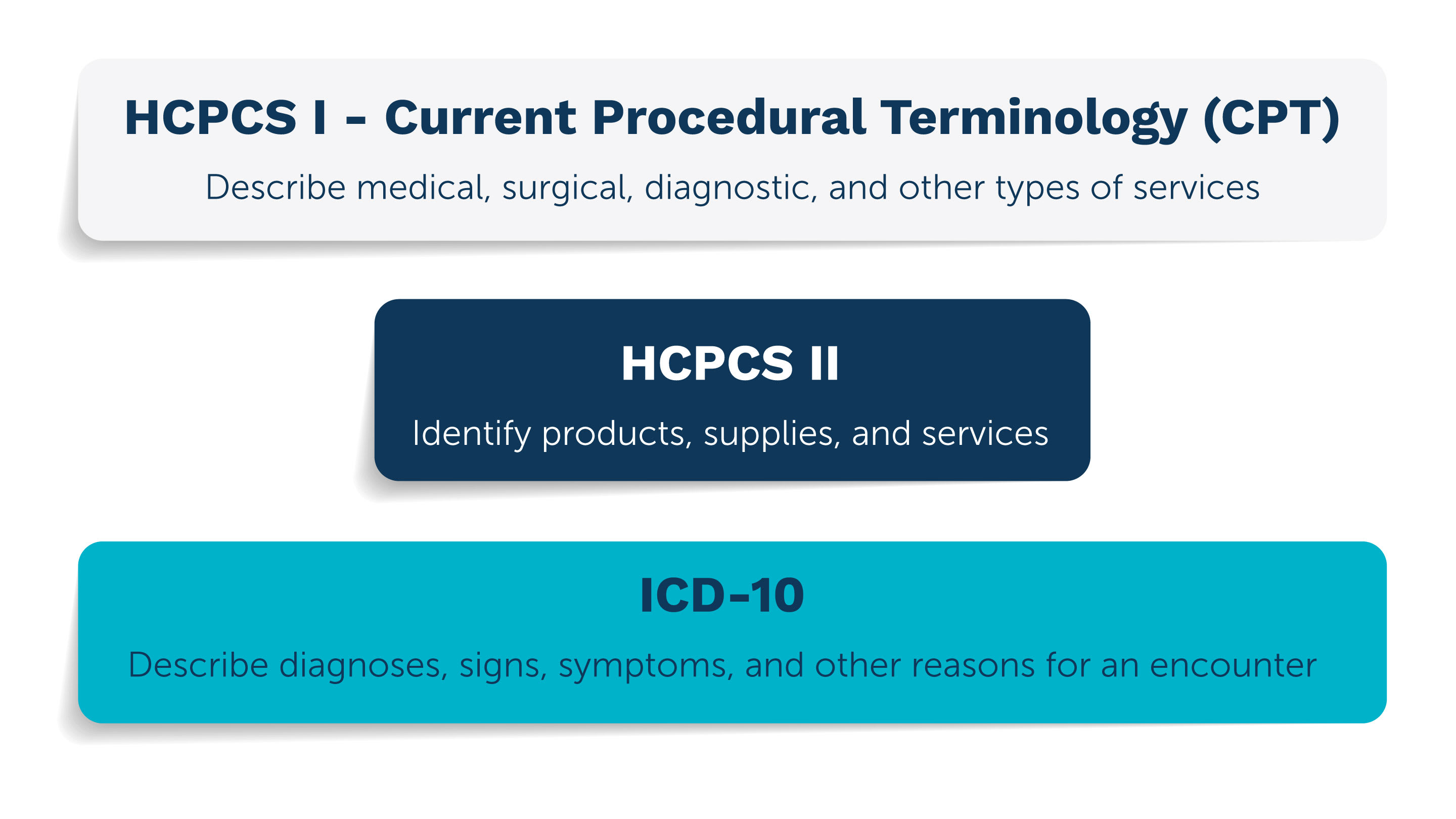
CPT codes describe most of the clinical care you provide—medical, surgical, diagnostic and other types of services. These are the codes you’ll use for office visits, preventive care and procedures and decision-making. They are:
- Maintained by the AMA, which updates the codes regularly to reflect changes in clinical practice.
- Formatted as five-character numeric or alphanumeric codes, with most codes using only numbers.
- Always begin with a number, which sets them apart from HCPCS Level II codes that start with a letter.
- Supported by two-digit modifiers that indicate that a service or procedure has been altered by a specific circumstance, or meet payer-specific billing requirements.
- 99204—This is a CPT code used for a Level 4 E/M visit with a new patient. It requires moderate medical decision making or 45 min. total time.
- 25 Modifier—This modifier is added to an E/M code (like 99204) when a significant, separately identifiable E/M service is performed by the same physician on the same day as another procedure. It tells the payer that the visit wasn’t just part of the procedure; it involved its own decision-making and documentation.
Often referred to as “hick-picks,” HCPCS Level II codes are used when CPT doesn’t include the item or service you need to report. These codes cover things like durable medical equipment, supplies and drugs. They are:
- Maintained by the Centers for Medicare and Medicaid Services (CMS), which is responsible for updating and overseeing the use of these codes.
- Five-character alphanumeric codes made up of a combination of letters and numbers.
- Always begin with a letter, unlike CPT codes, which start with numbers. HCPCS Level II codes start with a letter that typically reflects a category of service.
- Support two-character modifiers that give more detail about the service or item, such as location on the body or the type of provider delivering the care.
- G0008—This HCPCS Level II code is used to report the administration of the influenza virus vaccine to Medicare patients. It identifies the act of giving the vaccine, not the vaccine itself, which would be billed separately.
- AJ—This is a modifier used to indicate that the service was provided by a clinical social worker (CSW). Modifiers like AJ help clarify the type of provider delivering care, which may affect payment.
- F1—This is a modifier that specifies the left hand, second digit (i.e., the index finger). It gives more precise information about the location on the body where a service was performed. This is particularly helpful when billing for procedures involve limbs or digits.
Getting the code right isn’t just about payment, it ensures your documentation reflects the care you provided. Clean claims reduce denials, support compliance and help your practice track services, spot trends and identify care gaps.
Tip: Most EHR and billing systems let you run reports based on CPT and HCPCS codes, helping you monitor patient care and practice performance.
Coding systems and focuses
ICD-10 codes
Physicians use International Classification of Diseases, 10th Revision, Clinical Modification (ICD-10-CM) codes to report diagnoses, symptoms and other reasons for a patient’s visit. These codes are submitted on health insurance claims to explain why care was provided. As with HCPCS codes, ICD-10-CM codes can also support population health, quality improvement and public health reporting by making it easier to track patient conditions across settings and over time. Understanding how to use these codes correctly can help your practice uncover trends, reduce errors and improve care.
A detailed look at ICD-10 codes
- ICD-10 codes are used to report diagnoses, symptoms and other reasons for patient encounters. These codes are added to insurance claims to explain the why behind a visit, helping ensure appropriate and supporting clinical and population health efforts. They are:
- Maintained by a federal committee made up of representatives from the CMS and the CDC’s NCHS.
- Alphanumeric codes made up of three to seven characters, with added digits providing more detail about the condition.
- Always begin with a letter, which corresponds to a general category or chapter of conditions (e.g., “E” for endocrine, “I” for circulatory).
- Part of the U.S. version called ICD-10-CM—where “CM” stands for Clinical Modification. This means the codes include more detail than the international version of ICD-10 to support better tracking and reporting in clinical settings.
- E11.42—This code comes from ICD-10-CM and is used for type 2 diabetes with diabetic polyneuropathy.
- E identifies the chapter for endocrine, nutritional and metabolic diseases.
- 1 specifies type 2 diabetes.
- .42 adds the detail: diabetic polyneuropathy, a common complication affecting the peripheral nervous system.
- E10.649—This code indicates type 1 diabetes with hypoglycemia without coma.
- E represents endocrine-related conditions.
- 10 signals type 1 diabetes
- .649 provides specificity—hypoglycemia as a complication, but without loss of consciousness.
- I50.42—This code is used for chronic combined systolic and diastolic congestive heart failure.
- I places it in the circulatory system chapter.
- 50 identifies heart failure.
- .42 denotes both systolic and diastolic dysfunction in a chronic form.
Understanding medical coding for specific services
- Advance care planning
- Advanced primary care management
- Annual wellness visit
- Behavioral health integration services
- CHI services
- Chronic care management
- Evaluation and management services: FAQs
- Group visits
- Hierarchical condition category coding
- Initial preventive physical examination
- Medicare non-covered services
- Medicare Part B and Part D vaccine coverage
- Newborn care services
- Non-physician clinician services
- PIN services
- Remote patient monitoring and continuous glucose monitoring
- Social determinants of health
- Telehealth, audio-only and virtual-digital visits
- Transitional care management
- Vaccine administration