
FPs Take on Technology, Burnout, Patient Care Issues
May 02, 2018 01:40 pm Sheri Porter Kansas City, Mo. – It's family physicians' love of their specialty that draws them each year to the AAFP's annual National Conference of Constituency Leaders (NCCL) to passionately draft, discuss and vote on resolutions that help guide AAFP policy.
Attendees tackled tough issues ranging from physician burnout and wellness to telemedicine and other emerging technology. Here is a sampling of the work accomplished by the Reference Committee on Practice Enhancement.
Staying on Top of Technology
Attendees considered a resolution asking the AAFP to help physicians learn to utilize emerging technologies -- such as telemedicine, telehealth and artificial intelligence -- during clinical encounters with patients.
Matthew Varallo, D.O., a new physician and general registrant from Corona, Calif., one of several co-authors, told the reference committee that new physicians begin practice with "zero experience" with telemedicine.
"I see about six patients a day utilizing telemedicine. I have seen people with COPD exacerbation, chest pain, and just this past Monday, I’m fairly certain the woman I was speaking to had a potential peritonsillar abscess based on how she sounded and what she was saying," Varallo said.
"We need some guidance, some training in residencies and at the very least, some exposure to telemedicine," he added.
Story Highlights
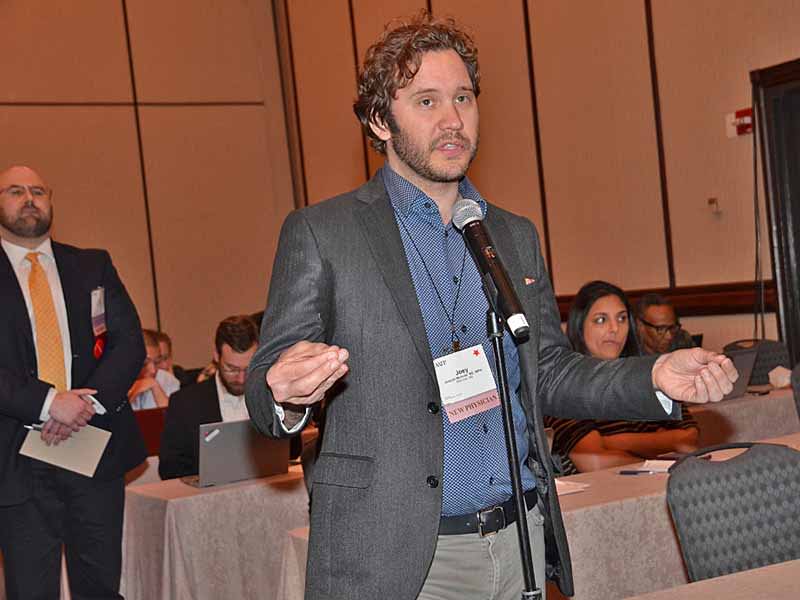
Joseph Nichols, M.D., M.P.H., a new physician delegate from Baltimore, also a co-author, stepped to the microphone to underscore a couple of points.
"It is true that we have a telehealth MIG (Member Interest Group), and I'm a proud member of that MIG," said Nichols. "We're asking the Academy to think about a more formalized type of mentorship opportunities we can provide to our members. It's the logical next step."
Nichols said a best-practices toolkit could include CME offerings and would be a big deal for family physicians who want to participate in telemedicine. "Currently it's the wild West out there," he said.
Nichols also suggested that the Accreditation Council for Graduate Medical Education (ACGME) consider including telemedicine in residency curriculum because the issue isn't going away.
Co-author Ean Bett, M.D., a new physician delegate from Columbus, Ohio, said he had spent the first half of his week at the World Medical Innovation Forum in Boston "where people looked at me sideways because I was a family physician.
"That's because they're developing this technology not with us in mind, but for us to use."
He urged the AAFP to get actively involved so physicians will have technology designed for them to use in practice -- unlike electronic health records that were "designed to use us," he said.
During the April 28 business session, delegates adopted a resolution asking the AAFP to explore creating a mentor network, develop a best-practices toolkit and CME materials around new technologies, and communicate with the ACGME about telemedicine, telehealth, artificial intelligence and other technologies in clinical encounters.
Avoiding Physician Burnout, Promoting Wellness
Family physicians discussed a resolution that focused on taking steps to reduce physician burnout in the workplace. Venis Wilder, M.D., a general registrant from New York, N.Y., spoke about
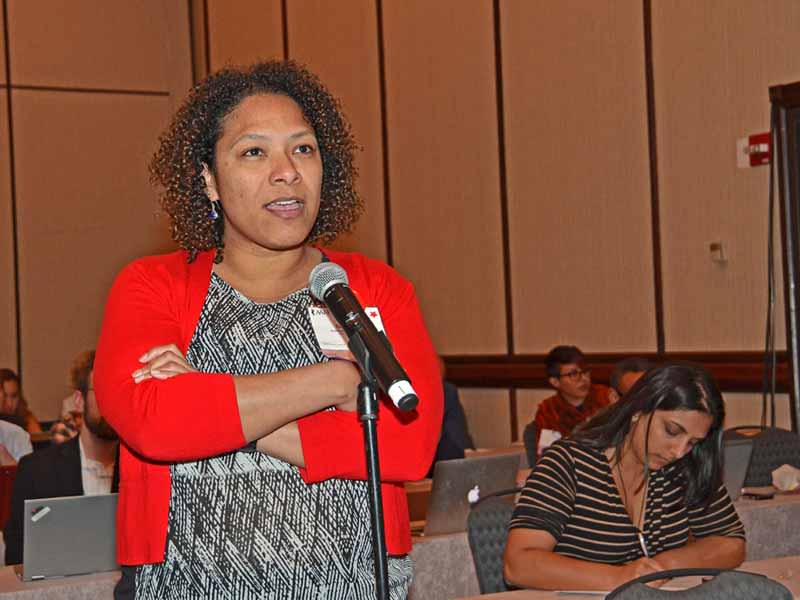
physicians who shoulder much of the workload as employed physicians in clinic and practicing settings, "and yet we don't seem to have a lot of power."
She pointed out that nurses and other staff members are guaranteed their 15-minute breaks and lunch periods because of labor laws and union oversight. However, employed physicians are not afforded those same benefits, said Wilder.
Work-hour regulations protect residents, "but once we graduate from residency, we have no protection," she added.
Kim Eubanks, M.D., an LGBT delegate from Atlanta, testified about her experiences as a traveling family physician engaged in various facets of family medicine, including primary care and urgent care. "When you're working in that type of environment, a lot of times doctors work the whole day through without a lunch break," said Eubanks.
The expectation is to see 20-30 patients a day in primary care and 40-50 a day in an urgent care setting, said Eubanks. She suggested that hiring scribes to assist physicians in those settings "would enable physicians to go home at a decent time, and have a better quality of life."
Delegates adopted a resolution that was amended during the business session asking the AAFP to extend healthy workplace standards beyond resident physicians to practicing physicians and also directs the Academy to evaluate how labor laws apply to family physicians. The goal is to create a national standard of physician care and wellness.
The reference committee also heard testimony on a resolution titled "Wellness is Primary."
Lisa Lavadie-Gomez, M.D., of Iowa City, Iowa, and a delegate in the minority constituency, co-authored the resolution. She reminded her colleagues that patients are encouraged to recognize depression as a disease.
"However, when physicians suffer mental health conditions, we often are not encouraged to acknowledge this among our peers or among the leaders in our administration," said Lavadie-Gomez.
Micheline Epstein, M.D., of New York, N.Y., a general registrant affiliated with the minority constituency, testified on her own behalf when she stepped to the microphone and simply said, "I just want to add that before we are doctors, we are human beings."
On Saturday, after extracting the resolution for further discussion, delegates adopted an amended resolution that asks the AAFP to explore new opportunities for increasing public awareness of physician burnout to create a culture of change that destigmatizes physician burnout without inducing fear of retribution from peers, employees and licensing boards.
Addressing Other Issues
The reference committee heard testimony on a variety of other issues, and delegates at the business session adopted resolutions, substitute resolutions or amended resolutions on topics related to
- supporting family physicians in obtaining privileges within their scope of practice,
- advocating for coverage of medication-assisted treatment without limit of duration,
- advocating for unisex or non-gendered rates for long-term disability insurance for all Americans and for physician members of the AAFP,
- updating AAFP policy on physicians' professional responsibility to provide unbiased information and referrals in a clinically reasonable timeframe for services that are legal but that a physician is unable or unwilling to perform due to moral objection, and
- educating family physicians about providing prenatal counseling that explains the difference between sex and gender.
Related AAFP News Coverage
2018 NCCL
FPs Discuss Underserved Populations, Reproductive Health
(5/2/2018)
2018 NCCL
NCCL Delegates Tackle Wide Range of Advocacy Issues
(5/2/2018)
2018 NCCL
Delegates Focus on Sexual Education, Preventing STIs
(5/2/2018)
2018 NCCL
FPs Ask AAFP to Empower Physicians, Protect Patients
(5/1/2018)
2018 NCCL Delegates Elect New Leaders
(4/28/2018)
2018 NCCL
Blackwelder: FPs, Go Out and Make the Case for Family Medicine
(4/27/2018)
2018 ACLF/NCCL
Pre-conference Workshop Aims to Advance Health Equity
(4/27/2018)