

You are the primary care physician for a 45-year-old, self-identified South Asian woman who was adopted at birth. She does not know the family history of her birth parents, and she has no personal history of cancer or cardiovascular disease. Because of her unknown family history and the desire to know her own individual risks, she asks about an advertisement for a product that provides polygenic risk scores for breast, colorectal, and prostate cancers. After mailing in a buccal swab, 2 weeks later she receives an email notifying her that her polygenic risk score test results are available. She uses a smartphone app to view her Breast Cancer Polygenic Risk Score Report, which states that she has a typical likelihood of developing breast cancer in her lifetime. How should you prepare to discuss the results at her follow-up appointment?
Polygenic risk pertains to the aggregate contribution of multiple genetic variants to predict the risk for developing a range of common, complex diseases or conditions. Polygenic risk scores are derived from genome-wide association studies of single nucleotide polymorphisms for a range of conditions, including cancers, cardiovascular disease, and other chronic conditions. Polygenic risk scores report lifetime risk using hazard ratios that correlate to the presence or absence of single nucleotide polymorphisms relative to population averages. Higher-risk patients are more likely to be identified by assessments that combine family history and polygenic risk scores compared with family history or polygenic risk scores alone.1–5 Unlike genetic diagnostic screening tests for mendelian (or monogenic) conditions, polygenic risk scores are predictive tests. Diagnostic genetic tests must have well-established clinical utility; the results have major implications for the future care of patients affected by monogenic conditions.6 Polygenic risk score reports do not include monogenic tests (eg, BRCA1, BRCA2) or other high-risk variations.6,7 Therefore, polygenic risk scores alone may underestimate the absolute risk of breast cancer.
Early polygenic risk scores were validated only in populations with European ancestry, potentially underestimating risk in patients from other ancestral backgrounds.8,9 More recent research has increasingly included diverse, multiethnic cohort studies of millions of individuals, enabling ethnicity-stratified polygenic risk scores that have been validated for patients whose ancestral origins span a range of ethnic and racial groups.10,11
After discussing the direct-to-consumer polygenic risk score report with your patient, you decide to order polygenic risk score testing for cancer and cardiovascular disease for her through an academic health center that provides user-centered, contextualized reports for patients and their physicians as part of a clinical implementation pilot study at no cost to the patient. The results in eFigure A illustrate how her lifetime genetic risk of coronary artery disease is at least 1.5 times that of the population average. These results describe this risk in the context of nongenetic, modifiable lifestyle risk factors (eg, hypertension, obesity, smoking cessation) that when combined with polygenic risk can be tailored into a personalized cardiovascular disease prevention plan.
eFIGURE A
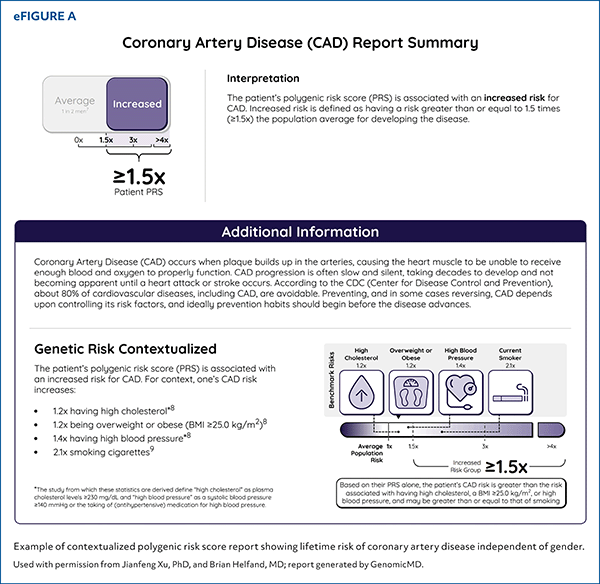
Example of contextualized polygenic risk score report showing lifetime risk of coronary artery disease independent of gender.
Used with permission from Jianfeng Xu, PhD, and Brian Helfand, MD; report generated by GenomicMD.
Because primary care physicians work on the front lines with patients from diverse backgrounds, they should prepare themselves with the knowledge and resources to discuss patient questions about direct-to-consumer genetic testing. Table 1 provides a list of useful information on polygenic risk scores and related topics. Table 2 lists helpful points to consider from the American College of Medical Genetics and Genomics that can guide testing decisions and patient education.12
TABLE 1. Informative Resources on Polygenic Risk Scores
| Topic | Information | Source | URL |
|---|---|---|---|
| Clinical guidance | Points to consider for the development, implementation, and laboratory reporting of polygenic risk scores | American College of Medical Genetics and Genomics (Table 2) | https://pubmed.ncbi.nlm.nih.gov/36920474/ |
| Glossary of terms | Approximately 250 terms explained in easy-to-understand language by leading experts | National Human Genome Research Institute | https://www.genome.gov/genetics-glossary |
| Polygenic risk scores | Description of what polygenic risk scores represent and the science behind these predictive tests | National Human Genome Research Institute | https://www.genome.gov/Health/Genomics-and-Medicine/Polygenic-risk-scores |
| Information on polygenic risk scores state of the science as it pertains to public health | Centers for Disease Control and Prevention | https://www.cdc.gov/genomics/php/about/index.html https://blogs.cdc.gov/genomics/tag/polygenic-risk-scores/ | |
| Polygenic Risk Score Knowledge Base | Permits calculation of polygenic risk scores from raw data and visualization of multiple conditions across international cohorts based on published genome-wide association studies | UK Biobank and Kauwe Laboratory at Brigham Young University | https://www.ukbiobank.ac.uk/enable-your-research/approved-research/polygenic-risk-score-knowledge-base https://prs.byu.edu/ https://pubmed.ncbi.nlm.nih.gov/36056235/ |
TABLE 2. Points to Consider for the Clinical Application of Polygenic Risk Scores
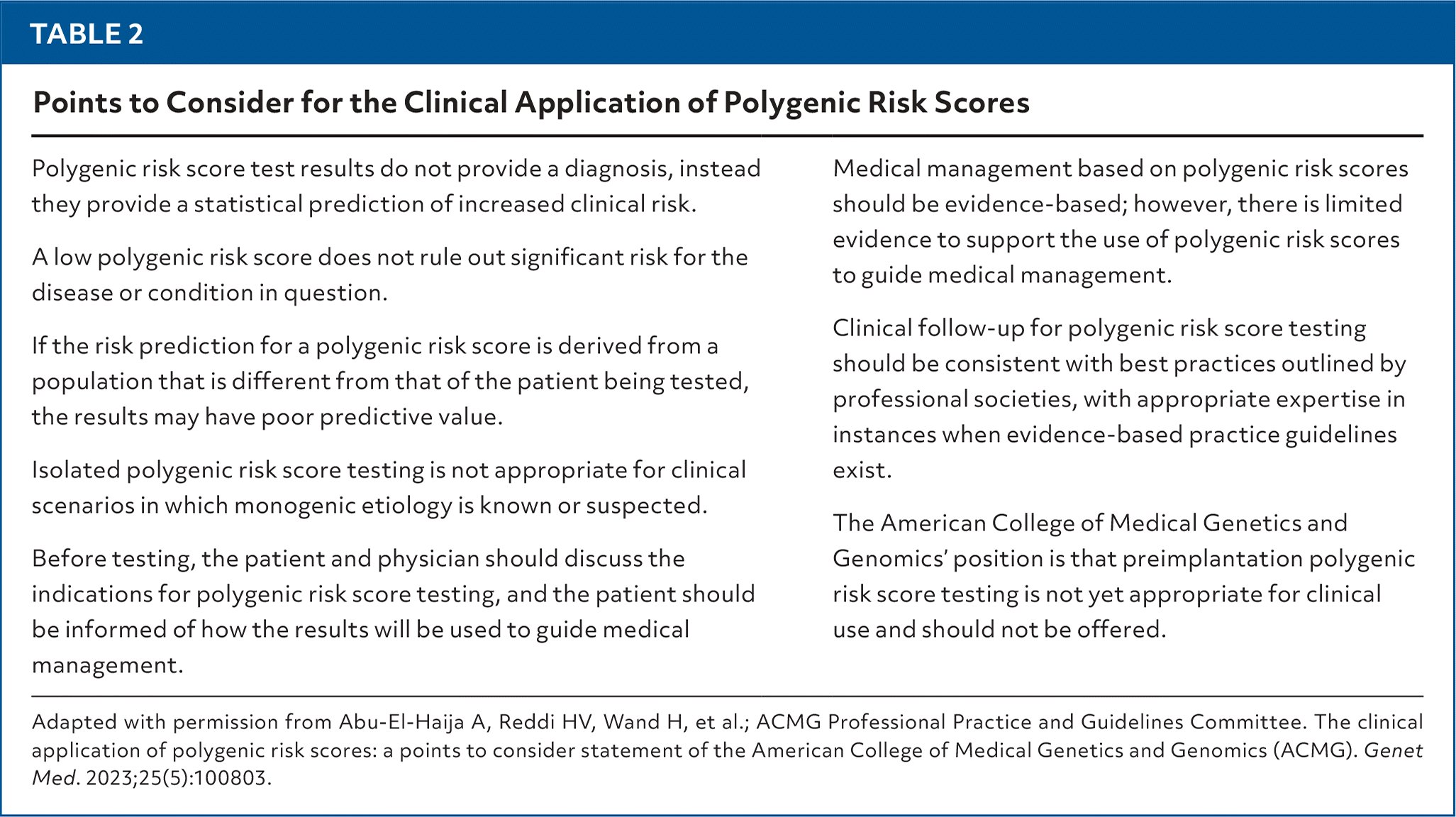
| Polygenic risk score test results do not provide a diagnosis, instead they provide a statistical prediction of increased clinical risk. A low polygenic risk score does not rule out significant risk for the disease or condition in question. If the risk prediction for a polygenic risk score is derived from a population that is different from that of the patient being tested, the results may have poor predictive value. Isolated polygenic risk score testing is not appropriate for clinical scenarios in which monogenic etiology is known or suspected. Before testing, the patient and physician should discuss the indications for polygenic risk score testing, and the patient should be informed of how the results will be used to guide medical management. |
Medical management based on polygenic risk scores should be evidence-based; however, there is limited evidence to support the use of polygenic risk scores to guide medical management. Clinical follow-up for polygenic risk score testing should be consistent with best practices outlined by professional societies, with appropriate expertise in instances when evidence-based practice guidelines exist. The American College of Medical Genetics and Genomics' position is that preimplantation polygenic risk score testing is not yet appropriate for clinical use and should not be offered. |
Adapted with permission from Abu-El-Haija A, Reddi HV, Wand H, et al.; ACMG Professional Practice and Guidelines Committee. The clinical application of polygenic risk scores: a points to consider statement of the American College of Medical Genetics and Genomics (ACMG). Genet Med. 2023;25(5):100803.
The National Academies of Sciences, Engineering, and Medicine recommends that payment decisions for genetic testing be informed by evidence of clinical utility for patients in the context of specific clinical scenarios.13 Recent systematic reviews have not identified unequivocal evidence of clinical utility for any polygenic risk scores.14,15 Therefore, patients should be informed that their health insurance is unlikely to pay for polygenic risk score testing, although this could change as the state of the science advances. It is also crucial to warn patients that a polygenic risk score suggesting an increased risk for cancer could adversely affect insurance premiums or lead to denial of long-term care or life insurance applications.
Some experts have recommended a risk stratification framework to guide polygenic risk score–informed preventive interventions justified by data showing that the top quintile of polygenic risk has the lowest number needed to treat with statins to prevent a heart attack, the fewest women needed to screen to detect an occurrence of breast cancer, and the highest positive predictive value of prostate-specific antigen testing.16
Although consultation and partnerships with clinical genetics experts are needed, primary care physicians will be increasingly called on to coordinate polygenic risk score–informed disease screening and preventive interventions. Primary care physicians can leverage trusted relationships with patients and their families to skillfully navigate them through the evolving landscape of genetic risk and its health management implications.
