Paige Moreland, MD
Brody Gaffney, MD
Jason S. Lanham, MD, MA

American Family Physician. 2025;111(5):443-450.

Author disclosure: No relevant financial relationships.

This clinical content conforms to AAFP criteria for CME.

Related Letter to the Editor: More Options to Treat Migraine

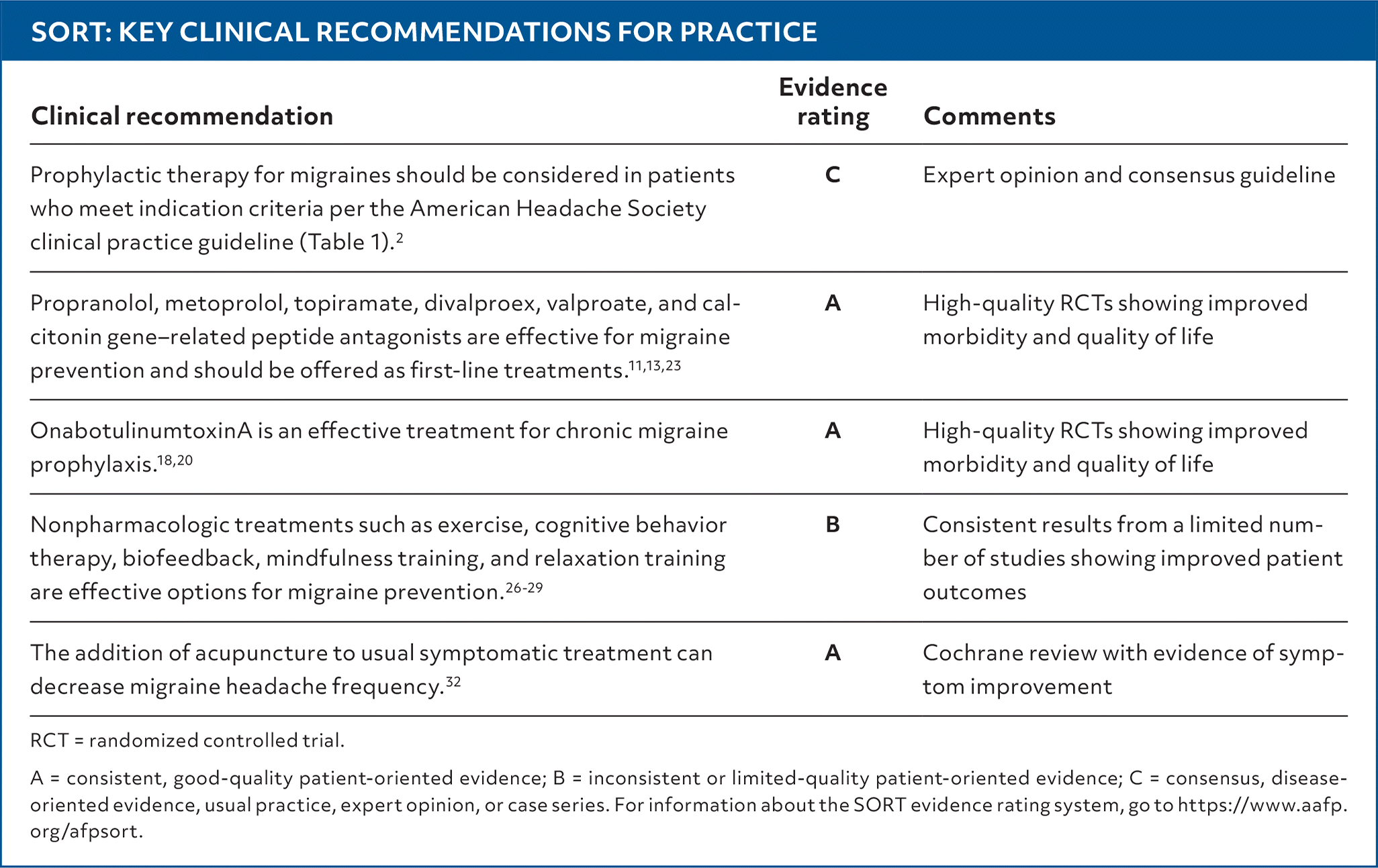
In the United States, the prevalence of migraines is 11% to 14%; prevalence of chronic migraine is 1%. Goals of migraine prophylaxis include reduction in headache severity and frequency, improved response to acute treatment, fewer days with disability, improvement in quality of life, and empowerment of patients with a sense of control over the condition. Indications for consideration of preventive therapy include frequent headaches, failure of or contraindication to acute treatments, overuse of acute treatments, and patient preference. First-line medications include propranolol, metoprolol, topiramate, divalproex, valproate, and calcitonin gene–related peptide receptor antagonists. However, use of calcitonin gene–related peptide receptor antagonists is limited by cost and insurance coverage. Amitriptyline and venlafaxine are considered second-line medications due to a greater number of adverse events and less supporting evidence, respectively. OnabotulinumtoxinA (Botox) injection is approved for chronic migraine prophylaxis. It is as effective as other medications, is well tolerated, and has lower discontinuation rates than other drugs. Common migraine triggers include alcohol, anxiety, dehydration, excessive caffeine, eye strain, hunger, sleep deprivation, and stress. Physicians should recommend identification and management of migraine triggers. Cognitive behavior therapy, acupuncture, neural stimulators, and exercise are supported by varying levels of evidence and can be used individually or in combination with pharmacotherapy. Alternative agents, including feverfew, magnesium, and melatonin, have shown effectiveness and are generally well tolerated.

PAIGE MORELAND, MD, is a staff physician in family medicine at General Leonard Wood Army Community Hospital, Fort Leonard Wood, Missouri.

BRODY GAFFNEY, MD, is a staff physician in family medicine at Blanchfield Army Community Hospital, Fort Campbell, Tennessee.

JASON S. LANHAM, MD, MA, FAAFP, is an associate professor in the Department of Family and Community Medicine at the Medical College of Georgia at Augusta University, Augusta.

Address correspondence to Paige Moreland, MD, at paige.e.moreland2.mil@health.mil.

Author disclosure: No relevant financial relationships.

  1. 1.Headache Classification Committee of the International Headache Society (IHS) The International Classification of Headache Disorders. 3rd edition. Cephalalgia. 2018;38(1):1-211.
  2. 2.Ailani J, Burch RC, Robbins MS; Board of Directors of the American Headache Society. The American Headache Society consensus statement: update on integrating new migraine treatments into clinical practice. Headache. 2021;61(7):1021-1039.
  3. 3.Thomsen AV, Ashina H, Al-Khazali HM, et al. Clinical features of migraine with aura: a REFORM study. J Headache Pain. 2024;25(1):22.
  4. 4.Lipton RB, Fanning KM, Buse DC, et al. Identifying natural subgroups of migraine based on comorbidity and concomitant condition profiles: results of the Chronic Migraine Epidemiology and Outcomes (CaMEO) study. Headache. 2018;58(7):933-947.
  5. 5.Cohen F, Brooks CV, Sun D, et al. Prevalence and burden of migraine in the United States: a systematic review. Headache. 2024;64(5):516-532. [corrected]
  6. 6.Bigal ME, Serrano D, Buse D, et al. Acute migraine medications and evolution from episodic to chronic migraine: a longitudinal population-based study. Headache. 2008;48(8):1157-1168.
  7. 7.Ha H, Gonzalez A. Migraine headache prophylaxis. Am Fam Physician. 2019;99(1):17-24.
  8. 8.Silberstein SD, Holland S, Freitag F, et al. Evidence-based guideline update: pharmacologic treatment for episodic migraine prevention in adults: report of the Quality Standards Subcommittee of the American Academy of Neurology and the American Headache Society. Neurology. 2012;78(17):1337-1345.
  9. 9.Silberstein SD. Preventive migraine treatment. Continuum (Minneap Minn). 2015;21(4 Headache):973-989.
  10. 10.Jackson JL, Kuriyama A, Kuwatsuka Y, et al. Beta-blockers for the prevention of headache in adults, a systematic review and meta-analysis. PLoS One. 2019;14(3):e0212785.
  11. 11.Sprenger T, Viana M, Tassorelli C. Current prophylactic medications for migraine and their potential mechanisms of action. Neurotherapeutics. 2018;15(2):313-323.
  12. 12.Rollo E, Romozzi M, Vollono C, et al. Antiseizure medications for the prophylaxis of migraine during the anti-CGRP drugs era. Curr Neuropharmacol. 2023;21(8):1767-1785.
  13. 13.Jackson JL, Cogbill E, Santana-Davila R, et al. A comparative effectiveness meta-analysis of drugs for the prophylaxis of migraine headache. PLoS One. 2015;10(7):e0130733.
  14. 14.Mulleners WM, McCrory DC, Linde M. Antiepileptics in migraine prophylaxis: an updated Cochrane review. Cephalalgia. 2015;35(1):51-62.
  15. 15.Lampl C, Versijpt J, Amin FM, et al. European Headache Federation (EHF) critical re-appraisal and meta-analysis of oral drugs in migraine prevention–part 1: amitriptyline. J Headache Pain. 2023;24(1):39.
  16. 16.US Department of Veterans Affairs. VA/DoD clinical practice guideline for management of headache. 2023. Accessed January 13, 2025. https://www.healthquality.va.gov/guidelines/Pain/headache/
  17. 17.Barbanti P, Ferroni P. Onabotulinum toxin A in the treatment of chronic migraine: patient selection and special considerations. J Pain Res. 2017;10:2319-2329.
  18. 18.Rothrock JF, Adams AM, Lipton RB, et al. FORWARD study: evaluating the comparative effectiveness of onabotulinumtoxinA and topiramate for headache prevention in adults with chronic migraine. Headache. 2019;59(10):1700-1713.
  19. 19.Talbet JH, Elnahry AG. OnabotulinumtoxinA for the treatment of headache: an updated review. J Integr Neurosci. 2022;21(1):37.
  20. 20.Loder E, Renthal W. Calcitonin gene–related peptide monoclonal antibody treatments for migraine. JAMA Intern Med. 2019;179(3):421-422.
  21. 21.Hwang TJ, Vokinger KN, Kesselheim AS, et al. New treatments for migraine-therapeutic ratings and comparative coverage in the US, Canada, and Europe. JAMA Intern Med. 2022;182(2):101-102.
  22. 22.Lampl C, MaassenVanDenBrink A, Deligianne CI, et al. The comparative effectiveness of migraine preventive drugs: a systematic review and network meta-analysis. J Headache Pain. 2023;24(1):56.
  23. 23.Sacco S, Amin FM, Ashina M, et al. European Headache Federation guideline on the use of monoclonal antibodies targeting the calcitonin gene related peptide pathway for migraine prevention – 2022 update. J Headache Pain. 2022;23(1):67.
  24. 24.Charles AC, Digre KB, Goadsby PJ, et al. Calcitonin gene–related peptide-targeting therapies are a first-line option for the prevention of migraine: an American Headache Society position statement update. Headache. 2024;64(4):333-341.
  25. 25.Zhang N, Robbins MS. Migraine. Ann Intern Med. 2023;176(1):ITC1-ITC16.
  26. 26.McGrath K, Rague A, Thesing C, et al. Migraine: expanding our tx arsenal. J Fam Pract. 2019;68(1):10-14.
  27. 27.Varkey E, Cider A, Carlsson J, et al. Exercise as migraine prophylaxis: a randomized study using relaxation and topiramate as controls. Cephalalgia. 2011;31(14):1428-1438.
  28. 28.Barber M, Pace A. Exercise and migraine prevention: a review of the literature. Curr Pain Headache Rep. 2020;24(8):39.
  29. 29.Wells RE, Beuthin J, Granetzke L, et al. Complementary and integrative medicine for episodic migraine: an update of evidence from the last 3 years. Curr Pain Headache Rep. 2019;23(2):10.
  30. 30.Sharpe L, Dudeney J, Williams ACC, et al. Psychological therapies for the prevention of migraine in adults. Cochrane Database Syst Rev. 2019;7(7):CD012295.
  31. 31.Linde K, Allais G, Brinkhaus B, et al. Acupuncture for the prevention of episodic migraine. Cochrane Database Syst Rev. 2016;2016(6):CD001218.
  32. 32.Moisset X, Pereira B, Ciampi de Andrade D, et al. Neuromodulation techniques for acute and preventive migraine treatment: a systematic review and meta-analysis of randomized controlled trials. J Headache Pain. 2020;21(1):142.
  33. 33.Zavarize P, Ngonga G, Pezzini A, et al. Combination of tanacethum partenium, 5-hydrossitriptophan (5-Http) and magnesium in the prophylaxis of episodic migraine without aura (AURASTOP) an observational study. Int J Neuro Brain Dis. 2017;4(3):1-4.
  34. 34.Volta GD, Zavarise P, Perego L, et al. Comparison of the effect of tanacethum parthenium, 5-hydroxy tryptophan, and magnesium (Aurastop) versus magnesium alone on aura phenomenon and its evolution. Pain Res Manag. 2019;2019:6320163.
  35. 35.Blaze J. A comparison of current regulatory frameworks for nutraceuticals in Australia, Canada, Japan, and the United States. Innov Pharm. 2021;12(2) ): 10.24926/iip.v12i2.3694.
  36. 36.Jarvis S, Dassan P, Piercy CN. Managing migraine in pregnancy. BMJ. 2018;360:k80.
  37. 37.Burch R. Epidemiology and treatment of menstrual migraine and migraine during pregnancy and lactation: a narrative review. Headache. 2020;60(1):200-216.
  38. 38.Headaches in pregnancy and postpartum. ACOG Clinical Practice Guideline No. 3. Obstet Gynecol. 2022;139(5):944-972.
  39. 39.Pavlović JM. Headache in women. Continuum (Minneap Minn). 2021;27(3):686-702.
  40. 40.Hovaguimian A, Roth J. Management of chronic migraine. BMJ. 2022;379:e067670.
  41. 41.Vig SJ, Garza J, Tao Y, et al. The use of erenumab for migraine prophylaxis during pregnancy: a case report and narrative review. Headache. 2022;62(10):1256-1263.
  42. 42.Wong H, Khalil M, Ahmed F, et al. OnabotulinumtoxinA for chronic migraine during pregnancy: a real world experience on 45 patients. J Headache Pain. 2020;21(1):129.
  43. 43.Halker Singh RB, Ailani J, Robbins MS. Neuromodulation for the acute and preventive therapy of migraine and cluster headache. Headache. 2019;59(suppl 2):33-49.
  44. 44.Faubion SS, et al. Migraine throughout the female reproductive life cycle. Mayo Clin Proc. 2018;93(5):639-645.
  45. 45.Nguyen AT, Curtis KM, Tepper NK, et al. US medical eligibility criteria for contraceptive use, 2024. MMWR Recomm Rep. 2024;73(4):1-126.
  46. 46.World Health Organization. Medical Eligibility Criteria for Contraceptive Use. 5th ed. Geneva: World Health Organization; 2015.
  47. 47.Oskoui M, Pringsheim T, Billinghurst L, et al. Practice guideline update summary: pharmacologic treatment for pediatric migraine prevention: report of the Guideline Development, Dissemination, and Implementation Subcommittee of the American Academy of Neurology and the American Headache Society. Neurology. 2019;93(11):500-509.
  48. 48.Modi S, Lowder DM. Medications for migraine prophylaxis. Am Fam Physician. 2006;73(1):72-78.

Copyright © 2026 by the American Academy of Family Physicians.

This content is owned by the AAFP. A person viewing it online may make one printout of the material and may use that printout only for his or her personal, non-commercial reference. This material may not otherwise be downloaded, copied, printed, stored, transmitted or reproduced in any medium, whether now known or later invented, except as authorized in writing by the AAFP. See permissions for copyright questions and/or permission requests.