Trigeminal Neuralgia: Rapid Evidence Review

Octavia Amaechi, MD

American Family Physician. 2025;111(5):427-432.

Author disclosure: No relevant financial relationships.

This clinical content conforms to AAFP criteria for CME.

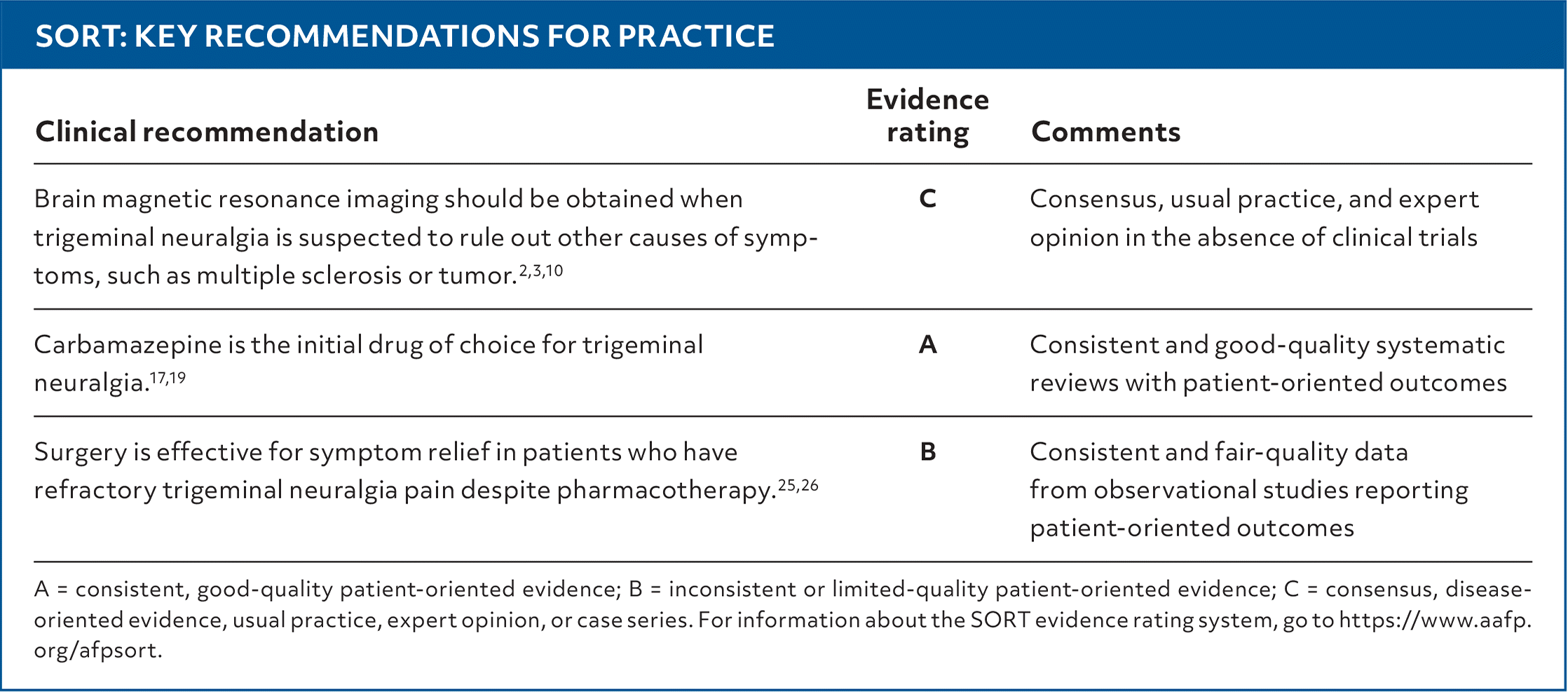
Trigeminal neuralgia (TN) is a chronic neuropathic pain condition that causes sudden, brief episodes of electric shock–like, lancinating pain in one or more trigeminal nerve distributions. Facial spasms may occur during intense flare-ups. Trigger zones are small areas where minimal stimulation may precipitate a painful flare-up. Painful episodes of TN are often precipitated by seemingly benign stimuli, such as talking, chewing, light touch, or even a breeze across a trigger zone. Nerve root contact, compression, and subsequent demyelination are implicated as the central underlying pathophysiology. The average age of onset is 50 to 60 years, and incidence increases with age. Diagnosis is based on International Headache Society clinical criteria distinguishing classic, secondary, and idiopathic TN. Classic TN is caused by direct neurovascular compromise due to anatomic compression. Secondary TN is caused by another condition such as multiple sclerosis or a tumor. Idiopathic TN has no identifiable etiology. Examination findings typically are normal between painful episodes. Brain magnetic resonance imaging with and without contrast media is recommended for all patients with suspected TN to rule out key differential diagnoses, such as a tumor, and to determine surgical candidacy. The International Headache Society guidelines encourage tailored treatment based on TN type and etiology. Carbamazepine is the initial drug of choice, and 75% of patients with TN achieve initial symptom control with pharmacotherapy. Refractory TN or intolerable adverse drug effects should prompt a trial of adjunctive drugs and referral for surgical evaluation. Microvascular decompression is more effective in improving or alleviating symptoms of TN than other surgical options.

OCTAVIA AMAECHI, MD, FAAFP, is an associate professor at the Spartanburg Regional Family Medicine Residency Program, and an assistant professor in the Department of Family Medicine at the Medical University of South Carolina, Charleston, a part of the Area Health Education Consortium.

Address correspondence to Octavia Amaechi, MD, FAAFP, at octavia.amaechi@gmail.com.

Author disclosure: No relevant financial relationships.

  1. 1.Headache Classification Committee of the International Headache Society (IHS). The International Classification of Headache Disorders, 3rd edition. Cephalalgia. 2018;38(1):1-211.
  2. 2.De Toledo IP, Conti Réus J, Fernandes M, et al. Prevalence of trigeminal neuralgia: a systematic review. J Am Dent Assoc. 2016;147(7):570-576.e2.
  3. 3.Katusic S, Beard CM, Bergstralh E, et al. Incidence and clinical features of trigeminal neuralgia, Rochester, Minnesota, 1945–1984. Ann Neurol. 1990;27(1):89-95.
  4. 4.Maarbjerg S, Gozalov A, Olesen J, et al. Trigeminal neuralgia—a prospective systematic study of clinical characteristics in 158 patients. Headache. 2014;54(10):1574-1582.
  5. 5.Mousavi SH, Lindsey JW, Westlund KN, et al. Trigeminal neuralgia as a primary demyelinating disease: potential multimodal evidence and remaining controversies. J Pain. 2024;25(2):302-311.
  6. 6.Bendtsen L, Zakrzewska JM, Abbott J, et al. European Academy of Neurology guideline on trigeminal neuralgia. Eur J Neurol. 2019;26:831-839.
  7. 7.Krafft RM. Trigeminal neuralgia. Am Fam Physician. 2008;77(9):1291-1296.
  8. 8.Love S, Coakham HB. Trigeminal neuralgia: pathology and pathogenesis. Brain. 2001;124(pt 12):2347-2360.
  9. 9.Li S, Liao C, Qian M, et al. Narrow ovale foramina may be involved in the development of primary trigeminal neuralgia. Front Neurol. 2022;13:1013216.
  10. 10.Li S, Liao C, Yang X, et al. Association of concomitant continuous pain in trigeminal neuralgia with a narrow foramen ovale. Front Neurol. 2023;14:1277654.
  11. 11.Liu P, Zhong W, Liao C, et al. Narrow foramen ovale and rotundum: a role in the etiology of trigeminal neuralgia. J Craniofac Surg. 2016;27(8):2168-2170.
  12. 12.von Eckardstein KL, Keil M, Rohde V. Unnecessary dental procedures as a consequence of trigeminal neuralgia. Neurosurg Rev. 2015;38(2):355-360 , discussion 360.
  13. 13.Siqueira SR, Teixeira MJ, Siqueira JT. Clinical characteristics of patients with trigeminal neuralgia referred to neurosurgery. Eur J Dent. 2009;3(3):207-212.
  14. 14.Cai J, Xin ZX, Zhang YQ, et al. Diagnostic value of 3D time-of-flight MRA in trigeminal neuralgia. J Clin Neurosci. 2015;22(8):1343-1348.
  15. 15.Haanpää M, Attal N, Backonja M, et al. NeuPSIG guidelines on neuropathic pain assessment. Pain. 2011;152(1):14-27.
  16. 16.Cruccu G, Biasiotta A, Galeotti F, et al. Diagnostic accuracy of trigeminal reflex testing in trigeminal neuralgia. Neurology. 2006;66(1):139-141.
  17. 17.Zakrzewska JM, Linskey ME. Trigeminal neuralgia. BMJ Clin Evid. 2014;2014:1207.
  18. 18.Melek LN, Devine M, Renton T. The psychosocial impact of orofacial pain in trigeminal neuralgia patients: a systematic review. Int J Oral Maxillofac Surg. 2018;47(7):869-878.
  19. 19.Zhao X, Ge S. The efficacy and safety of gabapentin vs. carbamazepine in patients with primary trigeminal neuralgia: a systematic review and meta-analysis. Front Neurol. 2023;14:1045640.
  20. 20.Rana MH, Khan AAG, Khalid I, et al. Therapeutic approach for trigeminal neuralgia: a systematic review. Biomedicines. 2023;11(10):2606.
  21. 21.Wiffen PJ, Derry S, Moore RA, et al. Carbamazepine for chronic neuropathic pain and fibromyalgia in adults. Cochrane Database Syst Rev. 2014(4):CD005451.
  22. 22.Zhou M, Chen N, He L, et al. Oxcarbazepine for neuropathic pain. Cochrane Database Syst Rev. 2017(12):CD007963.
  23. 23.Peterson-Houle GM, AbdelFattah MR, Padilla M, et al. Efficacy of medications in adult patients with trigeminal neuralgia compared to placebo intervention: a systematic review with meta-analyses. J Dent Anesth Pain Med. 2021;21(5):379-396.
  24. 24.Rubis A, Juodzbalys G. The use of botulinum toxin A in the management of trigeminal neuralgia: a systematic literature review. J Oral Maxillofac Res. 2020;11(2):e2.
  25. 25.Mendoza N, Illingworth RD. Trigeminal neuralgia treated by microvascular decompression: a long-term follow-up study. Br J Neurosurg. 1995;9(1):13-19.
  26. 26.Di Carlo DT, Benedetto N, Perrini P. Clinical outcome after microvascular decompression for trigeminal neuralgia: a systematic review and meta-analysis. Neurosurg Rev. 2022;46(1):8.
  27. 27.Liu J, Wu G, Xiang H, et al. Long-term retrospective analysis of microvascular decompression in patients with recurrent trigeminal neuralgia. Front Neurol. 2020;11:584224.
  28. 28.Holste K, Chan AY, Rolston JD, et al. Pain outcomes following microvascular decompression for drug-resistant trigeminal neuralgia: a systematic review and meta-analysis. Neurosurgery. 2020;86(2):182-190.
  29. 29.Sarica C, Iorio-Morin C, Aguirre-Padilla DH, et al. Clinical outcomes and complications of peripheral nerve field stimulation in the management of refractory trigeminal pain: a systematic review and meta-analysis. J Neurosurg. 2022;137(5):1387-1395.
  30. 30.Tuleasca C, Régis J, Sahgal A, et al. Stereotactic radiosurgery for trigeminal neuralgia: a systematic review. J Neurosurg. 2019;130(3):733-757.
  31. 31.Motwani M, Fadnavis A, Dhole A. Efficacy of transcutaneous electrical nerve stimulation (TENS) in the management of trigeminal neuralgia: a systematic review and meta-analysis. J Clin Exp Dent. 2023;15(6):e505-e510.
  32. 32.Hwang JH, Ku J. Herbal medicine for the management of idiopathic trigeminal neuralgia: a protocol for a systematic review of controlled trials. Medicine (Baltimore). 2020;99(25):e20779.
  33. 33.Marbach JJ, Lund P. Depression, anhedonia and anxiety in temporomandibular joint and other facial pain syndromes. Pain. 1981;11(1):73-84.
  34. 34.Houshi S, Tavallaei MJ, Barzegar M, et al. Prevalence of trigeminal neuralgia in multiple sclerosis: a systematic review and meta-analysis. Mult Scler Relat Disord. 2022;57:103472.

Copyright © 2026 by the American Academy of Family Physicians.

This content is owned by the AAFP. A person viewing it online may make one printout of the material and may use that printout only for his or her personal, non-commercial reference. This material may not otherwise be downloaded, copied, printed, stored, transmitted or reproduced in any medium, whether now known or later invented, except as authorized in writing by the AAFP. See permissions for copyright questions and/or permission requests.