Venous Thromboembolism: Diagnosis and Treatment

Munima Nasir, MD
Shannon Brumbaugh, MD
Kevin Wile, MD

American Family Physician. 2025;112(4):424-434.

Author disclosure: No relevant financial relationships.

This clinical content conforms to AAFP criteria for CME.

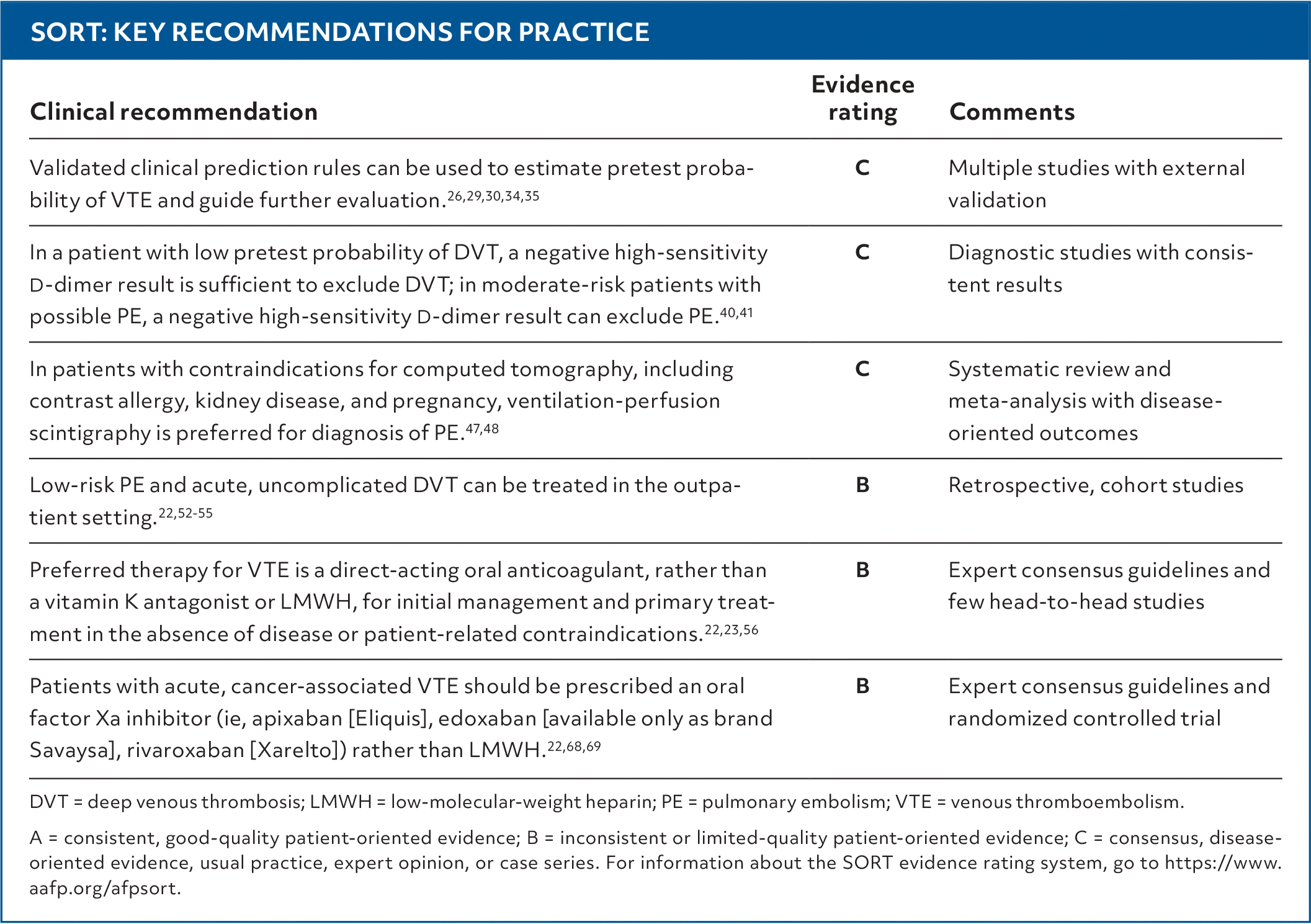
Venous thromboembolism (VTE) presents as deep venous thrombosis (DVT) or pulmonary embolism (PE). VTE is the third most common fatal cardiovascular condition in the United States. Clinical prediction rules such as the Wells' Criteria for DVT, Wells' Criteria for PE, and Pulmonary Embolism Rule-Out Criteria should be used to determine the pretest probability of DVT or PE. The D-dimer assay is used in low-risk patients to rule out DVT and in moderate-risk patients to rule out PE. Compression ultrasonography is the preferred imaging modality to diagnose DVT. PE typically is diagnosed with computed tomographic pulmonary angiography or with ventilation-perfusion scintigraphy if the patient has contraindications to computed tomographic pulmonary angiography. Preferred outpatient therapy for VTE is a direct-acting oral anticoagulant rather than a vitamin K antagonist or low-molecular-weight heparin. Most patients with acute uncomplicated DVT can be treated as outpatients. The Simplified PE Severity Index can guide treatment decisions for patients with PE. Apixaban or rivaroxaban can be used for initial management without the need to bridge with parenteral therapy. Treatment is recommended for 3 to 6 months after initial VTE. Patients with chronic risk factors, a recurrent VTE after primary treatment, or a first unprovoked VTE should be considered for secondary prevention with a direct-acting oral anticoagulant or warfarin after a bleeding-risk assessment.

MUNIMA NASIR, MD, FAAFP, is a professor in the Department of Family and Community Medicine at Penn State Health, Penn State College of Medicine, Hershey, Pennsylvania.

SHANNON BRUMBAUGH, MD, is an assistant professor in the Department of Family and Community Medicine at Penn State Health, Penn State College of Medicine, Hershey.

KEVIN WILE, MD, is an assistant professor in the Department of Family and Community Medicine at Penn State Health, Penn State College of Medicine, Hershey.

Address correspondence to Munima Nasir, MD, FAAFP, at mnasir@pennstatehealth.psu.edu.

Author disclosure: No relevant financial relationships.

  1. 1.Giordano NJ, Jansson PS, Young MN, et al. Epidemiology, pathophysiology, stratification, and natural history of pulmonary embolism. Tech Vasc Interv Radiol. 2017;20(3):135-140.
  2. 2.Goldhaber SZ. Venous thromboembolism: epidemiology and magnitude of the problem. Best Pract Res Clin Haematol. 2012;25(3):235-242.
  3. 3.Raskob GE, Angchaisuksiri P, Blanco AN, et al.; ISTH Steering Committee for World Thrombosis Day. Thrombosis: a major contributor to global disease burden. Arterioscler Thromb Vasc Biol. 2014;34(11):2363-2371.
  4. 4.Tagalakis V, Patenaude V, Kahn SR, et al. Incidence of and mortality from venous thromboembolism in a real-world population: the Q-VTE study cohort. Am J Med. 2013;126(9):832.e13-832.e21.
  5. 5.Nielsen JD. The incidence of pulmonary embolism during deep vein thrombosis. Phlebology. 2013;28(suppl1):29-33.
  6. 6.Centers for Disease Control and Prevention. Data and statistics on venous thromboembolism. Venous thromboembolism (blood clots). January 27, 2025. Accessed August 13, 2025.
  7. 7.Wilbur J, Shian B. Deep venous thrombosis and pulmonary embolism: current therapy. Am Fam Physician. 2017;95(5):295-302.
  8. 8.Goldhaber SZ, Bounameaux H. Pulmonary embolism and deep vein thrombosis. Lancet. 2012;379(9828):1835-1846.
  9. 9.Stein PD, Matta F, Musani MH, et al. Silent pulmonary embolism in patients with deep venous thrombosis: a systematic review. Am J Med. 2010;123(5):426-431.
  10. 10.Hirmerova J, Seidlerova J, Chudacek Z. The prevalence of concomitant deep vein thrombosis, symptomatic or asymptomatic, proximal or distal, in patients with symptomatic pulmonary embolism. Clin Appl Thromb Hemost. 2018;24(8):1352-1357.
  11. 11.Moyer E, Bernard K, Gottlieb M. Epidemiology of deep venous thrombosis in US emergency departments during an 8-year period. Clin Exp Emerg Med. 2025;12(2):132-138.
  12. 12.Brækkan SK, Hansen JB. VTE epidemiology and challenges for VTE prevention at the population level. Thromb Update. 2023;10:100132.
  13. 13.Zafar Y, Iqbal AZ, Zafar A, et al. Trends in pulmonary embolism-related mortality in adults in the United States, 1999–2020. Chest. 2023;164(4):A5973.
  14. 14.Gottlieb M, Moyer E, Bernard K. Epidemiology of pulmonary embolism diagnosis and management among United States emergency departments over an eight-year period. Am J Emerg Med. 2024;85:158-162.
  15. 15.Carrier M, Righini M, Wells PS, et al. Subsegmental pulmonary embolism diagnosed by computed tomography: incidence and clinical implications. A systematic review and meta-analysis of the management outcome studies. J Thromb Haemost. 2010;8(8):1716-1722.
  16. 16.Bikdeli B, Wang Y, Jimenez D, et al. Pulmonary embolism hospitalization, readmission, and mortality rates in US older adults, 1999–2015. JAMA. 2019;322(6):574-576.
  17. 17.Mahan CE, Borrego ME, Woersching AL, et al. Venous thromboembolism: annualised United States models for total, hospital-acquired and preventable costs utilising long-term attack rates. Thromb Haemost. 2012;108(2):291-302.
  18. 18.Previtali E, Bucciarelli P, Passamonti SM, et al. Risk factors for venous and arterial thrombosis. Blood Transfus. 2011;9(2):120-138.
  19. 19.Farmer-Boatwright MK, Roubey RAS. Venous thrombosis in the antiphospholipid syndrome. Arterioscler Thromb Vasc Biol. 2009;29(3):321-325.
  20. 20.Ramzi DW, Leeper KV. DVT and pulmonary embolism: part I. Diagnosis. Am Fam Physician. 2004;69(12):2829-2836.
  21. 21.Anderson FA, Spencer FA. Risk factors for venous thromboembolism. Circulation. 2003;107(23 suppl 1):I9-I16.
  22. 22.Stevens SM, Woller SC, Kreuziger LB, et al. Antithrombotic therapy for VTE disease: second update of the CHEST guideline and expert panel report. Chest. 2021;160(6):e545-e608.
  23. 23.Ortel TL, Neumann I, Ageno W, et al. American Society of Hematology 2020 guidelines for management of venous thromboembolism: treatment of deep vein thrombosis and pulmonary embolism. Blood Adv. 2020;4(19):4693-4738.
  24. 24.American Academy of Family Physicians. AAFP endorses guidelines on venous thromboembolism Dx. April 24, 2019. Accessed August 13, 2025.
  25. 25.Fürbringer-Schwarz A, Janscak M, Jeanneret-Gris CR. Outcome after bilateral deep vein thrombosis. Vasa. 2022;51(6):372-376.
  26. 26.Oudega R, Moons KGM, Hoes AW. Ruling out deep venous thrombosis in primary care. A simple diagnostic algorithm including d-dimer testing. Thromb Haemost. 2005;94(1):200-205.
  27. 27.Tritschler T, Kraaijpoel N, Le Gal G, et al. Venous thromboembolism: advances in diagnosis and treatment. JAMA. 2018;320(15):1583-1594.
  28. 28.Toll DB, Oudega R, Vergouwe Y, et al. A new diagnostic rule for deep vein thrombosis: safety and efficiency in clinically relevant subgroups. Fam Pract. 2008;25(1):3-8.
  29. 29.Wells PS, Anderson DR, Rodger M, et al. Excluding pulmonary embolism at the bedside without diagnostic imaging: management of patients with suspected pulmonary embolism presenting to the emergency department by using a simple clinical model and D-dimer. Ann Intern Med. 2001;135(2):98-107.
  30. 30.Le Gal G, Righini M, Roy PM, et al. Prediction of pulmonary embolism in the emergency department: the revised Geneva score. Ann Intern Med. 2006;144(3):165-171.
  31. 31.Freund Y, Cohen-Aubart F, Bloom B. Acute pulmonary embolism: a review. JAMA. 2022;328(13):1336-1345.
  32. 32.Kahn SR, de Wit K. Pulmonary embolism. N Engl J Med. 2022;387(1):45-57.
  33. 33.Raja AS, Greenberg JO, Qaseem A, et al. Evaluation of patients with suspected acute pulmonary embolism: best practice advice from the Clinical Guidelines Committee of the American College of Physicians. Ann Intern Med. 2015;163(9):701-711.
  34. 34.Wells PS, Anderson DR, Bormanis J, et al. Value of assessment of pretest probability of deep-vein thrombosis in clinical management. Lancet. 1997;350(9094):1795-1798.
  35. 35.Penaloza A, Verschuren F, Meyer G, et al. Comparison of the unstructured clinician gestalt, the Wells score, and the revised Geneva score to estimate pretest probability for suspected pulmonary embolism. Ann Emerg Med. 2013;62(2):117-124.
  36. 36.Kline JA, Mitchell AM, Kabrhel C, et al. Clinical criteria to prevent unnecessary diagnostic testing in emergency department patients with suspected pulmonary embolism. J Thromb Haemost. 2004;2(8):1247-1255.
  37. 37.Hendriksen JMT, Geersing GJ, Lucassen WAM, et al. Diagnostic prediction models for suspected pulmonary embolism: systematic review and independent external validation in primary care. BMJ. 2015;351:h4438.
  38. 38.Douma RA, Mos IC, Erkens PM, et al.; Prometheus Study Group. Performance of 4 clinical decision rules in the diagnostic management of acute pulmonary embolism: a prospective cohort study. Ann Intern Med. 2011;154(11):709-718.
  39. 39.Freund Y, Cachanado M, Aubry A, et al.; PROPER Investigator Group. Effect of the Pulmonary Embolism Rule-Out Criteria on subsequent thromboembolic events among low-risk emergency department patients: the PROPER randomized clinical trial. JAMA. 2018;319(6):559-566.
  40. 40.Stein PD, Hull RD, Patel KC, et al. D-dimer for the exclusion of acute venous thrombosis and pulmonary embolism: a systematic review. Ann Intern Med. 2004;140(8):589-602.
  41. 41.Wells PS, Anderson DR, Rodger M, et al. Evaluation of D-dimer in the diagnosis of suspected deep-vein thrombosis. N Engl J Med. 2003;349(13):1227-1235.
  42. 42.Righini M, Van Es J, Den Exter PL, et al. Age-adjusted D-dimer cutoff levels to rule out pulmonary embolism: the ADJUST-PE study. JAMA. 2014;311(11):1117-1124.
  43. 43.Schouten HJ, Geersing GJ, Koek HL, et al. Diagnostic accuracy of conventional or age adjusted D-dimer cut-off values in older patients with suspected venous thromboembolism: systematic review and meta-analysis. BMJ. 2013;346(7910):f2492.
  44. 44.Kraaijpoel N, Carrier M, Le Gal G, et al. Diagnostic accuracy of three ultrasonography strategies for deep vein thrombosis of the lower extremity: a systematic review and meta-analysis. PLoS One. 2020;15(2):e0228788.
  45. 45.Abdalla G, Fawzi Matuk R, Venugopal V, et al. The diagnostic accuracy of magnetic resonance venography in the detection of deep venous thrombosis: a systematic review and meta-analysis. Clin Radiol. 2015;70(8):858-871.
  46. 46.Patel P, Patel P, Bhatt M, et al. Systematic review and meta-analysis of test accuracy for the diagnosis of suspected pulmonary embolism. Blood Adv. 2020;4(18):4296-4311.
  47. 47.Squizzato A, Pomero F, Allione A, et al. Diagnostic accuracy of magnetic resonance imaging in patients with suspected pulmonary embolism: a bivariate meta-analysis. Thromb Res. 2017;154:64-72.
  48. 48.Phillips JJ, Straiton J, Staff RT. Planar and SPECT ventilation/perfusion imaging and computed tomography for the diagnosis of pulmonary embolism: a systematic review and meta-analysis of the literature, and cost and dose comparison. Eur J Radiol. 2015;84(7):1392-1400.
  49. 49.Khan F, Vaillancourt C, Bourjeily G. Diagnosis and management of deep vein thrombosis in pregnancy. BMJ. 2017;357:j2344.
  50. 50.van der Pol LM, Tromeur C, Bistervels IM, et al.; Artemis Study Investigators. Pregnancy-adapted YEARS algorithm for diagnosis of suspected pulmonary embolism. N Engl J Med. 2019;380(12):1139-1149.
  51. 51.American College of Obstetricians and Gynecologists’ Committee on Practice Bulletins—Obstetrics. ACOG Practice Bulletin No. 196: thromboembolism in pregnancy. Obstet Gynecol. 2018;132(1):e1-e17.
  52. 52.Stevens SM, Woller SC, Baumann Kreuziger L, et al. Executive summary: antithrombotic therapy for VTE disease: second update of the CHEST guideline and expert panel report. Chest. 2021;160(6):2247-2259.
  53. 53.Righini M, Roy PM, Meyer G, et al. The Simplified Pulmonary Embolism Severity Index (PESI): validation of a clinical prognostic model for pulmonary embolism. J Thromb Haemost. 2011;9(10):2115-2117.
  54. 54.Vinson DR, Hofmann ER, Johnson EJ, et al.; PEPC Investigators of the KP CREST Network. Management and outcomes of adults diagnosed with acute pulmonary embolism in primary care: community-based retrospective cohort study. J Gen Intern Med. 2022;37(14):3620-3629.
  55. 55.Lozano F, Trujillo-Santos J, Barrón M, et al.; RIETE Investigators. Home versus in-hospital treatment of outpatients with acute deep venous thrombosis of the lower limbs. J Vasc Surg. 2014;59(5):1362.e1-1367.e1.
  56. 56.van Es N, Coppens M, Schulman S, et al. Direct oral anticoagulants compared with vitamin K antagonists for acute venous thromboembolism: evidence from phase 3 trials. Blood. 2014;124(12):1968-1975.
  57. 57.Lexicomp. Accessed January 11, 2025.
  58. 58.Agnelli G, Buller HR, Cohen A, et al.; Amplify Investigators. Oral apixaban for the treatment of acute venous thromboembolism. N Engl J Med. 2013;369(9):799-808.
  59. 59.Cohen AT, Bauersachs R. Rivaroxaban and the EINSTEIN clinical trial programme. Blood Coagul Fibrinolysis. 2019;30(3):85-95.
  60. 60.Schulman S, Kakkar AK, Goldhaber SZ, et al.; RE-COVER II Trial Investigators. Treatment of acute venous thromboembolism with dabigatran or warfarin and pooled analysis. Circulation. 2014;129(7):764-772.
  61. 61.Büller HR, Décousus H, Grosso MA, et al.; Hokusai-VTE Investigators. Edoxaban versus warfarin for the treatment of symptomatic venous thromboembolism. N Engl J Med. 2013;369(15):1406-1415.
  62. 62.Avgerinos ED, Black S, van Rijn MJ, et al. The role and principles of stenting in acute iliofemoral venous thrombosis. J Vasc Surg Venous Lymphat Disord. 2024;12(5):101868.
  63. 63.Flumignan CD, Nakano LC, Baptista-Silva JC, et al. Antiplatelet agents for the treatment of deep venous thrombosis. Cochrane Database Syst Rev. 2022(7):CD012369.
  64. 64.Reedy-Cooper A, Perez J. Antiplatelet agents for the treatment of deep venous thrombosis [Cochrane for Clinicians]. Am Fam Physician. 2023;107(3):231-232.
  65. 65.Jasionowska S, Turner BRH, Machin M, et al. Systematic review of exercise therapy in the management of post-thrombotic syndrome. Phlebology. 2022;37(10):695-700.
  66. 66.Kahn SR, Shapiro S, Ducruet T, et al. Graduated compression stockings to treat acute leg pain associated with proximal DVT. A randomised controlled trial. Thromb Haemost. 2014;112(6):1137-1141.
  67. 67.Martin KA, Beyer-Westendorf J, Davidson BL, et al. Use of direct oral anticoagulants in patients with obesity for treatment and prevention of venous thromboembolism: updated communication from the ISTH SSC Subcommittee on Control of Anticoagulation. J Thromb Haemost. 2021;19(8):1874-1882.
  68. 68.Lyman GH, Carrier M, Ay C, et al. American Society of Hematology 2021 guidelines for management of venous thromboembolism: prevention and treatment in patients with cancer. Blood Adv. 2021;5(4):927-974.
  69. 69.Schrag D, Uno H, Rosovsky R, et al.; CANVAS Investigators. Direct oral anticoagulants vs low-molecular-weight heparin and recurrent VTE in patients with cancer: a randomized clinical trial. JAMA. 2023;329(22):1924-1933.
  70. 70.Kearon C, Akl EA, Comerota AJ, et al. Antithrombotic therapy for VTE disease: Antithrombotic Therapy and Prevention of Thrombosis, 9th ed: American College of Chest Physicians Evidence-Based Clinical Practice Guidelines. Chest. 2012;141(2 suppl):e419S-e496S.
  71. 71.Mount HR, Rich M, Putnam MS. Recurrent venous thromboembolism. Am Fam Physician. 2022;105(4):377-385.
  72. 72.Middeldorp S, Nieuwlaat R, Baumann Kreuziger L, et al. American Society of Hematology 2023 guidelines for management of venous thromboembolism: thrombophilia testing. Blood Adv. 2023;7(22):7101-7138.
  73. 73.Wilbur J, Shian B. Diagnosis of deep venous thrombosis and pulmonary embolism. Am Fam Physician. 2012;86(10):913-919.
  74. 74.Ramzi DW, Leeper KV. DVT and pulmonary embolism: part II. Treatment and prevention. Am Fam Physician. 2004;69(12):2841-2848.

Copyright © 2026 by the American Academy of Family Physicians.

This content is owned by the AAFP. A person viewing it online may make one printout of the material and may use that printout only for his or her personal, non-commercial reference. This material may not otherwise be downloaded, copied, printed, stored, transmitted or reproduced in any medium, whether now known or later invented, except as authorized in writing by the AAFP. See permissions for copyright questions and/or permission requests.