
Understanding the gender pay gap in medicine

Learn strategies and get supporting data to effectively identify and reduce the gender pay gap in your organization.
Is there a gender pay gap in medicine?
Women physicians are consistently paid less than men across specialties, including in primary care. This gap starts early in women physicians' careers and the effect compounds over decades.
What research shows
Multiple studies show that women physicians improve quality of care, build stronger doctor-patient relationships and bring other benefits. (See articles in Medical Care, New England Journal of Medicine and the Journal of General Internal Medicine.)
The wage gap persists even when researchers consider variables like productivity, demographics and specialty.
Over 30 years, women in family medicine will earn $1.84 million less than men.
Women working full-time earn just 84.6% of the compensation their male peers earn, according to 2024 data from the AAFP Career Benchmark Dashboard.
Female physicians work fewer hours, but earn less per hour.
Women are more represented in lower-paying physician positions and settings. Even within the same setting, though, they still earn less than men.
There are significant income disparities by both race and gender.
Blended compensation models that better recognize time-intensive, relationship-centered care can narrow gender wage gaps.
AAFP Career Benchmark Dashboard data can be filtered to show how wide the pay gap is in dozens of family medicine-specific settings. Members can access different chart views showing the gender pay gap more fully across experience levels and practice settings.
Gender pay gap in family medicine by practice setting
Women's compensation as a percentage of men's, across specialties and practice settings.
Based on 2024 data from the AAFP Career Benchmark Dashboard. (PC = primary care; FQHC = federally qualified health center)
Gender pay gap myths
Compensation is dynamic and affected by many factors, such as hours worked, years in practice, professional role, geographic area and practice setting. Common theories that try to explain the gender pay gap point to women working fewer hours, having fewer years in practice or choosing to work in lower-paying settings.
Data show that while these factors play some part in the wage gap, they don’t account for the full discrepancy. Studies find a persistent wage gap even when controlling for hours worked, practice type or setting, geography, experience and degree type.
The amount of the pay gap between men and women that can’t be explained by any factor other than gender.
What’s driving the gender pay gap in medicine?
Major drivers of the wage gap in medicine are:
Bias
Volume-based, fee-for-service physician payment structures
Lack of leadership opportunities and organizational support
The long-term impact of lower pay early in a career
Factors that are commonly cited, like fewer hours worked or choice of practice setting, have not been able to fully explain the gender pay gap.
How compensation models can influence pay equity
Fee-for-service drives modern physician compensation models, rewarding volume and emphasizing visit counts and relative value units. Women physicians are less likely to benefit from this system than men because they tend to spend more time with each patient, provide services with lower reimbursement rates, and have slightly more complex patient visits.
Payment models based on the number of patients cared for instead of the number of visits or services billed reduce the wage gap.
Access to leadership opportunities and organizational support
In clinic and health system leadership roles, physicians can influence hiring and compensation policies. For example, members of compensation committees can advocate for pay transparency and equity, and optimize pay for primary care. However, many employers lack incentives for volunteering for leadership or don’t offer clear training and pathways into these roles.
Career advancement and promotion
A person’s starting salary ends up impacting their future salaries, and once a contract has been signed it can be hard to change a salary structure. Women are less likely to negotiate their salaries and may face more bias in negotiations, leading to lower initial pay.
The role of physician salary transparency
Salary transparency means giving physicians clear information on factors like salary, pay decisions, promotions and related compensation details. Transparency can come in several forms, including listing salaries in job postings, defining pay grades for an organization’s roles and promotional pathways, and legal protections for employee conversations.
The National Labor Relations Act protects many physicians' right to discuss their salaries with coworkers. However, there are important exceptions around leadership roles, contract status and more. Individual circumstances and state laws affect legal protections for salary discussions.
the number of states that generally require salary ranges in job postings as of 2026
How transparency can reduce pay disparities
Salary transparency policies and laws are important for reducing gender pay inequity. By supporting open sharing of information around compensation, organizations and physicians can identify pay gaps, build trust, define career progression and promote fair negotiation.
Related member stories
How health systems can fix pay disparities
Clinic and health system leadership should take action to close the gender wage gap rather than placing the burden on individual physicians. Evidence supports several measures for reducing bias that may be leading to pay inequity:
Increase transparency about salary ranges, salary structures, promotion processes and hiring practices. This benefits organizations by attracting high-quality candidates, enhancing the employer’s brand and shortening the time it takes to hire.
Conduct regular salary audits and correct disparities. Pay equity efforts should examine both gender and race/ethnicity.
Provide bias training for people involved in hiring, promotion and compensation decisions.
Expand mentorship, sponsorship and leadership pathways for women. Women physicians should not be penalized for past reduced hours or productivity.
Improve organizational supports such as childcare, flexibility and inclusive workplace practices.
Consider payment reforms or alternative payment models that better recognize high-value care activities that are not fully rewarded under fee-for-service payment. Shifting toward capitation or blended models that value time-intensive, relationship-centered care can narrow gender wage gaps.
How physicians can advocate for fair compensation
Institutional changes that improve pay equity can take time, but waiting isn’t an option when you’re making career decisions. It shouldn’t fall to women physicians to solve the pay equity gap, but there are some strategies that can help mitigate its impact when you’re seeking a new role or trying to advance your career.
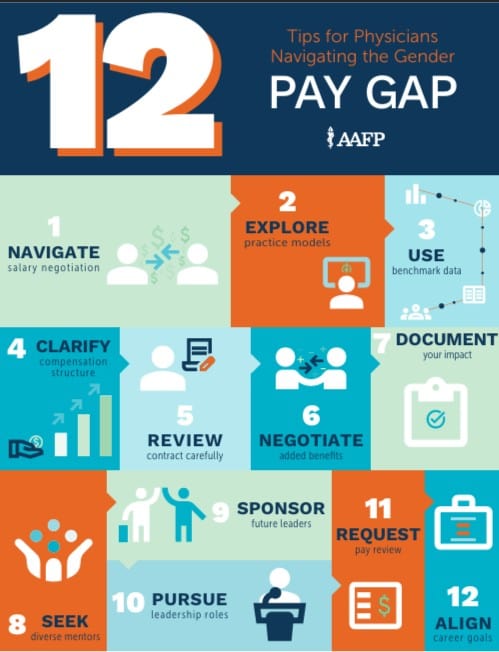
Tips for navigating the gender pay gap
Download infographicClosing the gender pay gap: 12 tips for women in medicine
Build negotiation skills and plan to negotiate your salary. Hiring a lawyer as part of reviewing a job offer and attending a negotiation workshop can help you understand what’s possible and learn tactics for success.
Consider seeking employment in a physician-owned practice or under an alternative payment model, and explore partnership tracks or ownership.
Use known salary scales, compensation details or benchmark data when preparing for negotiation or promotion conversations.
Ask about the salary and bonus structure, as well as the promotion process and requirements at the health care organization or medical institution.
Carefully review your contract and know how to spot red flags.
Negotiate your contract. Even if a health system doesn’t amend contracts, there are often ways to improve it, for example by securing more CME stipend or support for leadership training.
Document your productivity, outcomes and leadership contributions. Have that information readily available when it’s time to renew your contract.
Seek out and accept mentorships and sponsorships from men and women in leadership to cultivate a diverse set of knowledge and experience.
Become a sponsor for other female or underrepresented physicians, helping others to recognize their strengths, encourage leadership development, pursue opportunities, expand networks and offer support.
Get involved in governance, management and leadership roles in your organization, for example, serving on compensation committees.
Ask your department chair for an internal review of salaries if you feel you’re being unfairly compensated.
Be prepared to search for a new position if your practice doesn’t fit your career goals.
Compensation equity resources
Featured resource from the AAMC
Find salary equity data, recommendations and strategies specific to academic medicine.
Frequently asked questions
Is there a gender pay gap in medicine?
Yes, across specialties, women physicians earn less than men, even when accounting for factors like hours worked, practice setting. The gender pay gap is not new. More research is needed to understand its persistence and how to close it.
Why does salary transparency matter?
Salary transparency is key to helping physicians and organizations identify pay gaps, build trust in the culture and promote fair hiring practices. There are federal and state laws and regulations that protect or promote salary transparency in certain settings and roles.
The AAFP supports transparency and recommends that employers do not include compensation non-disclosure policies in their contracts.
Do compensation models affect pay equity?
Yes, compensation models based on fee-for-service and relative value units are associated with worse pay equity than alternative or value-based payment formulas that factor in complexity, relationship building and high-quality outcomes. Women physicians tend to spend more time with patients and have a higher number of complex patients.
What factors contribute to pay disparities?
Compensation is dynamic and more research is needed to understand why women physicians make less than men, but some of the commonly identified sources of the pay gap include:
- Bias
- Compensation models focused on volume and procedures
- Lack of organizational support for flexible work and leadership development
- Underrepresentation in leadership roles, especially in academic medicine
- Lower income in previous roles affecting promotions and career advancement
References and further reading
American Academy of Family Physicians. Principles to optimize family physician employment (position paper). August 21, 2023. Accessed June 19, 2026.
Anderson A, Morgan ZJ, Olaisen RH, Bazemore A, Taylor MK, Wang T, Eden AR. Family physician income disparities by race and gender. J Am Board Fam Med. 2022;35(4):859-861.
Dahrouge S, Seale E, Hogg W, et al. A Comprehensive Assessment of Family Physician Gender and Quality of Care: A Cross-Sectional Analysis in Ontario, Canada. Med Care. 2016;54(3):277-286. doi:10.1097/MLR.0000000000000480
Dandar VM, Lautenberger DM, Garrison GE. Promising Practices for Understanding and Addressing Salary Equity at U.S. Medical Schools. Association of American Medical Colleges; 2019:1-90.
Esteves-Sorenson C, Snyder J. The gender earnings gap for physicians and its increase over time. Econ Lett. 2011;(116):37-41.
Frintner MP, Sisk B, Byrne BJ, Freed GL, Starmer AJ, Olson LM. Gender Differences in Earnings of Early- and Midcareer Pediatricians. Pediatrics. 2019;144(4):e20183955. doi:10.1542/peds.2018-3955
Ganguli I, Sheridan B, Gray J, Chernew M, Rosenthal MB, Neprash H. Physician Work Hours and the Gender Pay Gap — Evidence from Primary Care. N Engl J Med. 2020;383(14):1349-1357. doi:10.1056/NEJMsa2013804
Hart KM. The Gender Penalty: Reasons for Differences in Reported Weekly Work Hours Among Male and Female Family Physicians. J Am Board Fam Med. 2020;33(5):650-652. doi:10.3122/jabfm.2020.05.200384
Harvard Business Review Analytic Services. Making Pay Equity Work for All. Harvard Business Review Analytic Services; 2022. https://www.ukg.com/resources/analyst-report/new-study-shows-importance-making-pay-equity-work-all
Heisler CA, Mark K, Ton J, Miller P, Temkin SM. Has a critical mass of women resulted in gender equity in gynecologic surgery? Am J Obstet Gynecol. 2020;223(5):665-673. doi:10.1016/j.ajog.2020.06.038
Horstman C. Male physicians earn more than women in primary and specialty care. To the Point (blog). Commonwealth Fund. Published July 27, 2022. Accessed June 25, 2026.
Hudgins A. Salary transparency in healthcare recruitment: trends and legislation. Health eCareers. Published March 18, 2026. Accessed July 15, 2026.
Jabbarpour Y, Wendling A, Taylor M, Bazemore A, Eden A, Chung Y. Family Medicine’s Gender Pay Gap. J Am Board Fam Med. 2022;35(1):7-8.
Jabbarpour Y. What family medicine compensation transparency has already taught us, and what we hope to learn next. AAFP Blog. Published September 4, 2025. Accessed July 15, 2026.
Jagsi R, Griffith KA, Stewart A, Sambuco D, DeCastro R, Ubel PA. Gender Differences in Salary in a Recent Cohort of Early-Career Physician-Researchers. Acad Med J Assoc Am Med Coll. 2013;88(11):10.1097/ACM.0b013e3182a71519. doi:10.1097/ACM.0b013e3182a71519
Jagsi R, Griffith KA, Stewart A, Sambuco D, DeCastro R, Ubel PA. Gender Differences in the Salaries of Physician Researchers. JAMA. 2012;307(22). doi:10.1001/jama.2012.6183
Jena AB, Olenski AR, Blumenthal DM. Sex Differences in Physician Salary in US Public Medical Schools. JAMA Intern Med. 2016;176(9):1294. doi:10.1001/jamainternmed.2016.3284
Lo Sasso AT, Richards MR, Chou CF, Gerber SE. The $16,819 Pay Gap For Newly Trained Physicians: The Unexplained Trend Of Men Earning More Than Women. Health Aff (Millwood). 2011;30(2):193-201. doi:10.1377/hlthaff.2010.0597
Macias Londono AA. Understanding mentorship and sponsorship in medicine. LinkedIn. Published February 6, 2024. Accessed July 22, 2026.
Madsen TE, Linden JA, Rounds K, et al. Current Status of Gender and Racial/Ethnic Disparities Among Academic Emergency Medicine Physicians. Acad Emerg Med. 2017;24(10):1182-1192.
Mazzolini C. How AAFP’s career dashboard can help family physicians win their next contract negotiation. Medical Economics. Published August 6, 2025. Accessed July 15, 2026.
Modestino AS. The Impact of Managed Care on the Gender Earnings Gap among Physicians. Res Rev. 2012;19:18-21.
Okereke GO. Gender Wage Gap in Contemporary America. Int J Gend Womens Stud. 2020;8(2):61-75. doi:10.15640/ijgws.v8n2p7
Paladine H, Dempster J. The Gender Pay Gap in Family Medicine: Evidence and Next Steps. J Am Board Fam Med. 2022;35(1):197-199.
Puleo NJ, Schaefer LC, Pourshadi K. Navigating the complexities of pay transparency legislation. National Law Review. Published January 13, 2025. Accessed July 15, 2026.
Rotenstein LS, Dudley J. How to Close the Gender Pay Gap in U.S. Medicine. Harv Bus Rev. Published online November 4, 2019. Accessed November 30, 2022.
Roy B. Gender Pay Gaps in Medicine: Moving from Explanations to Action. J Gen Intern Med. 2018;33(9):1413-1414. doi:10.1007/s11606-018-4579-3
Sanders S, Kaplan J, Jabbarpour Y, Phillips JP, Fleischer S, Peterson LE. The gender wage gap among early-career family physicians. J Am Board Fam Med. 2024;37(2):270-278
Shah SS, Spector ND. The art of sponsorship: Priming talent for success in academic medicine. J Hosp Med. 2025;20(12):1271-1273.
Sheridan B, Gray J, Chernew M, Rosenthal MB, Neprash H. Physician Work Hours and the Gender Pay Gap — Evidence from Primary Care. N Engl J Med. 2020;383(14):1349-1357.
Teamed. Pay transparency laws by state (2026): which US states require salary ranges in job postings. Reviewed July 1, 2026. Accessed July 15, 2026.
The Gender Pay Gap in Medicine (2026): Latest Data and Physician Salary Analysis. MedSalaryData. Published September 2025. Accessed July 14, 2026.
Walter G, Siddiqi A, Huffstetler A. Female family physicians may earn $1.8 Million less than male peers over a lifetime. Am Fam Physician. 2023;108(4):346-347B.
Warner AS, Lehmann LS. Gender Wage Disparities in Medicine: Time to Close the Gap. J Gen Intern Med. 2019;34(7):1334-1336.
Winter E. How pay transparency laws can promote fair wages in health care. FPM Blogs: Quick Tips. October 24, 2023. Accessed July 15, 2026.